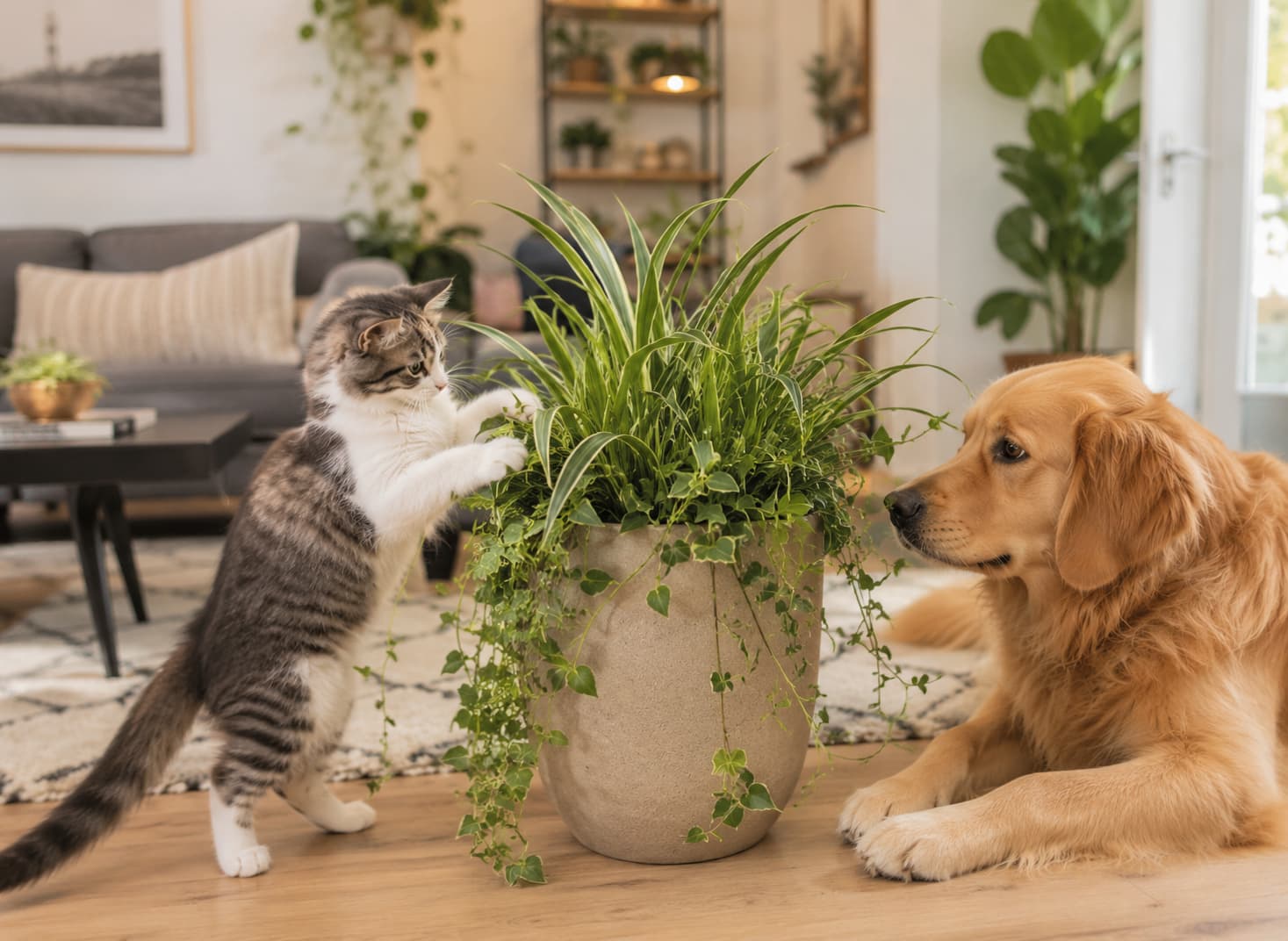
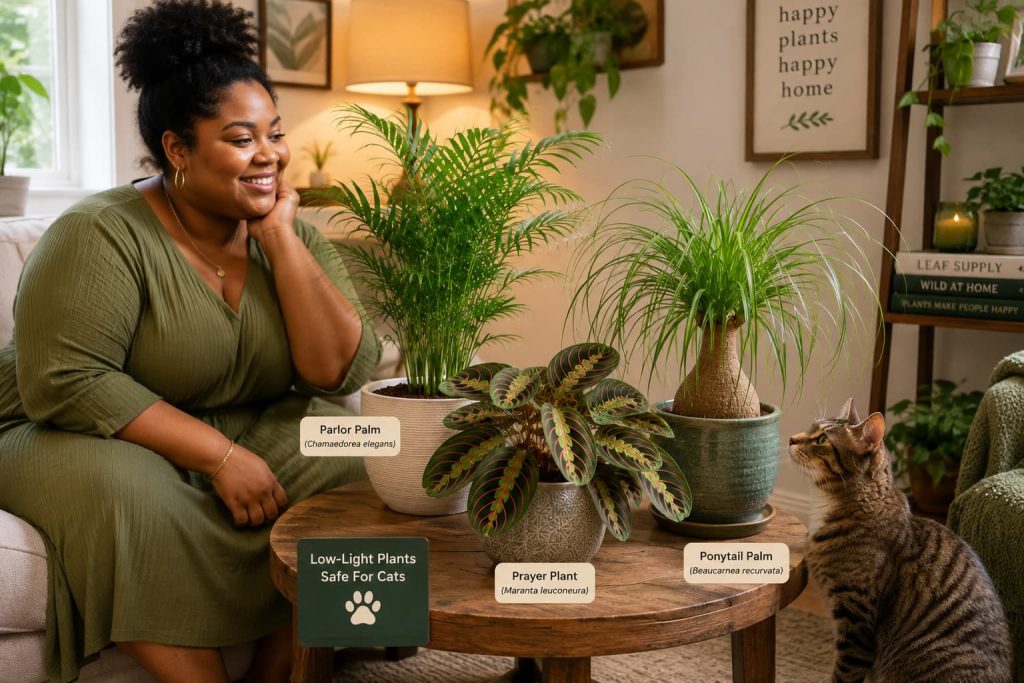
If you share your home with a cat, choosing low light indoor plants safe for cats is about more than finding something that looks good in a dim corner. You also need to consider what happens if your cat chews the leaves, knocks over the pot, or digs through the soil. The right plant should not only tolerate lower-light conditions but also be a suitable choice for a cat-friendly home.
The good news is that you don’t have to give up houseplants simply because you have a curious cat.
Several attractive houseplants are considered non-toxic to cats and can tolerate the lower-light conditions common in hallways, bedrooms, offices, and rooms that receive filtered daylight. Good examples include cast iron plants, parlor palms, spider plants, prayer plants, and several peperomias. The ASPCA lists these and other plants as non-toxic to cats.
One important qualification: low light does not mean no light. Every plant needs light for photosynthesis. A plant may survive in a darker location while growing more slowly, becoming less compact, or flowering less. University of Minnesota Extension describes low-light areas as places such as a north-facing window or a fairly dark corner, while the RHS similarly cautions that no houseplant can thrive in complete darkness.
Understand the importance of choosing pet-friendly indoor plants safe for cats and dogs when creating a healthy home environment. Selecting non-toxic houseplants helps reduce the risk of accidental poisoning while allowing you to enjoy the beauty and benefits of indoor greenery without compromising your pets’ safety.
Quick Picks: Best Low-Light Indoor Plants Safe for Cats
| Plant | Cat Safety | Low-Light Tolerance | Care Level | Best For |
| Cast Iron Plant | Non-toxic | Excellent | Easy | Darker rooms |
| Parlor Palm | Non-toxic | Good | Easy | Living rooms |
| Spider Plant | None-toxic | Good | Easy | Beginners |
| Prayer Plant | Non-toxic | Good | Moderate | Colorful foliage |
| Calathea | Non-toxic | Good | Moderate | Humid rooms |
| Baby Rubber Plant | Non-toxic | Good | Easy | Small spaces |
| Peperomia | Non-toxic | Good | Easy | Desks & shelves |
| Nerve Plant | Non-toxic | Moderate | Moderate | Bathrooms/terrariums |
| Polka Dot Plant | Non-toxic | Moderate | Moderate | Colorful displays |
| African Violet | Non-toxic | Moderate | Moderate | Small flowering plants |
| Ponytail Palm | Non-toxic | Good | Easy | Sunny-to-low-light flexibility |
| Swedish Ivy | Non-toxic | Moderate | Easy | Hanging baskets |
| Rabbit’s Foot Fern | Non-toxic | Moderate | Moderate | Humid rooms |
| Boston Fern | Non-toxic | Moderate | Moderate | Humid spaces |
| Christmas Cactus | Non-toxic | Moderate | Easy | Seasonal flowers |
Important: “Non-toxic” does not mean a cat should eat the plant. The ASPCA notes that consuming plant material can still cause vomiting or gastrointestinal upset in cats and dogs, even when a plant is classified as non-toxic.
What Counts as “Low Light” for Indoor Plants?
Before choosing a plant, it helps to understand what low light actually means.
Low light is often misunderstood as a room with no sunlight. That’s not what it means.
A low-light location might be:
• A room with a north-facing window
• A space several feet away from a bright window
• A hallway that receives some borrowed daylight
• An office with modest natural light
• A room where direct sunlight rarely reaches the plant
University of Minnesota Extension gives low-light houseplant environments as roughly 50–250 foot-candles, while emphasizing that light availability affects plant growth and water use. Plants in lower light generally grow more slowly and use less water.
A simple test
Stand where you want to place the plant during the daytime.
If you can comfortably read a newspaper or book using natural daylight, you may have enough light for some low-light houseplants. The RHS uses a similar practical guideline for shady indoor locations.
If the area is so dark that you need to switch on a light during the day simply to see comfortably, it may be too dark for long-term healthy plant growth.
In that situation, a grow light can make the difference.
Top 15 Low-Light Indoor Plants That Are Safe for Cats
Now, let’s take a closer look at each of these 15 low-light indoor plants that are safe for cats and discover why they might be the perfect choice for your feline-friendly home.
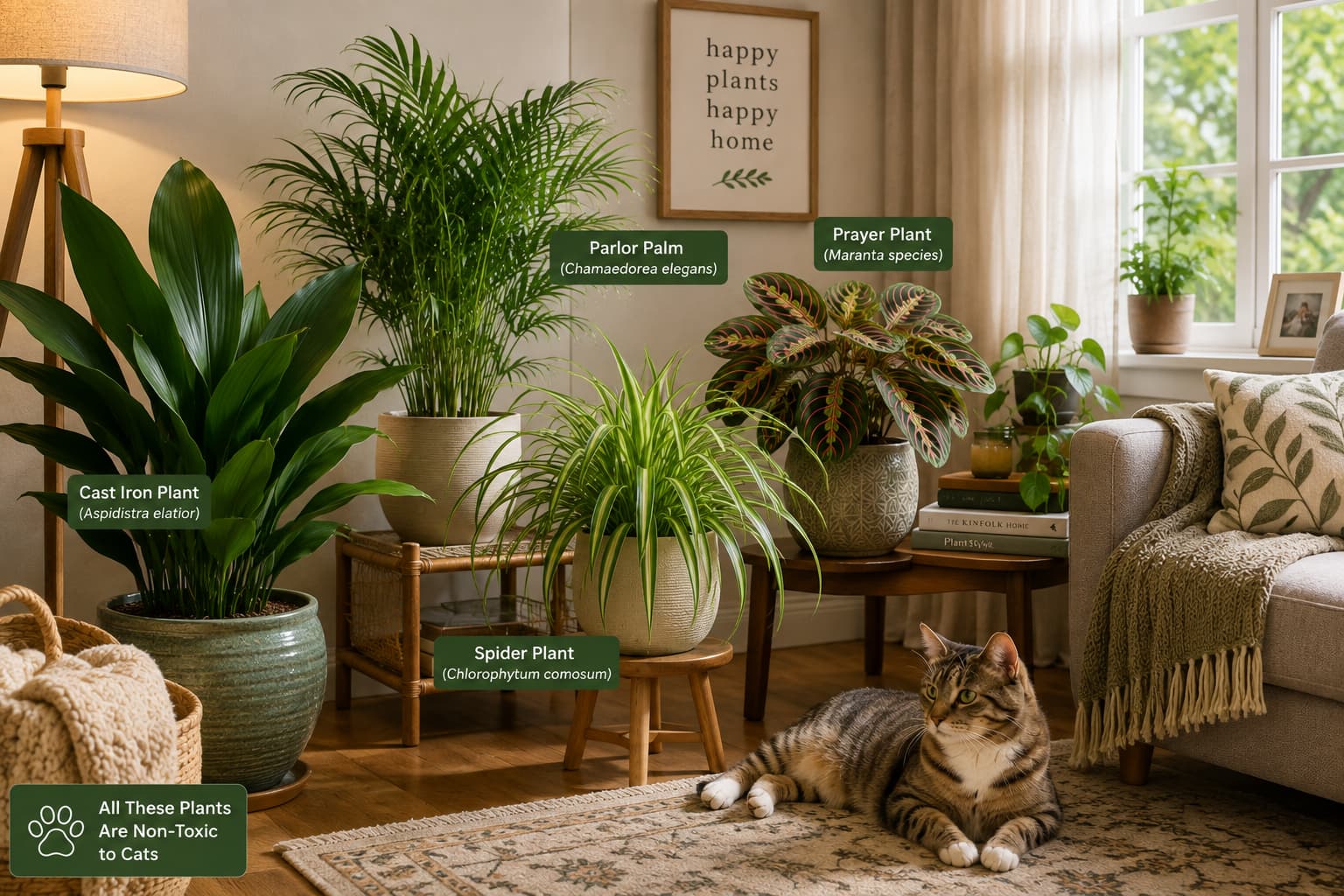
1. Cast Iron Plant (Aspidistra elatior)
The Cast Iron Plant (Aspidistra elatior) is one of the best low-light indoor plants safe for cats, making it an excellent choice for pet owners who want a hardy, low-maintenance houseplant. True to its name, this resilient plant tolerates lower light levels, inconsistent watering, and a wide range of indoor conditions better than many other houseplants.
Its elegant, dark-green, lance-shaped leaves grow upright from the base, adding year-round greenery to living rooms, bedrooms, offices, and other areas with limited natural light where more demanding plants may struggle.
According to the University of Minnesota Extension, the cast iron plant is well suited to low-light indoor environments, while the ASPCA lists Aspidistra elatior as non-toxic to cats, making it a safe option for homes with curious pets.
Why It’s a Great Choice
• Thrives in low-light indoor conditions
• Safe and non-toxic for cats
• Extremely low-maintenance and beginner-friendly
• Tolerates occasional missed waterings
• Provides attractive evergreen foliage year-round
• Ideal for homes, apartments, bedrooms, and offices
Care Tip
Although the cast iron plant thrives in low light, avoid keeping the soil constantly wet. Lower light slows plant growth and reduces water consumption, making overwatering one of the most common causes of root damage. Water only when the top 1–2 inches (2.5–5 cm) of soil feel dry.
Best For: Cat owners looking for a low-maintenance, cat-safe indoor plant that thrives in darker rooms with minimal care.
2. Parlor Palm (Chamaedorea elegans)
The Parlor Palm (Chamaedorea elegans) is one of the best low-light indoor plants safe for cats, offering lush, tropical foliage without demanding bright sunlight. Its elegant, feathery fronds bring a relaxed, tropical feel to indoor spaces, making it a favorite for homes, apartments, and offices.
Unlike many palm species that require abundant light, the parlor palm adapts well to lower-light environments. It grows best in bright, indirect light but can continue to thrive in moderate to low-light conditions with proper care.
According to the ASPCA, Chamaedorea elegans is non-toxic to cats and dogs, making it a safe choice for pet-friendly households. The University of Minnesota Extension also recommends the parlor palm as a suitable houseplant for low-light indoor environments.
Why It’s a Great Option
• Thrives in low to moderate indirect light
• Safe and non-toxic for cats and dogs
• Adds a lush, tropical look to indoor spaces
• Low-maintenance and beginner-friendly
• Helps brighten living rooms, bedrooms, and offices with graceful foliage
Best Locations
• Living rooms with filtered sunlight
• Bedroom corners
• Home offices
• Areas near north- or east-facing windows
Care Tip
Although the parlor palm tolerates lower light, it grows more vigorously in bright, indirect light. Water when the top inch (2.5 cm) of soil feels dry, and avoid leaving the roots in soggy soil to prevent root rot.
Best For: Cat owners who want a tropical-looking, cat-safe indoor plant that’s easy to care for.
Understand the importance of choosing the best indoor plants that are easy to grow all year long for a healthier, greener, and more enjoyable home. Easy-care plants require less maintenance, adapt well to indoor conditions, and can provide lasting greenery even for beginners or busy plant owners.
3. Spider Plant (Chlorophytum comosum)
The Spider Plant (Chlorophytum comosum) is one of the easiest cat-safe indoor plants for beginners. Its long, arching green or variegated leaves create an attractive cascading display, while mature plants often produce baby plantlets that make propagation simple and rewarding.
The ASPCA lists the spider plant as non-toxic to cats and dogs, making it one of the safest houseplants for pet-friendly homes.
Although many people consider it a low-light plant, the University of Minnesota Extension classifies the spider plant as better suited to medium indirect light. It can tolerate lower light levels, but brighter indirect light encourages healthier growth and more vibrant foliage.
Why It’s a Great Choice
• Safe and non-toxic for cats
• One of the easiest houseplants for beginners
• Produces attractive baby plantlets for easy propagation
• Adapts well to a range of indoor conditions
• Fast-growing with minimal maintenance
Care Tip
A spider plant can survive in lower light, but brighter indirect light promotes faster growth, stronger leaf variegation, and more plantlets. Water when the top inch (2.5 cm) of soil dries out, and avoid overwatering.
Best For: Beginners looking for a low-maintenance, cat-safe indoor plant that’s easy to grow and propagate.
4. Prayer Plant (Maranta species)
The Prayer Plant (Maranta species) is one of the most eye-catching low-light indoor plants safe for cats, prized for its beautifully patterned foliage rather than its flowers. Depending on the variety, its leaves display striking shades of green, red, burgundy, cream, and purple, adding vibrant color to shaded indoor spaces.
Like other members of the prayer plant family, its leaves gently fold upward in the evening, creating the “praying” appearance that gives the plant its common name.
The ASPCA lists prayer plants as non-toxic to cats and dogs, making them a safe choice for pet owners seeking decorative foliage plants.
Prayer plants naturally grow beneath the forest canopy, where they receive filtered light and consistently moist conditions. While they tolerate lower light, they still need adequate indirect light to maintain healthy growth and vivid leaf patterns.
Why You Should Consider It
• Safe and non-toxic for cats
• Stunning patterned foliage with vibrant colors
• Thrives in bright, indirect to moderate light
• Adds decorative appeal without relying on flowers
• Ideal for humid indoor environments
Care Tip
Unlike tougher plants such as the cast iron plant, the prayer plant prefers consistently moist soil, higher humidity, and stable indoor temperatures. Keep the soil evenly moist—but never waterlogged—and protect the plant from harsh, direct sunlight, which can fade or scorch its leaves.
According to the University of Minnesota Extension, prayer plants and related species perform best in filtered light with consistently moist, well-drained soil.
Best For: Cat owners who want a beautiful, cat-safe indoor plant with colorful foliage and can provide moderate humidity and consistent care.
5. Calathea (Calathea species)
The Calathea (Calathea species) is one of the most beautiful low-light indoor plants safe for cats, admired for its bold, decorative foliage. Rather than being a single plant, Calathea is a diverse group of tropical species and cultivars featuring stunning leaf patterns in shades of green, cream, purple, pink, and silver.
Native to tropical forests, calatheas naturally thrive beneath the tree canopy, making them well adapted to bright, filtered light and moderate indoor conditions.
According to the ASPCA, Calathea species are non-toxic to cats and dogs, making them an excellent choice for pet-friendly homes.
Why It’s Worth Choosing
• Safe and non-toxic for cats and dogs
• Eye-catching foliage with unique patterns and colors
• Thrives in bright, indirect to moderate light
• Perfect for adding a tropical feel to indoor spaces
• Available in many beautiful varieties
Care Tip
Although calatheas tolerate lower light, they perform best in bright, indirect light with consistently moist—but never soggy—soil. They also appreciate higher humidity, which helps prevent common problems such as brown leaf edges, curling leaves, and faded foliage.
Best For: Cat owners who want a decorative, cat-safe indoor plant and are willing to provide consistent watering and moderate humidity.
6. Baby Rubber Plant (Peperomia obtusifolia)
The Baby Rubber Plant (Peperomia obtusifolia) is a compact, cat-safe indoor plant with thick, glossy leaves that add a fresh, modern look to small spaces. Despite its common name, it is not related to the rubber tree (Ficus elastica). Instead, it belongs to the diverse Peperomia genus.
Its slow growth, compact size, and forgiving nature make it an excellent choice for apartments, bedrooms, offices, and desktops where space is limited.
The ASPCA lists Peperomia obtusifolia as non-toxic to cats and dogs, while the University of Minnesota Extension notes that peperomias tolerate lower light, although brighter indirect light promotes healthier growth.
What Makes It Stand Out
• Safe and non-toxic for cats
• Compact size is ideal for small spaces
• Thick, glossy leaves provide year-round interest
• Easy to care for and beginner-friendly
• Grows well on desks, shelves, and windowsills
Care Tip
The baby rubber plant stores moisture in its fleshy leaves, making it more drought tolerant than many houseplants. Allow the top inch (2.5 cm) of soil to dry before watering, and avoid overwatering, which can lead to root rot.
Best For: Cat owners looking for a small, low-maintenance, cat-safe indoor plant for desks, shelves, bedrooms, or apartments.
7. Peperomia (Peperomia species)
The Peperomia (Peperomia species) group includes dozens of cat-safe indoor plants that come in an impressive variety of shapes, textures, and colors. Whether you prefer trailing vines, compact rosettes, rippled leaves, silver markings, or colorful variegation, there’s likely a peperomia to suit your indoor space.
Popular varieties include Ripple Peperomia (Peperomia caperata), Trailing Jade (Peperomia rotundifolia), and Silver Peperomia (Peperomia griseoargentea), all of which are recognized by the ASPCA as non-toxic to cats.
Although peperomias tolerate lower light better than many houseplants, they grow best in bright, indirect light where their foliage remains vibrant and compact.
Why We Recommend It
• Safe and non-toxic for cats
• Wide variety of leaf shapes, colors, and growth habits
• Compact, space-saving plants for homes and offices
• Low-maintenance and beginner-friendly
• More drought tolerant than many tropical houseplants
Care Tip
Most peperomia plants have thick, water-storing leaves, so they don’t require frequent watering. Allow the soil to partially dry between waterings, and place the plant in bright, indirect light whenever possible for the healthiest growth.
Best For: Beginners and cat owners who want a versatile, low-maintenance, cat-safe indoor plant available in many attractive varieties.
8. Nerve Plant (Fittonia verschaffeltii)
The Nerve Plant (Fittonia verschaffeltii) is a compact, cat-safe indoor plant prized for its vibrant, vein-patterned foliage. Depending on the variety, its leaves display striking veins in shades of pink, white, red, or green, making it an excellent choice for adding color and texture to smaller indoor spaces.
Because of its compact size and love of humidity, the nerve plant is especially popular for terrariums, bathrooms, and decorative tabletop planters.
According to the ASPCA, Fittonia verschaffeltii is non-toxic to cats and dogs, making it a safe addition to pet-friendly homes.
Why It’s a Top Pick
• Safe and non-toxic for cats and dogs
• Colorful foliage adds visual interest year-round
• Compact size is perfect for small spaces
• Thrives in humid environments
• Excellent choice for terrariums and decorative containers
Care Tip
The nerve plant prefers evenly moist, well-drained soil and higher humidity. It may wilt dramatically when the soil becomes too dry, but it often recovers after watering. However, repeated drying stresses the plant and can weaken its long-term health.
Choosing the right potting mix is essential for healthy houseplants. Discover the Best Soil for Indoor Plants and learn how to choose a well-draining mix that supports strong roots, healthy growth, and proper moisture balance for different indoor plant varieties and growing conditions.
Best For: Cat owners looking for a small, colorful, cat-safe indoor plant for bathrooms, terrariums, or other humid spaces.
9. Polka Dot Plant (Hypoestes phyllostachya)
The Polka Dot Plant (Hypoestes phyllostachya) is a colorful cat-safe indoor plant grown for its vibrant spotted foliage. Its leaves are splashed with shades of pink, red, white, or cream, making it an excellent choice for brightening indoor spaces with bold color rather than flowers.
Although it tolerates lower light conditions, brighter indirect light helps maintain its compact growth and vibrant leaf coloration.
According to the ASPCA, the polka dot plant is non-toxic to cats and dogs. However, the organization notes that eating large amounts may occasionally cause mild stomach upset, such as vomiting or diarrhea.
Why It’s a Great Choice
• Safe and non-toxic for cats
• Bright, colorful foliage adds year-round interest
• Compact size is ideal for desks, shelves, and tabletops
• Easy to grow indoors
• Great accent plant for small spaces
Care Tip
While the polka dot plant adapts to moderate or lower light, insufficient light can reduce its vibrant colors and cause leggy growth. Place it in bright, indirect light whenever possible, and keep the soil lightly moist without becoming waterlogged.
Best For: Cat owners who want a colorful, cat-safe indoor plant that stands out from traditional green houseplants.
10. African Violet (Saintpaulia species)
The African Violet (Saintpaulia species) is one of the most popular flowering indoor plants safe for cats, producing clusters of beautiful blooms in shades of purple, pink, blue, white, and violet throughout much of the year. Its compact size makes it ideal for windowsills, desks, and small indoor spaces.
The ASPCA lists African violets as non-toxic to cats and dogs, making them a safe flowering option for pet-friendly homes.
Unlike many foliage plants, African violets require adequate light to bloom consistently. Although they tolerate moderate indoor light, they are not the best choice for very dark corners.
What Makes It a Great Fit
• Safe and non-toxic for cats
• Produces colorful flowers for much of the year
• Compact and ideal for small spaces
• Excellent choice for windowsills and tabletops
• Easy to grow with proper lighting
Care Tip
For the best flowering, place your African violet near a bright window with filtered sunlight, behind a sheer curtain, or under a quality grow light. The University of Minnesota Extension notes that supplemental lighting can help maintain flowering when natural light is limited.
Best For: Cat owners who want a flowering, cat-safe indoor plant and have a bright, indirect-light location.
11. Ponytail Palm (Beaucarnea recurvata)
The Ponytail Palm (Beaucarnea recurvata) is a unique, cat-safe indoor plant recognized for its swollen, water-storing trunk and long, cascading leaves that resemble a ponytail. Despite its common name, it is not a true palm, but it brings an attractive architectural look to homes and offices.
The University of Minnesota Extension includes the ponytail palm among houseplants that tolerate lower indoor light, while the ASPCA lists it as non-toxic to cats and dogs.
Its thick trunk stores water, making it far more drought tolerant than many tropical houseplants and an excellent option for busy plant owners.
Why It Works So Well
• Safe and non-toxic for cats
• Highly drought tolerant and low maintenance
• Distinctive architectural appearance
• Stores water in its swollen trunk
• Suitable for homes, apartments, and offices
Recommended Care Tip
Although the ponytail palm tolerates lower light, it grows best in bright, indirect light. Allow the soil to dry completely between waterings, and avoid frequent watering, as excess moisture is a much greater risk than occasional dryness.
Best For: Cat owners looking for a unique, low-maintenance, cat-safe indoor plant that tolerates occasional neglect and infrequent watering.
12. Swedish Ivy (Plectranthus australis)
The Swedish Ivy (Plectranthus australis) is a fast-growing, cat-safe trailing indoor plant that adds lush greenery to hanging baskets, shelves, and elevated plant stands. Its cascading stems and rounded green leaves create an attractive display while helping keep foliage out of reach of playful pets.
According to the ASPCA, Swedish ivy is non-toxic to cats and dogs, making it an excellent choice for pet-friendly homes.
One important distinction is that Swedish ivy is not a true ivy. Unlike English ivy (Hedera species), which is toxic to cats, Swedish ivy is considered safe for household pets.
Why It’s a Great Choice
• Safe and non-toxic for cats and dogs
• Attractive trailing growth for hanging displays
• Easy to grow and beginner-friendly
• Perfect for shelves, hanging baskets, and plant stands
• Adds lush greenery without taking up floor space
How to Care
The Swedish ivy grows best in bright to moderate indirect light. Keep the soil lightly moist but well-drained, and pinch back long stems occasionally to encourage fuller, bushier growth.
Most Suitable For: Cat owners looking for a trailing, cat-safe indoor plant for hanging baskets, shelves, or elevated displays.
Looking for the best indoor plants for offices that thrive with minimal care? This guide will help you make the right, healthy choice by highlighting low-maintenance plants that can add greenery, improve your workspace, and thrive in typical office conditions.
13. Rabbit’s Foot Fern (Davallia species)
The Rabbit’s Foot Fern (Davallia species) is a distinctive cat-safe indoor fern known for the soft, furry rhizomes that creep over the surface of the pot, resembling a rabbit’s foot. Combined with its delicate, arching fronds, it creates a unique texture that stands out among traditional houseplants.
The ASPCA lists Rabbit’s Foot Fern as non-toxic to cats and dogs, making it a safe choice for homes with curious pets.
Like most tropical ferns, it naturally thrives in filtered light, moderate humidity, and consistently moist soil.
What Makes It Special
• Safe and non-toxic for cats
• Unique fuzzy rhizomes provide year-round interest
• Elegant fern foliage softens indoor spaces
• Excellent for hanging baskets and elevated planters
• Adds texture unlike most common houseplants
Best Care Tip
Although the rabbit’s foot fern tolerates moderate indoor light, it performs best in bright, filtered light with good humidity and consistently moist—but never waterlogged—soil. The University of Minnesota Extension notes that many tropical ferns struggle in extremely low-light locations, so avoid placing this plant in a windowless room.
Suitable For: Cat owners with a humid home who want an unusual, pet-safe fern for hanging baskets or elevated displays.
14. Boston Fern (Nephrolepis exaltata ‘Bostoniensis’)
The Boston Fern (Nephrolepis exaltata ‘Bostoniensis’) is one of the most popular pet-safe indoor ferns, admired for its lush, arching fronds and timeless appearance. It adds softness and vibrant greenery to living rooms, bathrooms, and shaded indoor spaces.
The University of Minnesota Extension lists the Boston fern among houseplants suitable for homes with pets, making it a safe choice for cat owners.
Although often recommended as a low-light plant, Boston ferns actually perform best in bright, filtered or medium indirect light, rather than deep shade.
Why It’s Ideal for Your Home
• Safe for homes with cats
• Elegant, arching fronds create a lush display
• Excellent for bathrooms and humid rooms
• Classic houseplant with timeless appeal
• Helps create a tropical indoor atmosphere
Caring Tip
Keep the Boston fern in bright, indirect or filtered light, and maintain evenly moist soil with moderate to high humidity. According to the University of Minnesota Extension, many tropical ferns struggle in very low-light indoor conditions, so avoid placing this plant in a dark corner.
Best For: Cat owners who have a bright, humid location and want a lush, pet-safe fern.
15. Christmas Cactus (Schlumbergera species)
The Christmas Cactus (Schlumbergera species) is a beautiful flowering indoor plant safe for cats, offering colorful blooms during the holiday season while remaining easy to care for. Its cascading stems and long-lasting flowers make it an excellent alternative to foliage-only houseplants.
According to the ASPCA, Christmas cactus is non-toxic to cats and dogs, making it a safe flowering plant for pet-friendly homes.
Unlike many desert cacti, the Christmas cactus is a tropical species that naturally grows beneath forest canopies, where it receives bright, filtered light.
Why It’s a Popular Choice
• Safe and non-toxic for cats and dogs
• Produces vibrant seasonal flowers
• Compact size fits small indoor spaces
• Cascading stems look beautiful in hanging baskets
• Easy to care for with proper lighting
Best Care Tip
Although the Christmas cactus tolerates moderate indoor light, bright, indirect light encourages healthier growth and more reliable flowering. Allow the top layer of soil to dry slightly between waterings, and avoid exposing the plant to prolonged direct sunlight or overly dry conditions.
Best For: Cat owners looking for a flowering, cat-safe indoor plant that adds seasonal color to bright, indirectly lit rooms.
Which of These Plants Are Best for Truly Low-Light Rooms?
Not all plants in a “low-light” list perform equally well in low light.
If your room genuinely receives little natural daylight, prioritize the strongest low-light performers.
Best choices for darker spaces
1. Cast Iron Plant
2. Parlor Palm
3. Ponytail Palm
4. Prayer Plant
5. Calathea
For slightly brighter indirect-light locations, you can expand your choices to:
- Spider plant
- Peperomia
- Nerve plant
- Polka dot plant
- African violet
- Swedish ivy
- Ferns
- Christmas cactus
The University of Minnesota Extension specifically identifies cast iron plant, ponytail palm and parlor palm among low-light houseplants.
Best Low-Light Cat-Safe Plants by Situation
For a dark bedroom
Best choice: Cast iron plant
It tolerates lower light and doesn’t demand the humidity of many tropical foliage plants.
For a living-room floor
Best choice: Parlor palm
Its height and arching foliage make it more visually effective than a small tabletop plant.
For a beginner
Best choice: Spider plant or cast iron plant
Both are relatively forgiving choices.
For a small desk
Best choice: Baby rubber plant or another peperomia
Their compact growth makes them easier to fit into limited spaces.
For a colorful display
Best choice: Prayer plant or polka dot plant
Their foliage provides more visual variety than plain-green plants.
For a humid bathroom
Best choice: Prayer plant, Calathea or nerve plant
Humidity can make these plants considerably easier to manage.
For a hanging basket
Best choice: Swedish ivy
Its trailing growth is particularly suited to elevated displays.
How to Choose the Right Plant for Your Cat
Finding a plant that is non-toxic isn’t the only consideration.
Your cat’s behavior matters too.
If your cat chews plants
Choose sturdy plants such as:
• Cast iron plant
• Parlor palm
• Spider plant
• Peperomia
But remember: non-toxic doesn’t mean edible.
Even plants classified as non-toxic can cause gastrointestinal upset after ingestion.
If your cat digs in potting soil
The plant itself may be perfectly safe while the soil becomes the problem.
Cats may dig in containers because they are attracted to the loose soil.
You can try:
• covering exposed soil with a suitable physical barrier
• using heavier decorative pots
• placing plants where cats cannot easily access the soil
• providing an alternative digging/enrichment area
University of Minnesota Extension notes that cats may nibble leaves and dig into pots and suggests physical barriers over soil as one possible deterrent.
If your cat knocks plants over
Choose:
• heavier containers
• wider-based pots
• shorter plants
• stable plant stands
A tall, lightweight plant can be “cat-safe” botanically but still create a mess if your cat repeatedly knocks it over.
How to Keep Cat-Safe Plants Healthy in Low Light
The biggest mistake people make with low-light houseplants is overwatering.
It happens for a simple reason:
The plant receives less light → growth slows → water use decreases → soil remains wet longer.
Cornell University College of Agriculture and Life Sciences specifically warns that low-light plants grow more slowly and use less water, making it important to check the soil rather than watering automatically.
1. Check the soil before watering
Don’t water simply because it’s been seven days.
Instead, check the potting mix.
Depending on the plant, allow the appropriate portion of the soil to dry before watering again.
Your watering schedule will change with:
• season
• temperature
• pot size
• soil type
• humidity
• plant size
• available light
2. Give the plant the brightest suitable spot
“Low light” should mean lower light, not “put it in the darkest corner.”
The RHS notes that many houseplants struggle when placed far back from windows where there is very little light.
If the plant begins producing:
• unusually long stems
• widely spaced leaves
• pale foliage
• smaller new leaves
• fewer flowers
it may need more light.
Low-light stress can cause leggy growth, leaf yellowing and leaf drop.
3. Be careful with variegated plants
Variegated foliage contains areas with less chlorophyll than fully green leaves.
When light is limited, some variegated plants may produce greener leaves as they adapt.
University of Minnesota Extension notes that variegated plants may revert toward solid green under insufficient light.
If maintaining strong variegation is important to you, give the plant more indirect light.
4. Use drainage holes
A decorative pot without drainage can make watering mistakes much more damaging.
Ideally:
• Water thoroughly.
• Allow excess water to drain.
• Empty standing water from the saucer or outer container.
• Don’t leave the roots sitting in stagnant water.
This becomes particularly important in low light because the plant may not use water as quickly.
What About Artificial Light?
If your favorite cat-safe plant is struggling because the room is genuinely too dark, you don’t necessarily have to abandon it.
A suitable grow light can supplement natural daylight.
University of Minnesota Extension notes that supplemental lighting can compensate for inadequate natural light and describes LED lighting as one common option for indoor plants.
This can be especially useful for:
• windowless offices
• interior bathrooms
• dark hallways
• rooms with small windows
• winter conditions
The key is that artificial lighting needs to provide useful plant light, not simply make the room look brighter to human eyes.
Low-Light Indoor Plants to Avoid if You Have Cats
Not every popular low-light indoor plant is safe for cats. While many houseplants thrive in dimly lit spaces, several commonly recommended varieties can be toxic if chewed or ingested by curious pets.
If you’re creating a cat-safe indoor garden, it’s just as important to know which plants to avoid as it is to choose safe ones. Before bringing any new houseplant home, always verify its toxicity using trusted resources such as the ASPCA’s Toxic and Non-Toxic Plants Database.
The following popular low-light houseplants are beautiful and easy to grow—but they should not be included in a home with cats unless they can be kept completely out of your pet’s reach. This knowledge can help you prevent accidental poisoning and create a safer environment for your feline companion.
Examples include:
• Snake plant
• Pothos
• Peace lily
• Chinese evergreen
• ZZ plant
• Dieffenbachia
The American Horticultural Society lists several of these among plants suited to low-light conditions, but that does not mean they are appropriate choices for a cat household.
This illustrates why you should evaluate light tolerance and pet safety separately.
A plant can be excellent for low light and still be inappropriate for a home where a cat can chew it.
Are Non-Toxic Indoor Plants Completely Safe for Cats?
The short answer is no.
This is an important distinction that every cat owner should understand when choosing cat-safe indoor plants.
When the ASPCA classifies a plant as non-toxic to cats, it means the plant is not considered poisonous if a cat chews or ingests it. However, non-toxic doesn’t mean edible or completely risk-free.
Even plants that are classified as non-toxic can cause mild digestive upset if your cat eats large amounts of leaves or stems. The ASPCA notes that ingesting plant material may lead to symptoms such as:
• Vomiting
• Mild diarrhea
• Stomach irritation
These reactions are usually caused by the plant’s fiber or the physical irritation of chewing plant material, rather than by toxic compounds.
What “Non-Toxic” Really Means
When recommending pet-friendly houseplants, it’s more accurate to describe them as non-toxic to cats rather than 100% safe to eat. While these plants are far less likely to cause serious poisoning, they are still not intended to be a regular part of your cat’s diet.
What to Do if Your Cat Eats a Houseplant
If your cat chews a non-toxic indoor plant, monitor them for signs of digestive discomfort. However, if your cat develops persistent vomiting, diarrhea, excessive drooling, lethargy, difficulty breathing, or you suspect they have eaten a toxic plant, contact your veterinarian or an animal poison-control service immediately.
When in doubt, always identify the plant and seek professional advice rather than relying solely on information found online. This is the safest approach to protecting your pet’s health.
Frequently Asked Questions
1. What is the best low-light indoor plant that is safe for cats?
For a genuinely low-light location, the cast iron plant is one of the strongest choices. It tolerates lower light and is listed as non-toxic to cats by the ASPCA.
2. What indoor plants are safe for cats and don’t need much sunlight?
Good options include cast iron plant, parlor palm, ponytail palm, prayer plant and several peperomias. However, “doesn’t need much sunlight” should not be interpreted as “needs no light.”
3. Is spider plant safe for cats?
Yes. The ASPCA lists spider plant (Chlorophytum comosum) as non-toxic to cats and dogs.
4. Is a parlor palm safe for cats?
Yes. The ASPCA lists Chamaedorea elegans, commonly known as parlor palm, as non-toxic to cats and dogs.
5. Are prayer plants safe for cats?
Yes. The ASPCA lists prayer plant as non-toxic to cats and dogs.
6. Are peperomias safe for cats?
Several commonly grown peperomias are listed as non-toxic to cats, including baby rubber plant (Peperomia obtusifolia) and several other Peperomia species.
7. Can I put a cat-safe plant in a completely dark room?
No. Cat-safe describes the plant’s relationship to pets; it doesn’t change the plant’s biological requirement for light. Every normal houseplant needs light for photosynthesis.
9. What should I do if my cat keeps chewing my plants?
Choose plants classified as non-toxic to cats, but still try to discourage excessive chewing. Move plants out of easy reach, provide alternative enrichment, and monitor your cat’s behavior. Non-toxic plants can still cause gastrointestinal upset when eaten.
Conclusion
Choosing the best low-light indoor plants safe for cats doesn’t have to be difficult. By selecting species that are both non-toxic to cats and suited to your home’s lighting conditions, you can enjoy beautiful greenery without compromising your pet’s safety.
Remember, even the most low-light indoor plants need enough usable light to stay healthy. If a room is exceptionally dark, don’t simply move your plant farther from the window. Instead, place it where it can receive brighter indirect light or supplement natural light with a quality grow light.
Ultimately, the best cat-safe houseplant is one that matches your home’s lighting, your care routine, and your cat’s natural curiosity. With the right plant in the right location, you can create a lush, pet-friendly indoor garden that both you and your feline companion can enjoy for years to come.
Learn practical indoor plant care tips to keep your houseplants healthy, vibrant, and thriving year-round. Discover expert guidance on watering, lighting, soil, fertilizing, repotting, pruning, pest control, and common plant problems, with simple advice suitable for beginners and experienced indoor gardeners.

I’m Bon (aka Guider), an indoor gardening writer and houseplant enthusiast passionate about helping beginners successfully grow and care for indoor plants. I create practical, beginner-friendly guides covering indoor plant care, watering, lighting, soil, repotting, plant problems, and choosing suitable houseplants for different homes. My articles draw on research from trusted horticultural organizations, university extension resources, and botanical institutions, combined with practical plant-care principles and careful content review.