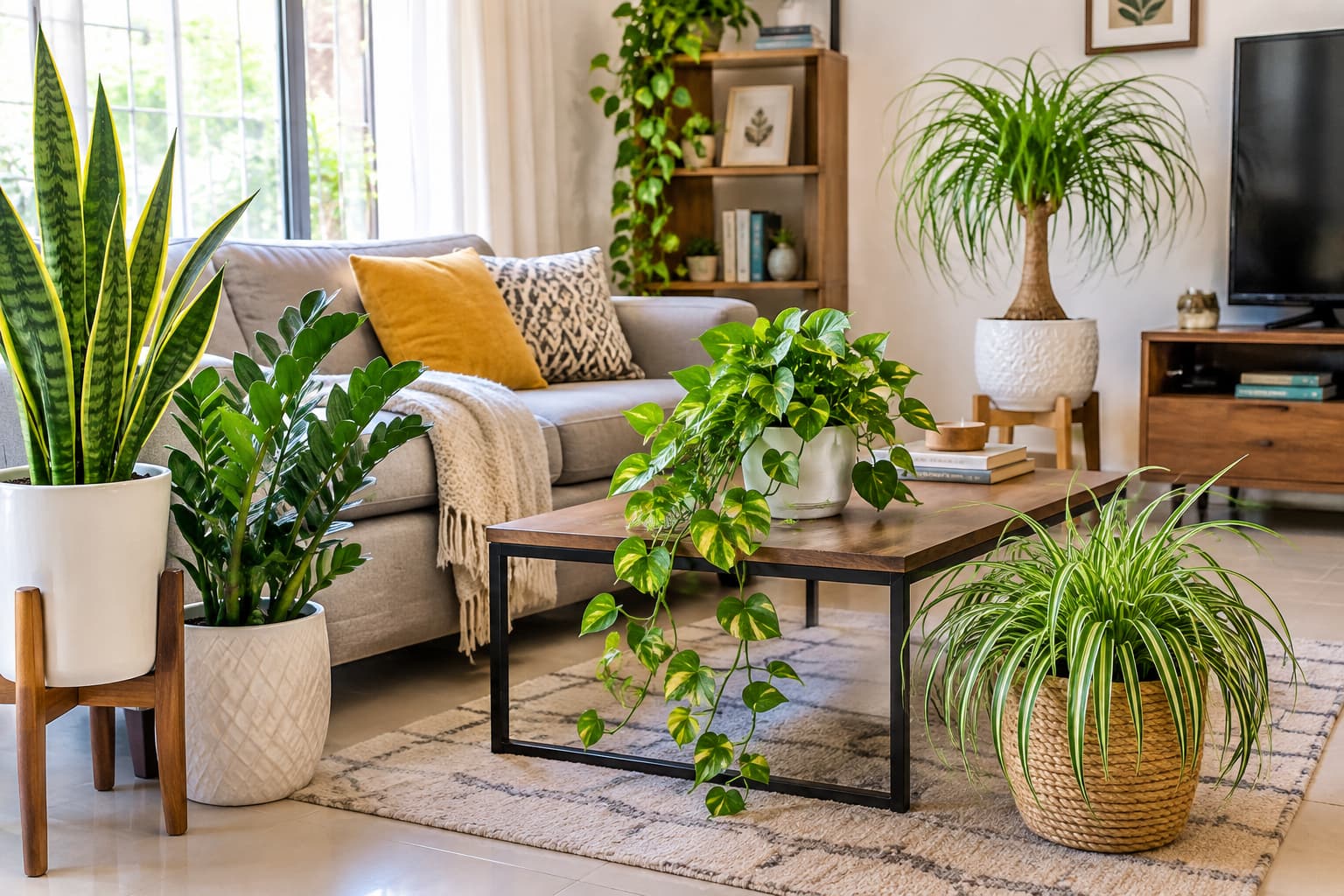
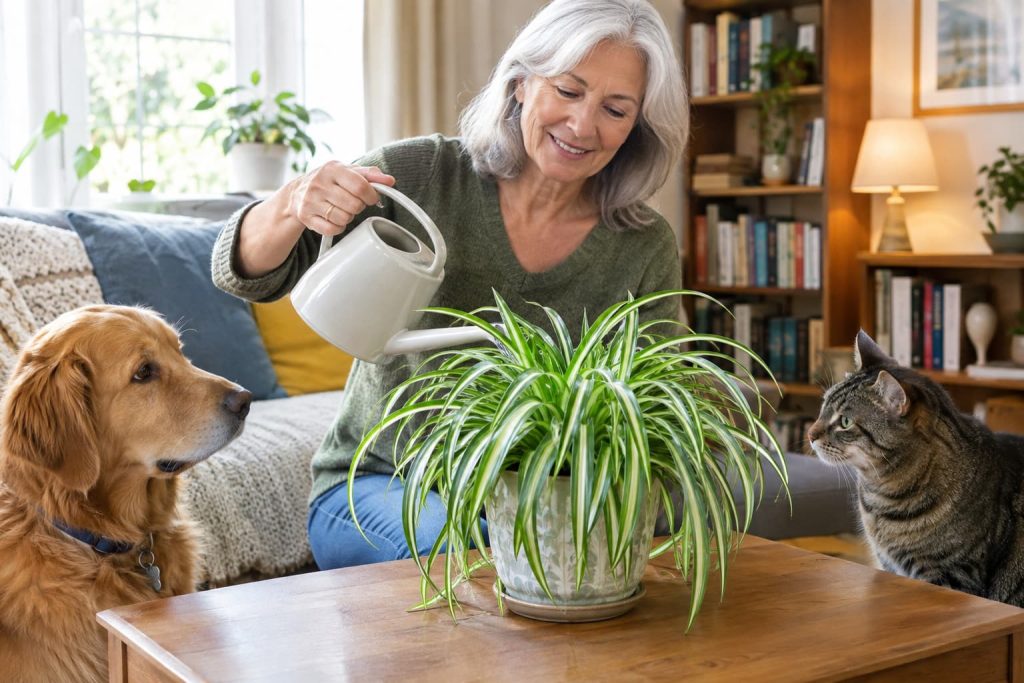
A spider plant can handle the occasional missed watering, adapt to ordinary indoor conditions, and produce new plantlets without demanding complicated care. But “easy” does not mean “care-free.” The wrong light, constantly wet soil, or a pot with poor drainage can still leave a spider plant with brown tips, weak growth, or rotting roots.
The good news is that spider plant care is relatively straightforward once you understand what the plant actually needs. Chlorophytum comosum grows as a clumping perennial with narrow, arching leaves and produces long stems carrying small plantlets, commonly called spider babies.
This guide explains how to grow a healthy spider plant indoors, including light, watering, soil, feeding, humidity, pruning, repotting, propagation, outdoor growing, water propagation, and common problems. It also explains where spider plants naturally occur and separates useful plant benefits from exaggerated “air-purifying” claims.
What Is a Spider Plant?
The spider plant, Chlorophytum comosum, is an evergreen perennial commonly grown as a houseplant. Its long, narrow leaves form a fountain-like clump, while mature plants can send out slender flowering stems that eventually carry small plantlets.
Those dangling plantlets are the feature that gives the plant its familiar name. A mature plant can produce numerous “babies,” making spider plants particularly useful for gardeners who enjoy propagating and sharing plants.
The species has a broad African native range extending from tropical West Africa through Cameroon and parts of eastern and southern Africa. Royal Botanic Gardens, Kew World Online lists Nigeria among the countries within its native range.
That African origin is worth remembering when thinking about its care. A spider plant is not a desert succulent, but it is also more forgiving of temporary dryness than many delicate tropical houseplants.
Where Do Spider Plants Grow Naturally?
Chlorophytum comosum occurs naturally across parts of Africa, including Nigeria, and is associated with tropical and subtropical environments. Its natural distribution is much broader than the typical indoor setting in which cultivated spider plants are grown.
For a houseplant owner, the important point is not to recreate an African habitat inside the home. Instead, provide the conditions the plant responds well to: reasonable light, free-draining soil, adequate moisture, and protection from extremes.
Cultivated spider plants are remarkably adaptable. American Horticultural Society (AHS) classifies them among easy-care houseplants and notes their ability to tolerate a range of indoor conditions.
How to Care for a Spider Plant
Good care is mostly about finding the middle ground. Give the plant enough light to maintain strong foliage, enough water to prevent prolonged drought, but not so much moisture that the roots remain saturated.
1. Give It Bright, Indirect or Medium Light
Spider plants are adaptable, but light still influences their appearance and growth.
A bright room with filtered light is an excellent starting point. An east-facing window can provide useful morning light, while a bright position farther back from a stronger south- or west-facing window can also work.
Medium light is acceptable, and spider plants can tolerate considerably less light than many high-light houseplants. However, very dark conditions may produce slower growth and less vigorous foliage.
Variegated cultivars generally benefit from adequate light if you want their leaf markings to remain attractive.
Avoid placing the plant where intense midday or afternoon sunlight falls directly on the foliage for long periods. Harsh direct sun can scorch leaves, particularly when a plant has been moved suddenly from a lower-light location.
A simple placement test: if the plant receives useful natural brightness for much of the day but the leaves are not being baked by strong direct sun, you are usually in a reasonable starting position.
2. Water According to the Soil, Not the Calendar
One of the most common spider plant mistakes is watering on a rigid schedule.
Instead, check the potting mix.
When the upper portion of the soil has dried and the pot feels noticeably lighter, water thoroughly. Apply enough water for some to drain from the bottom of the container, then empty excess water from the saucer or outer pot.
Do not leave the roots sitting in accumulated water.
Spider plants appreciate moisture but do not benefit from permanently saturated soil. Extension guidance recommends allowing the soil to dry between waterings, while the Royal Horticultural Society (RHS) similarly advises regular watering without allowing the compost to remain soggy.
The exact interval depends on:
• Pot size
• Pot material
• Soil composition
• Light level
• Room temperature
• Air movement
• Plant size
• Season
A small plant in a warm, bright room may dry much faster than a large plant in a relatively cool, shaded corner.
Better option is checking the plant’s soil rather than watering every Sunday simply because it is Sunday.
3. Use a Well-Draining Potting Mix
Spider plants do not need an exotic soil recipe.
A quality indoor potting mix that holds some moisture while allowing excess water to escape is generally appropriate. The container should also have drainage holes.
The objective is a root environment that contains both moisture and air.
If water remains around the roots for prolonged periods, roots can become damaged. On the other hand, an extremely dry, compacted mix can make it difficult for water to penetrate the root zone evenly.
If your existing potting mix stays wet for many days after watering, improving drainage may be more useful than simply watering less.
For broader guidance on selecting an indoor growing medium, see our guide to the best soil for indoor plants.
4. Choose a Pot With Drainage
A decorative container without drainage may look attractive, but it makes watering more difficult.
The safest arrangement is usually a nursery pot or functional container with drainage holes placed inside a decorative cover pot.
After watering, allow excess water to escape before returning the plant to the outer container.
Do not assume that putting stones at the bottom of a pot solves poor drainage. The more important factors are an appropriate growing medium and a container that allows excess water to leave.
For a detailed explanation of container selection, see how to choose the right pots for indoor plants.
5. Keep Humidity Reasonable
Spider plants are not among the houseplants that normally require extremely high humidity.
Average indoor conditions can be sufficient, provided the plant is not repeatedly exposed to very dry air or other environmental extremes.
If leaf tips repeatedly turn brown, do not automatically assume that humidity is the cause. Brown tips can also be associated with water quality, inconsistent moisture, root stress, excessive fertilizer, or other environmental factors.
This is why it is better to investigate the growing conditions as a whole rather than immediately buying a humidifier.
6. Feed Lightly Rather Than Heavily
Spider plants do not need constant fertilizer.
A balanced houseplant fertilizer used according to its label can support active growth. Fertilizing too heavily, however, can contribute to salt accumulation in the growing medium and may worsen leaf-tip browning.
If the plant is growing slowly because light is inadequate, adding more fertilizer is unlikely to solve the underlying problem.
A useful order of troubleshooting is:
Light → watering → roots/soil → pests → nutrition.
Correct the environmental problem before increasing fertilizer.
For a detailed feeding routine, see how to fertilize indoor plants correctly.
7. Rotate the Pot Occasionally
If all of the plant’s leaves lean toward a window, rotate the container occasionally so different sides receive light.
This is not essential, but it can help maintain a more balanced appearance.
Avoid constantly moving the plant from one extreme environment to another. Spider plants are adaptable, but gradual adjustments are generally easier on a houseplant than abrupt environmental changes.
Why Are My Spider Plant Leaves Turning Brown?
Brown tips are one of the most recognizable spider plant problems.
They do not automatically mean the plant is dying.
Possible contributing factors include:
• Dry soil for too long
• Inconsistent watering
• Excess fertilizer or salt accumulation
• Unsuitable water quality
• Root stress
• Very dry environmental conditions
• Abrupt changes in growing conditions
North Carolina State Extension specifically notes that chlorine and fluoride in tap water can contribute to leaf-tip burn in spider plants.
If your plant is otherwise healthy but repeatedly develops brown tips, consider the water source as well as the watering routine.
You can trim unattractive brown tips with clean scissors, following the natural shape of the leaf rather than cutting straight across every leaf.
Do not remove large amounts of healthy green foliage simply because a few tips are brown.
How to Prune a Spider Plant
Spider plants generally need very little pruning.
Pruning is mainly cosmetic or corrective.
Remove:
• Completely dead leaves
• Severely damaged foliage
• Brown or damaged leaf sections
• Old flowering stems if you do not want plantlets
When trimming a damaged leaf, follow its natural narrow shape. Avoid repeatedly cutting every leaf at the same height, which can make the plant look unnaturally squared off.
If the plant has produced a long flowering stem covered with plantlets, you can leave it in place for a cascading display or remove it if the plant is becoming crowded.
The Cornell University College of Agriculture and Life Sciences recommends trimming finished flowering spikes when new plantlets are not wanted.
How to Care for Spider Plant Babies
Spider plant babies, also called plantlets or offsets, are one of the easiest ways to multiply this plant.
A mature spider plant may produce long stems carrying small plants. Once a plantlet has developed a visible root system, it can be separated and grown independently.
There is no need to rush.
A very small plantlet with little or no root development is less prepared to live independently than a larger plantlet with visible roots.
How to Propagate Spider Plant Babies in Soil
1. Choose a healthy plantlet with visible roots or the beginnings of a root system.
2. Fill a small pot with moist, well-draining potting mix.
3. Position the plantlet so its developing roots make contact with the soil.
4. Keep the growing medium lightly moist while roots establish.
5. Place the new plant in suitable indirect light.
6. Once it begins producing new growth, gradually treat it like an established spider plant.
Spider plants are particularly well suited to propagation by plantlets, division and layering. Iowa State University Extension lists Chlorophytum comosum among houseplants that are easy to propagate.
Where Do You Cut Spider Plant Babies?
The safest place to cut is the connecting stem between the mother plant and the plantlet once you are ready to separate it.
Do not cut through the base of the baby itself.
If the baby already has roots, separate it from the mother plant by cutting the runner close to the plantlet while leaving the plantlet’s roots intact.
If it does not have sufficient roots yet, you can also root it while it remains attached to the mother plant. This is essentially a simple form of layering.
Penn State Extension specifically describes spider plants as suitable for natural layering, allowing plantlets to root before they are separated.
Can Spider Plants Grow in Water?
Yes, spider plant babies can be rooted in water.
This is different from saying that an established spider plant should permanently live in a glass of water.
For water propagation:
1. Select a healthy plantlet.
2. Place its developing roots in clean water.
3. Keep the leaves and crown above the waterline.
4. Change the water when it becomes cloudy or develops an unpleasant smell.
5. Move the plantlet into potting mix once it has developed a useful root system.
Water propagation is convenient because you can watch the roots develop.
However, a rooted plantlet ultimately needs an appropriate growing environment if you want it to develop into a conventional potted plant. Long-term water culture requires a different approach to nutrition, oxygenation and water management than simply placing a baby spider plant in a glass.
For most beginners, rooting the baby and then transferring it to a well-draining potting mix is the simpler route.
Why Is My Spider Plant Not Producing Babies?
A spider plant that is not producing plantlets is not necessarily unhealthy.
Plantlet production depends on the plant’s maturity and growing conditions.
Several factors can influence it:
• Light
• Plant maturity
• Growing conditions
• Pot and root-zone conditions
• Seasonal growth
• Cultivar differences
Interestingly, extension guidance notes that spider plants commonly produce plantlets when they become pot-bound.
That does not mean you should deliberately keep the plant severely root-bound or neglect repotting indefinitely.
If your plant is healthy but simply not producing babies, focus first on providing suitable light and consistent care rather than trying to force reproduction.
Should You Repot a Spider Plant?
Spider plants can remain in the same container for some time, but eventually the root system may outgrow its space.
Signs that repotting may be appropriate include:
• Roots densely filling the container
• Water passing rapidly through the pot without adequately wetting the mix
• The plant becoming unstable or top-heavy
• Repeated drying despite appropriate watering
• Noticeably restricted growth
The USDA Plants Database recommends repotting spider plants every few years, although the actual timing depends on the plant and its growing conditions.
When repotting, choose a container only moderately larger than the existing root system. Moving a small plant into a dramatically oversized pot can leave a large volume of soil wet for too long after watering.
For the complete process, see our detailed guide on how to repot indoor plants without damaging the roots.
Can Spider Plants Grow Outdoors?
Yes. Spider plants can be grown outdoors in suitable climates, but the conditions matter.
In frost-free tropical and subtropical environments, they can be grown outdoors in sheltered positions. In cooler climates, they are commonly treated as indoor plants or moved outdoors only during suitable warm periods.
Outdoor light can also be much stronger than indoor light. A spider plant accustomed to filtered indoor light should not suddenly be placed in intense midday sun.
For outdoor growing, choose:
• Bright filtered light or partial shade
• Protection from harsh afternoon sun
• Free-draining soil or container mix
• Adequate moisture without prolonged waterlogging
• Protection from unusually cold conditions
New York Botanical Garden guidance recommends growing spider plants outdoors only in suitable warm or frost-free conditions.
For gardeners in warm parts of Nigeria, an outdoor spider plant can therefore be practical, especially on a shaded veranda, covered balcony, or sheltered patio. In a hot exposed location, however, direct afternoon sunlight can be considerably more stressful than the filtered light the plant receives indoors.
Spider Plant Indoor Benefits: What Is Actually Supported?
Here are 7 practical spider plant indoor benefits that are well supported by the plant’s characteristics and everyday use as a houseplant.
1. Spider Plants Are Easy to Maintain
One of the biggest spider plant indoor benefits is their relatively simple care requirements. Spider plants can adapt to typical indoor conditions and generally do not require complicated maintenance.
With suitable indirect light, appropriate watering and a well-draining potting mix, they can grow successfully indoors. This makes spider plants a practical choice for beginners and anyone looking for a houseplant that does not demand constant attention.
2. They Are Easy to Propagate
Spider plants are remarkably easy to propagate. Mature plants commonly produce long stems with small plantlets, sometimes called spiderettes.
These plantlets can be rooted in soil or water and eventually grown into independent plants. As a result, one healthy spider plant can provide an inexpensive way to expand your indoor plant collection or share new plants with friends and family.
3. Spider Plants Look Attractive in Hanging Containers
Their naturally arching foliage makes spider plants especially suitable for hanging baskets and elevated containers.
As the leaves and plantlets cascade downward, they can add texture and visual interest to bedrooms, living rooms, offices and other indoor spaces. Hanging the plant can also make better use of limited floor or shelf space.
4. They Can Adapt to a Range of Indoor Conditions
Spider plants are relatively adaptable compared with many more demanding houseplants. They generally perform well in bright, indirect light but can tolerate somewhat lower-light indoor conditions.
However, lower light usually means slower growth and less vigorous production of plantlets. Avoid treating “low light” as complete darkness; plants still need sufficient light for photosynthesis and healthy growth.
5. Spider Plants Are Suitable for Pet-Conscious Homes
Another useful benefit is their favorable pet-safety profile. The ASPCA lists Chlorophytum comosum as non-toxic to dogs and cats.
That does not mean pets should be encouraged to chew on spider plants. Eating large amounts of plant material can still cause digestive upset, and individual animals may react differently. Keeping plants out of reach is still a sensible precaution, particularly for pets that like to nibble on foliage.
6. They Are an Affordable Way to Grow More Houseplants
Because spider plants produce numerous plantlets, they can be a cost-effective choice for people who want to build an indoor plant collection.
Instead of purchasing a new mature plant every time, you can propagate established plantlets and gradually create several additional plants. This makes spider plants particularly appealing to beginners who want to experiment with propagation.
7. Spider Plants Have Been Studied for Potential Air-Purifying Effects
Spider plants are frequently promoted as air-purifying plants because laboratory research has shown that plants can remove certain airborne compounds under controlled conditions.
However, there is an important distinction between laboratory findings and real-world indoor air quality. Controlled chamber experiments do not necessarily mean that keeping a few spider plants in a bedroom will produce a significant improvement in the air people breathe.
University of Florida IFAS Extension (EDIS) notes that houseplants have little practical effect on indoor air quality under normal home or office conditions.
Therefore, it is reasonable to grow a spider plant because it is attractive, adaptable, easy to propagate and enjoyable to care for. But it should not be treated as a substitute for adequate ventilation, source control or appropriate air filtration when addressing genuine indoor-air-quality problems.
Common Spider Plant Problems and What They Mean
Even though spider plants are generally easy to grow, they can develop problems when watering, lighting, drainage, pests or growing conditions are not well balanced.
The key is to diagnose the symptom before treating it. Brown tips, yellow leaves and damaged foliage can have several possible causes, so avoid assuming that every problem has a single explanation.
Here are 7 common spider plant problems and what they may mean.
1. Brown Leaf Tips
Brown tips are one of the most common spider plant problems. They can develop for several reasons, including inconsistent watering, excessive fertilizer, root problems, mineral buildup or unsuitable water quality.
Low humidity can also contribute, but it should not automatically be assumed to be the cause.
Start by checking the plant’s watering routine and soil condition. Also consider whether fertilizer is being applied too frequently or whether the potting mix and container allow excess water to drain freely.
A few brown tips do not necessarily mean the plant is seriously unhealthy. Focus on whether the damage is increasing and whether new growth also appears affected.
2. Pale or Weak New Growth
Pale, thin or weak new growth may indicate that the spider plant is not receiving enough useful light.
Spider plants can tolerate lower-light conditions, but very low light can slow growth and result in less vigorous foliage. Move the plant gradually toward a brighter location with suitable indirect light if its current position is particularly dim.
Avoid assuming that pale growth is always caused by fertilizer deficiency. Check the lighting conditions first and consider the overall health of the plant.
3. Yellow Leaves
Yellow leaves on a spider plant can have different meanings depending on how many leaves are affected and where they occur.
One or two older leaves gradually turning yellow can simply be part of normal leaf aging. However, widespread or rapidly developing yellowing deserves closer attention.
Check the soil before adding more water. If it remains wet for extended periods, the plant may be experiencing root stress. Also make sure the container has adequate drainage and that excess water can escape freely.
Yellow leaves combined with consistently wet soil are more concerning than an isolated older leaf turning yellow.
4. Soft or Collapsing Roots
Soft, dark or collapsing roots can indicate serious root stress, particularly when the potting mix stays excessively wet for long periods.
If the foliage is declining while the soil remains consistently moist, carefully remove the plant from its container and inspect the root system.
Healthy roots should generally be firm rather than soft and collapsing. Simply keeping the soil moist does not guarantee that the roots are healthy; excessive moisture can reduce the air available around the roots and contribute to root problems.
If significant root damage is present, affected roots may need to be removed and the plant repotted into a suitable, well-draining growing medium.
5. Spider Plant Leaves Splitting or Looking Damaged
Split, torn or physically damaged spider plant leaves do not necessarily indicate a disease.
Mechanical damage can occur during handling, transportation, repotting or routine movement around the home. Leaves can also become damaged through contact with furniture, pets or other objects.
Environmental conditions may contribute to unattractive foliage as well, so look at the pattern and location of the damage rather than treating every damaged leaf as a disease.
Old physical damage will not normally repair itself. Focus on preventing further injury and monitoring the new growth for signs of continuing problems.
6. Spider Plant Pests
Spider plants are relatively resilient, but they can still develop pest infestations indoors.
When growth becomes distorted, weakened or unusually discolored, inspect the undersides of leaves, leaf joints and areas around the plant’s base. Small pests can sometimes be difficult to notice during a quick visual inspection.
Scale insects are among the pests identified by the Royal Horticultural Society in connection with spider plants.
If you find pests, identify them before choosing a treatment. Different pests have different life cycles and may require different management approaches.
Regular inspection can also help you detect an infestation before it spreads to other houseplants.
While matching your plant to the right light is crucial, keeping an eye out for bugs is just as important; check out our complete guide on 8 Common Indoor Plant Pests and How to Eliminate Them to keep your foliage safe.
7. Spider Plant Declining Despite Apparently Correct Care
Sometimes a spider plant continues to decline even though its owner appears to be following a normal care routine.
When this happens, avoid changing several things at once. Work through the basic growing conditions systematically.
Check:
- How much useful light the plant receives
- How frequently the soil is watered
- Whether the soil remains wet for too long
- Whether the container has adequate drainage
- Whether fertilizer is being used too frequently
- Whether the roots show signs of stress
- Whether pests are present
Looking at several conditions together is often more useful than treating one symptom in isolation.
For a broader diagnostic approach, see our guide to common indoor plant problems and how to fix them to work through symptoms systematically and identify potential causes before choosing a treatment.
A Simple Spider Plant Care Routine
You do not need a complicated schedule.
Weekly
Check the soil rather than automatically watering.
Look for:
• Excessively dry soil
• Standing water
• New growth
• Brown tips
• Visible pests
Every few weeks
Inspect the plant more closely.
Remove dead foliage and clean away accumulated dust if necessary.
Check whether the plant is receiving the amount of light you intended.
During active growth
Apply fertilizer periodically according to the product label if the plant needs additional nutrition.
Do not increase fertilizer simply because growth appears slow. First determine whether light, roots or watering are limiting the plant.
Every couple of years, or when needed
Assess the root system and container.
If the plant has become severely crowded or the potting mix has deteriorated, consider repotting or division.
A Practical Spider Plant Decision Guide
When your spider plant develops a problem, choose your response based on what you actually observe rather than applying every possible treatment.
Use this quick spider plant problem-solving guide to narrow down the likely cause:
Leaves are green but the plant grows slowly: Check the amount of useful light first. Very low light can slow growth even when the foliage remains green.
The soil stays wet for many days: Check the container’s drainage, pot size and potting mix. Prolonged wetness can place stress on the roots.
The leaf tips are brown but the plant otherwise looks healthy: Review watering consistency, fertilizer use and water quality before assuming that low humidity is the cause.
The plant has produced many babies: You can leave the plantlets attached for a fuller, cascading appearance or propagate them to grow additional spider plants.
The plant is crowded or unstable: Consider whether division or repotting is appropriate. A crowded root system does not automatically require a larger pot, so assess the roots and growing conditions first.
The plant is wilted and the soil is bone dry: Water thoroughly, allowing excess water to drain away, then reassess the plant’s location and watering pattern.
The plant is wilted while the soil is very wet: Do not simply add more water. Check the drainage and inspect the roots for signs of stress.
This approach is more reliable than treating every spider plant symptom with the same remedy. Observation comes first; treatment comes second.
Spider Plant Care Mistakes to Avoid
Even an easy-care houseplant can struggle when basic growing conditions are overlooked. Avoid these common spider plant care mistakes to keep your plant healthier and make problems easier to diagnose.
1. Watering on a Fixed Calendar
Avoid watering your spider plant simply because it is a particular day of the week.
Soil moisture changes according to light, temperature, humidity, pot size, growing medium and the plant’s growth rate. Instead of following a rigid schedule, check the condition of the soil and water when the plant actually needs it.
2. Keeping the Roots Constantly Wet
Spider plants appreciate appropriate moisture, but constantly saturated soil can reduce the air available around the roots and contribute to root stress.
Make sure the container drains properly and avoid allowing the plant to sit in standing water for extended periods.
3. Exposing a Low-Light Spider Plant to Harsh Sun Suddenly
Spider plants can adapt to lower-light indoor conditions, but that does not mean they should be moved abruptly from a dim location into intense direct sunlight.
Sudden changes in light exposure can contribute to leaf damage. If you need to move the plant to a brighter position, gradual adjustment can help it adapt.
4. Fertilizing Every Time You Water
More fertilizer does not automatically produce healthier or faster growth.
Applying fertilizer too frequently can contribute to excess salts in the growing medium and may result in leaf-tip damage. Follow the instructions for the fertilizer you use and consider the plant’s growth and growing conditions before applying additional nutrients.
5. Cutting Brown Tips Without Finding the Cause
Trimming brown leaf tips can improve the plant’s appearance, but it does not address the underlying problem.
Before repeatedly cutting damaged foliage, consider why the tips are turning brown. Review watering consistency, fertilizer use, water quality, root condition and other environmental factors.
Otherwise, new leaf tips may continue developing the same damage.
6. Separating Spider Plant Babies Too Early
Spider plantlets are easy to propagate, but very small babies with little or no root development can have a more difficult transition after separation.
Allowing a plantlet to develop a stronger root system before removing it can make propagation easier. Alternatively, plantlets can sometimes be rooted while still attached to the parent plant.
7. Using an Oversized Pot
A very large container is not necessarily better for a spider plant.
When a relatively small root system is placed in an oversized pot, the growing medium may retain moisture for longer than necessary. Choose a container that is appropriate for the plant’s root system and provides adequate drainage.
Don’t Confuse Low Maintenance With No Maintenance
Spider plants are forgiving, but low maintenance does not mean no maintenance.
They still need suitable light, appropriate watering, good drainage and occasional inspection for pests or other problems. Paying attention to these basic conditions can prevent many common spider plant problems before they become serious.
FAQs About Spider Plants
1. How long can a spider plant live indoors?
A well-maintained spider plant can remain in cultivation for many years. Its longevity depends on growing conditions, root health, pests and general care rather than a fixed indoor lifespan.
2. Why are my spider plant leaves curling inward?
Curling can occur when the plant is experiencing water stress, excessive heat, unsuitable light or root problems. Check the soil moisture and examine the plant’s location before changing several conditions at once.
3. Do spider plants flower indoors?
Yes. Mature spider plants can produce small white flowers on long, arching stems. These flowering stems can later produce plantlets.
4. Why does my spider plant have thick roots coming out of the pot?
Spider plants develop substantial, fleshy roots that can fill a container. Roots emerging through drainage holes can indicate that the plant has become crowded, although the roots alone do not determine whether immediate repotting is necessary.
5. Can I grow a spider plant from a leaf cutting?
A normal spider plant leaf does not reliably produce a new plant on its own. Plantlets, division and layering are more appropriate propagation methods.
6. Can spider plants survive without natural sunlight?
They can tolerate relatively low indoor light, but complete darkness is not suitable for sustained growth. If natural light is inadequate, supplemental grow lighting can be considered.
7. Do spider plants need a moss pole or support?
No. Their natural growth habit is arching and cascading rather than climbing. A support structure is therefore usually unnecessary.
8. Can I grow a spider plant from seed?
It is possible for spider plants to reproduce sexually through seed, but home gardeners generally propagate them through plantlets or division because those methods are simpler and preserve the characteristics of the parent plant.
9. Are all spider plants variegated?
No. Both green and variegated forms exist. The familiar white- or yellow-striped varieties are especially common as houseplants, but solid-green plants are also available.
10. Should I remove spider plant flowers?
You do not have to. Leaving the flowering stems is harmless if you like their appearance and want the plantlets that may develop afterward. Remove finished stems if you prefer a tidier plant or do not need additional plantlets.
11. Can spider plants be grown in hanging baskets?
Yes. Hanging baskets are particularly well suited to spider plants because their leaves and plantlets naturally arch and cascade over the container.
Conclusion
Successful spider plant care does not require a complicated routine. Give the plant suitable indirect light, use a well-draining potting mix, water according to soil conditions, avoid prolonged saturation, and pay attention to changes in the foliage.
Its ability to produce plantlets makes the spider plant especially rewarding for beginners. Instead of constantly buying new plants, one established specimen can provide opportunities for propagation, sharing and experimentation.
For most homes, the simplest approach is also the best: provide consistent basic care, observe the plant before reacting, and correct the growing condition rather than treating symptoms in isolation.

I’m Bon (aka Guider), an indoor gardening writer and houseplant enthusiast passionate about helping beginners successfully grow and care for indoor plants. I create practical, beginner-friendly guides covering indoor plant care, watering, lighting, soil, repotting, plant problems, and choosing suitable houseplants for different homes. My articles draw on research from trusted horticultural organizations, university extension resources, and botanical institutions, combined with practical plant-care principles and careful content review.