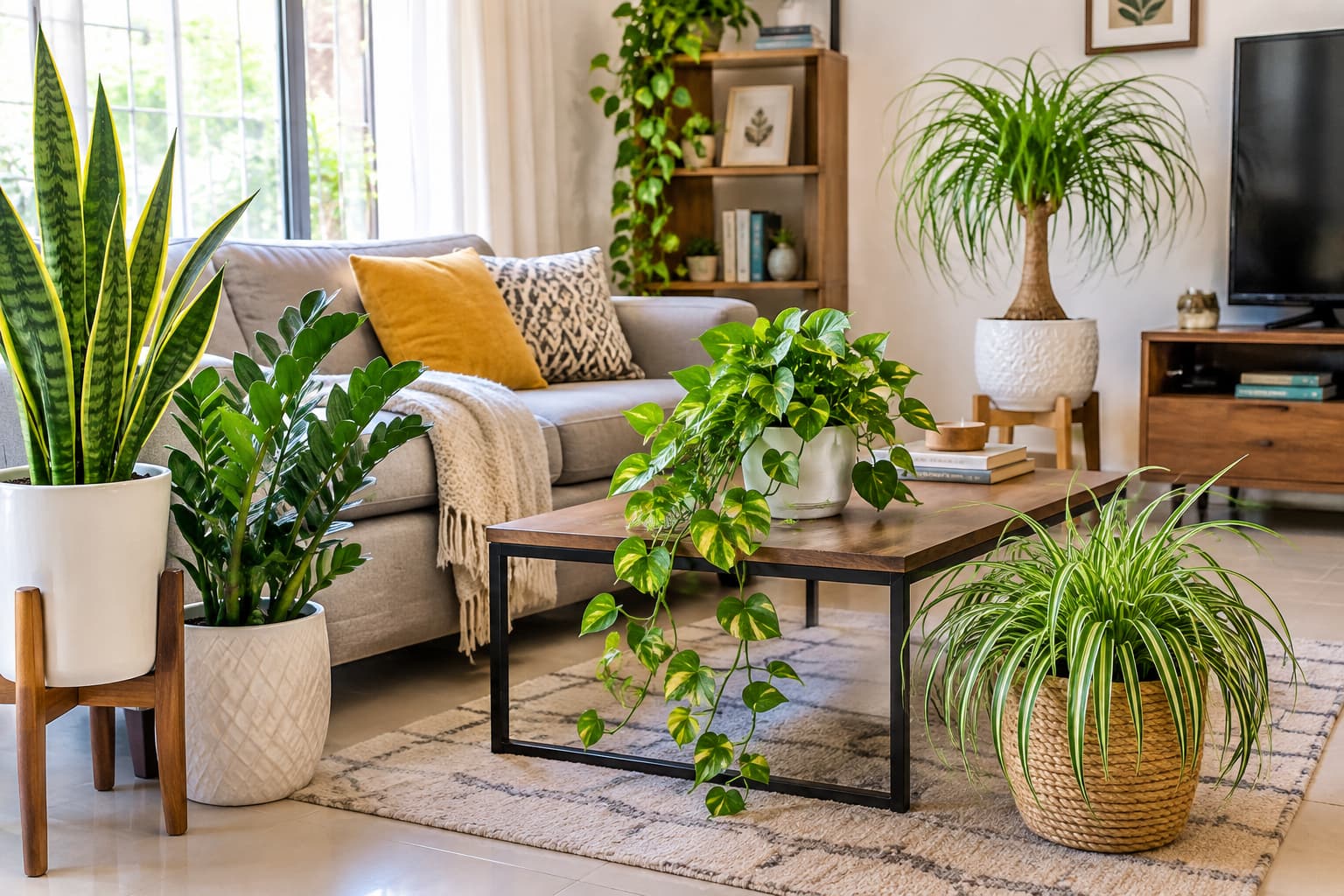
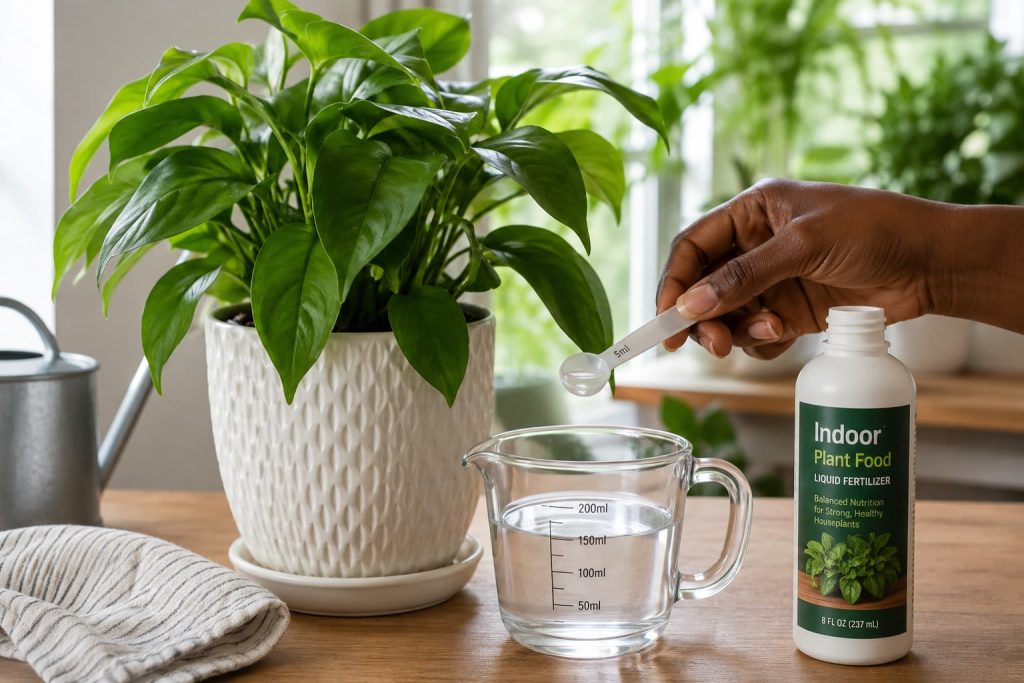
Fertilizing indoor plants isn’t about feeding them more—it’s about feeding them correctly. Learning how to fertilize indoor plants with the right fertilizer, at the right time, and in the proper amount helps promote healthy leaves, strong roots, vigorous new growth, and abundant blooms. However, overfertilizing or feeding a stressed plant can burn roots and cause more harm than good.
If you want to know how to fertilize indoor plants, start with a simple principle: fertilizer supplements nutrients; it does not replace good light, appropriate watering, suitable potting mix, or proper drainage.
Houseplants grow in a relatively small amount of potting mix. Over time, they can use available nutrients, while repeated watering can carry some nutrients out of the container. This is why established indoor plants often benefit from periodic feeding during active growth.
The safest approach is to identify what your plant actually needs, choose a suitable houseplant fertilizer, dilute or apply it according to the label, and adjust your routine according to the plant’s growth and growing conditions.
Struggling to keep indoor plants healthy because your home doesn’t get much natural light? Our guide to 21 best low light indoor plants for beginners features easy-care options that can tolerate lower-light conditions, helping you choose plants that are better suited to darker rooms and offices.
How Often Should You Fertilize Indoor Plants?
Most actively growing foliage houseplants can be fertilized approximately once or twice a month during their main growing period, although the exact frequency depends on the plant, fertilizer concentration, potting mix, light level, and watering routine.
For beginners, a conservative approach is usually best:
• Feed only when the plant is actively growing.
• Use a fertilizer formulated for houseplants.
• Start at a lower concentration rather than assuming more fertilizer means faster growth.
• Never exceed the product label’s recommended rate.
• Avoid fertilizing dry, severely stressed, or recently repotted plants unless the fertilizer instructions specifically indicate otherwise.
• Reduce or stop feeding when growth slows substantially because of low light or seasonal dormancy.
• Watch the plant rather than following a rigid calendar.
Texas A&M AgriLife Extension guidance recommends feeding foliage houseplants with a liquid general-purpose or houseplant fertilizer once or twice a month from roughly March through October, while other Extension recommendations emphasize adjusting feeding according to active growth and conditions.
The important point is that there is no universal fertilizer schedule that is correct for every indoor plant.
Why Do Indoor Plants Need Fertilizer?
Plants need mineral nutrients to build tissues, maintain cellular functions, produce chlorophyll, develop roots, and support growth.
Plants require 17 essential nutrients. Carbon, hydrogen, and oxygen are obtained primarily from air and water, while the remaining essential nutrients are generally supplied through the growing medium. Nitrogen, phosphorus, and potassium are the three primary macronutrients because plants require them in relatively large amounts.
In a garden, roots can explore a large volume of soil. An indoor plant may have only a few liters of potting mix surrounding its roots.
That difference matters.
Every time the plant grows, it uses nutrients. Watering can also move soluble nutrients through the pot and out of the drainage holes. Eventually, the nutrient supply in the container may become insufficient for vigorous growth.
This is particularly relevant for plants grown in soilless potting mixes, which may contain little nutritional value unless fertilizer has been incorporated into the mix.
But fertilizer is not plant food
You will often hear fertilizer described as “plant food,” but technically the plant manufactures its own food through photosynthesis.
Plants use light energy to convert carbon dioxide and water into carbohydrates. Fertilizer supplies mineral nutrients needed to build and operate the plant.
That distinction is useful because it explains why fertilizer cannot rescue a plant sitting in a dark corner.
If insufficient light is limiting photosynthesis, adding more fertilizer will not solve the underlying problem. Colorado State University Extension similarly notes that fertilization increases desirable growth primarily when nutrient availability is actually limiting; fertilizer cannot compensate for other major growth limitations.
Think of fertilizer as nutritional support—not a substitute for light and proper care.
What Do N-P-K Numbers Mean?
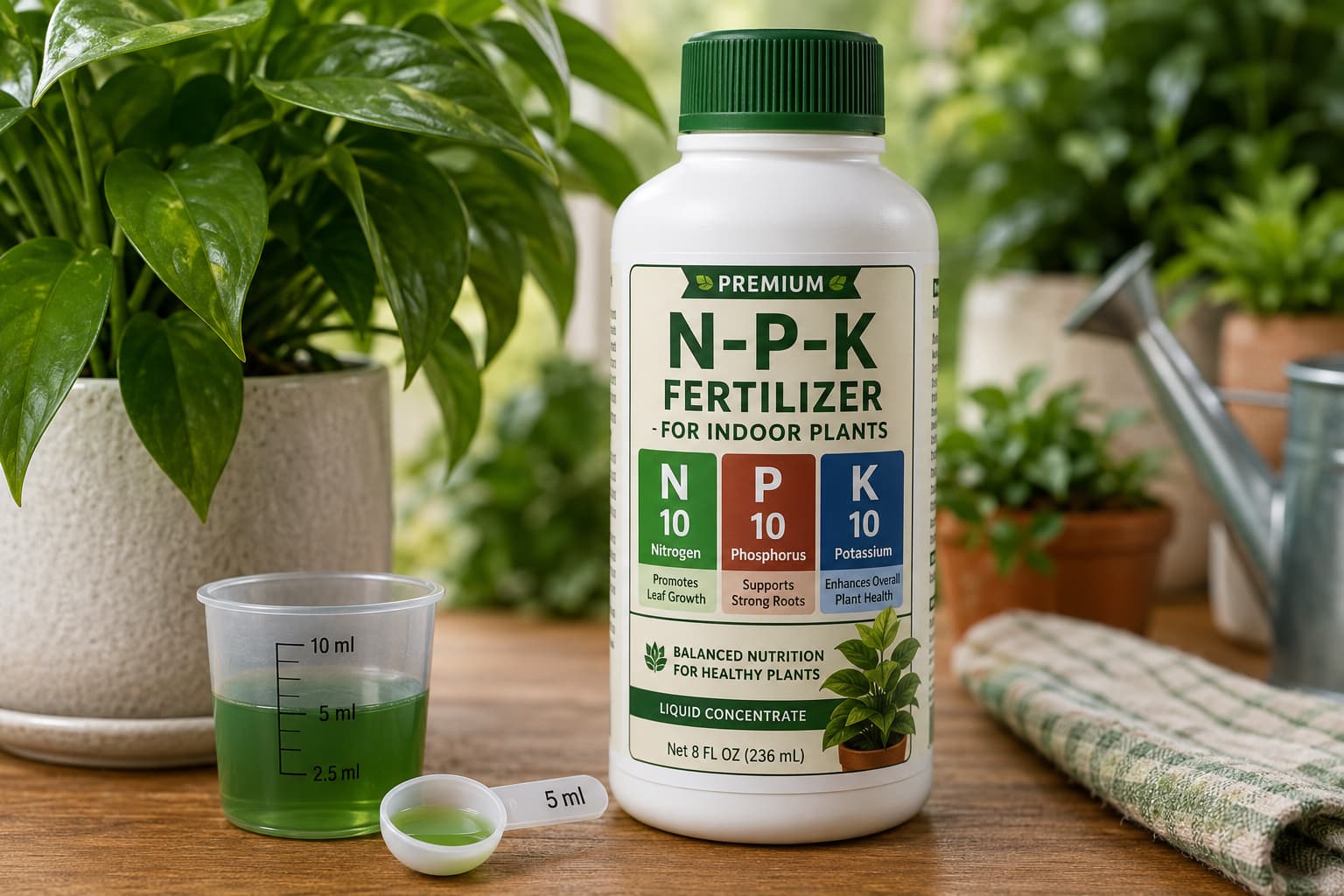
The three numbers displayed prominently on fertilizer packaging are the N-P-K analysis.
For example:
10-10-10
means the fertilizer contains:
• 10% nitrogen (N)
• 10% phosphate expressed as P₂O₅ (P)
• 10% potash expressed as K₂O (K)
These numbers describe the fertilizer’s guaranteed analysis rather than a simple “10% nitrogen, 10% phosphorus, 10% potassium” calculation.
Understanding the basic role of each nutrient is more useful than trying to find a magical N-P-K ratio.
Nitrogen (N)
Nitrogen is strongly associated with vegetative growth.
Adequate nitrogen supports:
• Leaf development
• Shoot growth
• Chlorophyll production
• Overall vegetative vigor
A nitrogen deficiency can cause older leaves to become uniformly pale or yellow-green, with smaller or thinner growth.
This is one reason foliage plants are often supplied with fertilizers containing substantial nitrogen.
However, more nitrogen is not automatically better. Excessive feeding can produce undesirable growth and contribute to salt accumulation.
Phosphorus (P)
Phosphorus participates in important processes involving energy transfer and plant development.
It is often marketed heavily as a “flowering” nutrient, but this has led to an oversimplified idea that indoor plants always need high-phosphorus fertilizer to bloom.
They do not.
Applying large amounts of phosphorus when a plant does not need it is not a shortcut to better flowering. Excess phosphorus can contribute to nutrient imbalances, including problems involving iron and zinc availability.
Potassium (K)
Potassium plays important roles in plant physiological processes, including water regulation and enzyme activity.
A potassium deficiency can produce symptoms such as yellowing or scorching around leaf margins, although symptoms can overlap with other stresses.
For most beginners, the practical lesson is simple:
You do not need to chase the highest number on the fertilizer shelf. You need an appropriate fertilizer applied conservatively.
Do Indoor Plants Need Special Fertilizer?
Not always.
A good-quality fertilizer formulated for houseplants is usually an appropriate starting point for beginners. Different plants can have different nutritional requirements, however, so specialist fertilizers can be useful for certain groups.
For example:
• General foliage plants: A balanced or general-purpose houseplant fertilizer is often suitable.
• Orchids: An orchid-specific fertilizer may be convenient because orchids are commonly grown in specialized media and have different cultivation requirements.
• Cacti and succulents: They generally require less frequent feeding than many vigorous foliage plants.
• Acid-loving plants: Some plants benefit from fertilizers formulated for acidic growing conditions.
• Flowering houseplants: A general-purpose fertilizer may be sufficient, but species-specific care can matter more than simply selecting the fertilizer with the highest phosphorus number.
RHS specifically recommends specialist approaches for groups such as orchids and acid-loving plants while noting that foliage houseplants can generally use a liquid general-purpose or houseplant feed.
The plant’s species, growing medium, light level, growth rate, and fertilizer already present in the potting mix should all influence your decision.
Liquid vs. Slow-Release Fertilizer
Indoor plant fertilizers are available in several forms. The two most useful categories for beginners are water-soluble/liquid fertilizers and slow-release fertilizers.
Liquid or water-soluble fertilizer
These fertilizers are mixed with water and applied during watering.
Advantages
• Nutrients become available relatively quickly.
• You can control the concentration.
• They are easy to adjust according to plant growth.
• They are convenient for plants that need regular but controlled feeding.
Water-soluble fertilizers are particularly useful when nutrients need to become available quickly.
Disadvantages
• They require regular attention.
• Concentration mistakes can cause problems.
• Repeated applications can contribute to soluble salt buildup if the plant is overfed or the growing medium is not adequately leached.
For beginners who want precise control, liquid fertilizer is often the easiest option.
Slow-release fertilizer
Slow-release products release nutrients gradually over time.
They may appear as:
• Pellets
• Granules
• Coated fertilizer particles
• Fertilizer spikes or similar products
Advantages
• Less frequent application
• Convenient for busy plant owners
• Provides nutrients gradually
• Can work well for plants that grow steadily
Disadvantages
• It can be harder to determine exactly how much nutrition a particular plant is receiving.
• Release rates vary with environmental conditions and product design.
• You can accidentally add more fertilizer if you forget that slow-release fertilizer is already present.
University of Georgia Extension notes that slow-release fertilizers can work effectively in containers because watering gradually releases nutrients, while RHS also recommends slow-release granules as a convenient option for houseplants.
Do not combine multiple fertilizer products simply because each one promises a different benefit. You can unintentionally overfertilize the plant.
What Is the Best Fertilizer Ratio for Indoor Plants?
There is no single N-P-K ratio that is “best” for every houseplant.
A common beginner mistake is to assume that a particular ratio—such as 10-10-10, 20-20-20, or a fertilizer with very high phosphorus—will automatically produce superior growth.
Plant nutrition does not work that simply.
A suitable fertilizer should provide nutrients in amounts appropriate to the plant and growing conditions. The source of the nutrient is less important to the plant than the nutrient being available in a form it can absorb.
For most foliage plants
A complete, general-purpose houseplant fertilizer is usually a sensible starting point.
Look for a product that provides:
• Nitrogen
• Phosphorus
• Potassium
• Relevant micronutrients where provided
For flowering plants
Don’t automatically select the fertilizer with the largest phosphorus number.
Flowering depends on more than phosphorus. Light intensity, plant maturity, temperature, photoperiod, species-specific requirements, and overall health can all influence flowering.
A fertilizer appropriate for the particular flowering species is a better approach than relying on marketing claims.
For succulents and cacti
These plants generally grow more slowly and are often fertilized less frequently than vigorous foliage plants. Avoid treating a cactus like a rapidly growing tropical vine simply because both are growing indoors.
When Is the Best Time to Fertilize Indoor Plants?
The best time to fertilize most indoor plants is when they are actively growing.
For many houseplants, active growth corresponds broadly with brighter conditions in spring and summer. However, the actual growing season depends on your climate, indoor temperature, light levels, and the particular plant.
RHS describes the houseplant growing season broadly as spring to autumn and recommends feeding during active growth.
Why winter feeding should usually be reduced
During periods of low light, many houseplants slow their growth.
If a plant is barely producing new leaves, stems, or roots, its demand for nutrients is lower.
Continuing a heavy fertilizer schedule under those conditions can result in nutrients accumulating in the potting mix rather than being incorporated into new growth.
Illinois Extension recommends fertilizing only during active growth and notes that many houseplants need little or no additional fertilizer during the short, low-light days of winter.
What if your plant grows year-round?
Indoor plants in warm, bright conditions may continue growing during periods when outdoor plants are dormant.
In that situation, don’t stop feeding simply because the calendar says “winter.”
Instead, look at the plant.
Signs of active growth include:
• New leaves emerging
• New stems extending
• New shoots appearing
• Active root growth
• Continued flowering in species that bloom indoors
If growth has slowed dramatically, reduce feeding.
How Light Affects Fertilizer Needs
This is one of the most overlooked parts of indoor plant fertilization.
A plant growing in bright light generally has greater potential for active photosynthesis and growth than the same plant struggling in very dim conditions.
University of Georgia Extension specifically identifies light intensity as a factor influencing fertilizer needs, noting that plants receiving higher light levels can require more nutrients for growth.
University of Minnesota Extension likewise recommends less feeding for low-light plants compared with plants growing under brighter conditions.
Consider two pothos plants:
Plant A: Bright indirect light, warm room, vigorous new leaves, regular watering.
Plant B: Very dim corner, little new growth, slow water use.
Giving both plants exactly the same fertilizer dose on exactly the same schedule would ignore their different growth rates.
This is why fertilizer schedules should be flexible rather than automatic.
If your plant is growing slowly because it lacks light, improve the light before reaching for more fertilizer.
For more guidance, see our guide to 21 best low light indoor plants for beginners.
How to Fertilize Indoor Plants Step by Step
If you’re unsure where to start, use this simple process.
Step 1: Identify the plant
Before applying fertilizer, determine what plant you are growing.
Different plants have different nutritional requirements.
A fast-growing foliage plant, orchid, cactus, succulent, and flowering plant should not automatically receive the same feeding routine.
If you cannot identify the plant, at least determine whether it is broadly a foliage plant, succulent/cactus, orchid, or flowering plant.
Step 2: Check whether it is actively growing
Look for fresh growth.
If the plant is dormant, severely stressed, recently moved into unsuitable conditions, or sitting in very low light, fertilizer may not be the solution.
Remember:
No active growth = be cautious about feeding.
Step 3: Check the potting mix
Find out whether the potting mix already contains fertilizer.
Some commercial potting mixes are pre-fertilized. Adding another fertilizer immediately can result in unnecessary nutrient accumulation.
Missouri Botanical Garden advises checking the potting mix before fertilizing because some mixes already contain fertilizer.
If you recently repotted the plant into a fresh, nutrient-containing mix, you may not need to fertilize immediately. Yellowing leaves, wilting, brown tips, pests, and slow growth can have several causes, so diagnosing the problem before treating it is essential. Our guide to common indoor plant problems and how to fix them explains the warning signs, likely causes, and practical solutions to help you restore stressed houseplants.
For more information on choosing growing media, see our guide to the best soil for indoor plants.
Step 4: Choose an appropriate houseplant fertilizer
For a typical foliage houseplant, a complete general-purpose houseplant fertilizer is a practical starting point.
You don’t need the most expensive product.
You also don’t need a fertilizer marketed as a miracle growth booster.
Focus on:
• Appropriate N-P-K analysis
• Clear application instructions
• Suitable use for indoor plants
• Any relevant micronutrients
• Ease of measuring accurately
Step 5: Read the fertilizer label
This step is essential.
The label tells you:
• How much fertilizer to use
• How much water to mix it with
• How frequently it can be applied
• Which plants it is intended for
• Any precautions
Never assume that two fertilizers with similar N-P-K numbers have identical application rates.
Their formulations and concentrations can differ.
Step 6: Dilute accurately if using liquid fertilizer
Measure the fertilizer carefully.
Don’t estimate by simply pouring some into the watering can.
If a product says to use a specific amount per liter or gallon, follow that instruction.
For cautious beginners, using a weaker concentration than the maximum label rate can be a reasonable approach for many established foliage plants, particularly when you are learning how your plants respond. UMN Extension, for example, recommends beginning with half-strength balanced fertilizer for new spring growth.
However, do not blindly halve every fertilizer product. Follow the specific product’s directions and plant requirements.
Step 7: Fertilize moist soil
Avoid applying concentrated fertilizer to completely dry potting mix.
RHS specifically advises against fertilizing dry soil because it can increase the risk of root damage.
If the plant needs watering, water it appropriately first or apply the fertilizer as part of a properly managed watering event, depending on the product instructions.
Proper watering is just as important as fertilizing when it comes to healthy indoor plants. If you’re unsure how to water indoor plants properly, this complete beginner’s guide explains when to water, how much to use, drainage essentials, and common mistakes that can lead to root problems.
Step 8: Apply the fertilizer evenly
Distribute the fertilizer solution around the potting medium rather than concentrating it in one small location.
Avoid intentionally pouring concentrated fertilizer onto stems or foliage unless the product is specifically formulated and labeled for foliar application.
The roots are normally the primary route through which plants acquire mineral nutrients from the growing medium.
Step 9: Allow excess water to drain
Your container should have appropriate drainage.
After watering, don’t leave the pot sitting indefinitely in stagnant water.
Poor drainage can contribute to root problems, while drainage allows excess water and some dissolved salts to leave the container.
Step 10: Monitor the plant
Don’t expect fertilizer to produce dramatic overnight changes.
Watch for:
• New leaf production
• Normal leaf color
• Healthy stem development
• Root growth
• Improved overall vigor
If symptoms worsen after fertilizing, stop and reassess rather than adding even more fertilizer.
How Much Fertilizer Should You Use?
This is where many indoor gardeners make their biggest mistake.
The correct amount is not “as much as the plant can take.”
Use the manufacturer’s recommended dosage as your starting point, taking into account the plant’s growth rate and growing conditions.
For beginners, conservative feeding is generally safer than aggressive feeding because fertilizer injury can be difficult to reverse.
University of Illinois Extension recommends that houseplants generally do not need frequent fertilizer applications and warns that excessive fertilizer can burn roots.
University of Georgia Extension explains that excessive fertilizer increases soluble salts in the growing medium, which can damage roots by interfering with their ability to take up water.
A useful rule
If you’re deciding between:
“A little more fertilizer might make it grow faster.”
and
“I’ll use a conservative amount and observe the plant.”
Choose the second approach.
Should You Fertilize Every Time You Water?
Not necessarily.
Some dilute-feed approaches involve applying a low concentration of fertilizer frequently during active growth. RHS, for example, notes that a quarter-strength liquid fertilizer can be used at each watering during the growing season for suitable houseplants.
But this doesn’t mean every plant should receive fertilizer every time you water.
It depends on:
• Fertilizer concentration
• Plant species
• Growth rate
• Light intensity
• Pot size
• Potting medium
• Watering frequency
• Existing nutrients in the mix
A fast-growing plant under bright light may consume nutrients more rapidly than a slow-growing plant in dim conditions.
If you use a frequent-feed approach, the concentration must be correspondingly low and consistent with the fertilizer’s instructions.
Signs Your Indoor Plant May Need Fertilizer
Nutrient deficiency is possible, but don’t assume every yellow leaf means “add fertilizer.”
Possible signs of inadequate nutrition can include:
• Slow growth
• Pale or yellow-green foliage
• Small new leaves
• Poor overall vigor
• Unusual coloration associated with particular nutrient deficiencies
Nitrogen deficiency, for example, commonly affects older leaves first and can cause general yellowing or pale green foliage.
But these symptoms are not diagnostic by themselves.
Yellow leaves can also result from:
• Overwatering
• Poor drainage
• Root damage
• Insufficient light
• Pest activity
• Temperature stress
• Natural aging of older leaves
• Water-quality issues
• Other nutrient problems
Missouri Botanical Garden specifically cautions that yellowing can have causes other than nutrient deficiency, including overwatering.
Before adding fertilizer, investigate the entire growing environment.
For a broader diagnostic approach, see 21 common indoor plant problems and how to fix them fast.
Signs You Are Overfertilizing Your Indoor Plant
Overfertilization can be more damaging than underfertilization.
Watch for:
• Brown leaf tips
• Brown or scorched leaf margins
• Wilting despite apparently adequate watering
• Stunted growth
• Leaf damage
• A white or crusty residue on the potting mix
• Declining root health
• Sudden deterioration after heavy feeding
Excess fertilizer increases soluble salts in the growing medium. These salts can make it harder for roots to take up water and, at sufficiently high concentrations, can injure roots.
A white crust around the soil surface or container rim can be an indication of salt accumulation, although it is not proof that fertilizer is the only source. Irrigation water can also contribute dissolved salts.
If you see fertilizer burn:
Stop fertilizing.
Check the drainage.
If the plant is otherwise suitable for leaching, thoroughly water the potting medium so excess water drains freely from the bottom. This can help move accumulated soluble salts out of the root zone.
UGA Extension recommends periodic leaching to help prevent salt buildup, while other Extension guidance similarly recommends adequate drainage and leaching when soluble salts accumulate.
If the plant is severely damaged, the potting mix is heavily contaminated, or drainage is poor, repotting into fresh appropriate growing medium may be necessary.
Repotting can stress indoor plants if roots are handled too roughly. Our guide on how to repot indoor plants without damaging the roots explains how to remove plants safely, protect delicate roots, choose the right pot, and help them recover after repotting.
Common Fertilizing Mistakes to Avoid
1. Fertilizing a struggling plant automatically
A sick plant doesn’t necessarily need more nutrients.
If the real problem is root rot, pests, inadequate light, or poor watering, fertilizer can make the situation worse.
Pests can quickly weaken indoor plants, causing yellow leaves, distorted growth, sticky residue, or visible damage. Our guide to common indoor plant pests and how to eliminate them explains how to identify common invaders, understand the damage they cause, and choose practical ways to control them.
Diagnose first.
2. Using more fertilizer to make plants grow faster
This is perhaps the most dangerous misconception.
Plants have physiological limits. Extra nutrients do not automatically translate into extra growth.
Fertilization is most beneficial when nutrient availability is limiting growth.
3. Fertilizing in very low light
A plant with minimal light may not be growing enough to justify a heavy feeding routine.
Improve its growing conditions first.
If you are growing plants in naturally low-light rooms, choose species that tolerate those conditions instead of trying to compensate with fertilizer.
See 21 best low light indoor plants for beginners for suitable choices.
4. Feeding immediately after every repot
Fresh potting mix may already contain nutrients.
Adding fertilizer immediately without checking the mix can unnecessarily increase the nutrient load.
Always check the product information for the growing medium.
5. Using garden fertilizer without checking the label
Outdoor fertilizers are not automatically appropriate for every indoor plant.
Some products may be highly concentrated or designed for completely different growing conditions.
A houseplant fertilizer is usually the simpler choice for beginners.
6. Using fertilizer spikes and liquid fertilizer together
This can unintentionally create excessive nutrient levels.
Choose one feeding system and understand how long it lasts before adding another.
7. Diagnosing every yellow leaf as nitrogen deficiency
This can lead to a cycle of:
yellow leaf → fertilizer → more yellow leaves → more fertilizer
Instead, inspect:
• Soil moisture
• Drainage
• Light
• Roots if necessary
• Pests
• Recent changes
• Fertilizer history
Only then decide whether nutrition is likely to be involved.
8. Ignoring water quality
Water itself can contain dissolved minerals and salts.
Over time, these can contribute to accumulation in containers, particularly when plants are repeatedly watered without adequate leaching.
If you repeatedly notice mineral deposits around the pot and fertilizer management seems appropriate, water quality may deserve investigation.
How Fertilizer Needs Differ Among Common Indoor Plants
There is no perfect schedule for every houseplant, but this general framework can help.
| Plant Group | Typical Approach |
| Pothos and philodendrons | Feed moderately during active growth |
| Snake plants | Feed sparingly; growth is often slower |
| ZZ plants | Feed conservatively, particularly in lower light |
| Peace lilies | Moderate feeding during active growth |
| Spider plants | Regular but moderate feeding during active growth |
| Rubber plants | Can be relatively vigorous under good light |
| Orchids | Use an orchid-appropriate fertilizer and follow its instructions |
| Cacti | Feed sparingly during active growth |
| Succulents | Light, infrequent feeding is generally appropriate |
| Newly repotted plants | Check whether fresh mix already contains fertilizer |
These are broad categories, not substitutes for species-specific care.
The amount of light a plant receives can substantially alter its growth rate and therefore its nutritional demand.
Can Fertilizer Make Indoor Plants Grow Faster?
Yes, if nutrients are limiting growth.
But fertilizer is not a universal growth accelerator.
Imagine a pothos that receives adequate water and fertilizer but sits several meters away from a dark window.
Adding more fertilizer won’t transform it into a vigorous plant because light remains the limiting factor.
Now imagine the same pothos receiving good light and appropriate water but growing in depleted potting mix. In that situation, supplying needed nutrients can support renewed growth.
This distinction is important:
Fertilizer can correct a nutritional limitation, but it cannot override every other limitation on plant growth.
Colorado State University Extension makes the same broader point: fertilizer improves growth when the applied nutrient is actually deficient and other important growth factors are not limiting.
Should You Fertilize Newly Purchased Indoor Plants?
Usually, don’t rush.
A newly purchased houseplant may already have nutrients available in its growing medium, and commercial growers may have fertilized it before sale.
University of Georgia Extension notes that a newly purchased, healthy indoor plant generally does not need immediate fertilizer and may already have sufficient nutrients for a period after purchase.
Instead:
• Give the plant time to acclimate.
• Identify its light requirements.
• Establish appropriate watering.
• Check the potting mix.
• Look for active growth.
• Begin feeding when appropriate.
This is especially useful because moving a plant from a greenhouse or nursery into a home can change its light, temperature, humidity, and watering conditions.
Should You Fertilize After Repotting?
It depends on the new potting mix.
If the fresh growing medium contains fertilizer, additional feeding may not be necessary immediately.
If the mix contains little or no fertilizer, feeding may eventually be required once the plant resumes active growth.
Avoid treating repotting as an automatic signal to fertilize.
The plant’s response after repotting matters more.
If it is temporarily stressed and not growing, give it appropriate light, moisture, and time to establish rather than immediately adding fertilizer.
For a complete repotting process, see how to repot indoor plants without damaging the roots.
How Often Should You Flush Indoor Plant Soil?
There is no universal monthly flushing requirement for every houseplant.
The need depends on:
• Fertilizer use
• Water quality
• Potting medium
• Drainage
• Watering habits
• Salt accumulation
If soluble salts are accumulating, occasional thorough watering that allows significant drainage can help move them through the growing medium.
However, flushing is not a substitute for correcting overfertilization.
If you continually apply too much fertilizer, repeatedly flushing the pot is treating the symptom rather than the cause.
A better strategy is:
Apply less → monitor the plant → maintain appropriate watering → leach when appropriate.
Organic vs. Synthetic Fertilizer for Indoor Plants
Both organic and manufactured fertilizers can provide plant nutrients.
The plant ultimately takes up nutrients in usable mineral forms; it does not “know” whether those nutrients originated from a synthetic fertilizer or an organic source.
Organic fertilizers
Examples include products derived from:
• Fish
• Plant materials
• Animal by-products
• Other organic sources
Advantages can include slower nutrient release and, depending on the product, lower salt concentrations.
However, organic fertilizers are not automatically risk-free. They can still be overapplied, and some need microbial activity to convert nutrients into forms available to plants.
Some organic products may also have noticeable odors, which can be inconvenient indoors. AHS notes this as a practical consideration for houseplants.
Synthetic or inorganic fertilizers
These can provide nutrients in readily available forms and make it easier to deliver measured amounts.
Their main disadvantage for inexperienced users is that overapplication can lead to soluble salt buildup and root damage.
Which should you choose?
For indoor plants, correct application matters more than choosing a fertilizer based purely on whether it is labeled organic or synthetic.
Choose a product you can measure accurately and use consistently.
A Simple Fertilizing Routine for Beginners
If you want a straightforward system without constantly calculating fertilizer requirements, use this framework.
During active growth
Every 2–4 weeks:
1. Check that the plant is actively growing.
2. Check whether the potting mix already contains fertilizer.
3. Use a suitable houseplant fertilizer.
4. Follow the label dosage or use a conservative concentration appropriate for the product.
5. Apply to appropriately moist growing medium.
6. Allow excess water to drain.
7. Observe the plant over the following weeks.
This is a practical starting point rather than a universal prescription. Some plants need less frequent feeding, while others under bright conditions may benefit from more regular low-dose feeding.
During low-growth periods
Reduce or stop feeding if the plant’s growth has slowed substantially.
Don’t continue feeding heavily simply because you have been following a calendar.
A Better Fertilizer Decision Guide
Use this quick checklist before every feeding.
Is the plant actively growing?
No: Wait.
Yes: Continue.
Is the plant receiving adequate light?
No: Improve the light before increasing fertilizer.
Yes: Continue.
Has the plant recently been repotted?
Yes: Check the new potting mix for existing fertilizer.
No: Continue.
Is the plant showing possible nutrient deficiency?
No: Continue normal conservative feeding.
Yes: Check watering, roots, pests, light, and other possible causes before treating it as a nutrient deficiency.
Has fertilizer been applied recently?
Yes: Don’t automatically apply more.
No: Continue if conditions are appropriate.
Is there a crust or salt buildup on the soil?
Yes: Stop excessive feeding and consider appropriate leaching.
No: Continue with a conservative routine.
What About Homemade Fertilizers?
Homemade plant feeds are sometimes recommended online using ingredients such as banana peels, coffee grounds, eggshells, or kitchen waste.
Be careful with this advice.
The fact that an ingredient contains nutrients does not mean placing it directly in a houseplant pot provides those nutrients in a predictable, plant-available form.
If you want to use homemade fertilizer, use a properly prepared method and understand what nutrients the resulting product actually supplies.
RHS notes that homemade liquid fertilizers can be made from suitable plant materials and used for houseplants, but preparation and application still matter.
For most beginners, a properly labeled commercial houseplant fertilizer is simpler because its nutrient analysis and application instructions are clearly defined.
Fertilizer and Indoor Plant Pests
Fertilizer does not directly replace pest management.
If your plant has:
• Mealybugs
• Spider mites
• Scale insects
• Aphids
• Thrips
• Fungus gnats
adding fertilizer will not eliminate the pest.
In fact, when a plant is already stressed by pests, the priority should be identifying and controlling the underlying problem.
RHS and university Extension resources emphasize examining plants for pest problems and maintaining appropriate growing conditions rather than treating every decline as a nutritional problem.
If pests are the issue, see our guide to 8 common indoor plant pests and how to eliminate them.
Frequently Asked Questions (FAQs)
1. What is the best fertilizer for indoor plants?
For many foliage houseplants, a complete, general-purpose fertilizer formulated for houseplants is a practical choice. The best product depends on the plant, growing medium, light level, and growth rate.
There is no single fertilizer that is best for every species.
2. How often should I fertilize houseplants?
Many foliage houseplants can be fed about once or twice a month during active growth, but the appropriate frequency varies. Slow-growing plants and plants in low light may require considerably less.
RHS recommends liquid feeding once or twice a month for foliage houseplants during the main growing season.
3. Should I fertilize indoor plants in winter?
Usually, feeding should be reduced when growth slows because of low light or dormancy. Plants that continue actively growing under bright indoor conditions may still require some nutrition.
4. Can too much fertilizer kill an indoor plant?
Yes. Excess fertilizer can increase soluble salts in the growing medium, damage roots, interfere with water uptake, and eventually cause severe plant decline.
5. Is 10-10-10 fertilizer good for houseplants?
It can be suitable for some plants, but the N-P-K ratio alone does not determine whether a fertilizer is appropriate. Plant species, concentration, micronutrients, growing conditions, and application rate also matter.
6. Should I fertilize a plant with yellow leaves?
Not automatically. Yellow leaves can result from nutrient deficiency, but they can also indicate overwatering, poor drainage, pests, inadequate light, aging, or other stress. Diagnose the cause before adding fertilizer.
7. Can I fertilize a newly repotted plant?
Check the new potting mix first. If it already contains fertilizer, additional feeding may not be necessary immediately. Allow the plant to establish and resume active growth before beginning a regular feeding routine.
8. Is liquid fertilizer better than slow-release fertilizer?
Neither is universally better. Liquid fertilizer provides greater control over timing and concentration, while slow-release fertilizer offers convenience and gradual nutrient delivery. Choose the method you can apply accurately and consistently.
9. Does fertilizer make plants grow faster?
It can support faster or healthier growth when inadequate nutrients are limiting the plant. It will not compensate for inadequate light, poor watering, root problems, pests, or unsuitable growing conditions.
10. Can I fertilize every time I water?
Some low-dose fertilization systems allow frequent feeding, but this depends on the fertilizer and plant. Frequent feeding should involve a suitably diluted product and careful attention to the manufacturer’s instructions.
11. Should I use high-phosphorus fertilizer to make my indoor plant flower?
Not automatically. Flowering depends on several factors, including species, maturity, light, environmental conditions, and nutrition. Excessive phosphorus is not a universal flowering solution and can contribute to nutrient imbalances.
Conclusion
Successful indoor fertilization is less about finding a magical fertilizer and more about matching nutrition to the plant’s actual growing conditions.
The most reliable routine is straightforward:
1. Give the plant enough light.
2. Use an appropriate, well-draining potting mix.
3. Water correctly.
4. Feed during active growth.
5. Use an appropriate houseplant fertilizer.
6. Measure carefully.
7. Avoid fertilizing dry or severely stressed plants.
8. Reduce feeding when growth slows.
9. Watch for signs of nutrient deficiency and fertilizer excess.
10. Never assume more fertilizer means faster growth.
A healthy plant does not need to be constantly fed.
In fact, one of the most useful habits an indoor gardener can develop is learning to recognize when not to fertilize.
The goal isn’t to put as many nutrients as possible into the pot. The goal is to provide enough nutrition to support healthy growth while maintaining the conditions that allow the plant to actually use those nutrients.
When light, water, roots, growing medium, temperature, and nutrition are working together, fertilizer becomes what it should be: a useful supplement—not a rescue treatment.
For reliable, expert-backed advice on feeding houseplants, understanding plant nutrition, and knowing when and how to fertilize, the Royal Horticultural Society (RHS) guidance offers practical recommendations that can help you avoid common feeding mistakes and keep your indoor plants growing healthily.

I’m Bon (aka Guider), an indoor gardening writer and houseplant enthusiast passionate about helping beginners successfully grow and care for indoor plants. I create practical, beginner-friendly guides covering indoor plant care, watering, lighting, soil, repotting, plant problems, and choosing suitable houseplants for different homes. My articles draw on research from trusted horticultural organizations, university extension resources, and botanical institutions, combined with practical plant-care principles and careful content review.