A dim room does not mean you have to give up on indoor greenery. Air purifying plants low light can add beauty to darker rooms while tolerating limited natural light and remaining relatively easy to maintain. However, it is important to understand the difference between plants shown to remove certain pollutants under laboratory conditions and plants that can meaningfully improve air quality in a real home.
That distinction matters. Research has demonstrated that plants and their growing media can interact with certain volatile organic compounds (VOCs), but the effect of a few ordinary potted plants is generally too small to replace ventilation or mechanical air filtration. The U.S. Environmental Protection Agency likewise notes that there is currently no evidence that a reasonable number of houseplants remove significant quantities of pollutants from homes and offices.
So, think of the plants below primarily as low-light indoor plants that may contribute modestly to indoor environmental quality while adding living greenery. Their biggest practical advantage is that many can tolerate the subdued light found in bedrooms, hallways, offices and rooms that sit away from windows.
What Are Air Purifying Plants for Low Light?
Air purifying plants for low light are indoor plants that can tolerate limited natural light while being associated with the removal or reduction of certain airborne pollutants under particular conditions. They are commonly chosen for rooms such as bedrooms, offices, bathrooms, hallways, and other spaces with little direct sunlight.
The term combines two characteristics:
Air purifying: The plant has demonstrated an ability, particularly in controlled laboratory studies, to absorb or interact with certain airborne compounds or pollutants.
Low light: The plant can survive and maintain reasonable growth under lower-light indoor conditions compared with plants that require bright, direct sunlight.
However, “air purifying” does not mean that these plants will dramatically clean the air in an ordinary home. Much of the evidence for plant-based air purification comes from controlled experiments, while real homes have ventilation, air exchange, larger room volumes, and relatively small amounts of plant material.
Therefore, houseplants should be viewed primarily as a way to add greenery and potentially contribute modestly to indoor environmental quality—not as a replacement for ventilation or mechanical air filtration.
What Does “Low Light” Actually Mean?
Low light does not mean complete darkness. Most plants described as low-light plants still need some natural or artificial light to photosynthesize and remain healthy.
A low-light location might include:
• A room with a north-facing or shaded window
• A spot several feet away from a bright window
• An office with limited natural sunlight
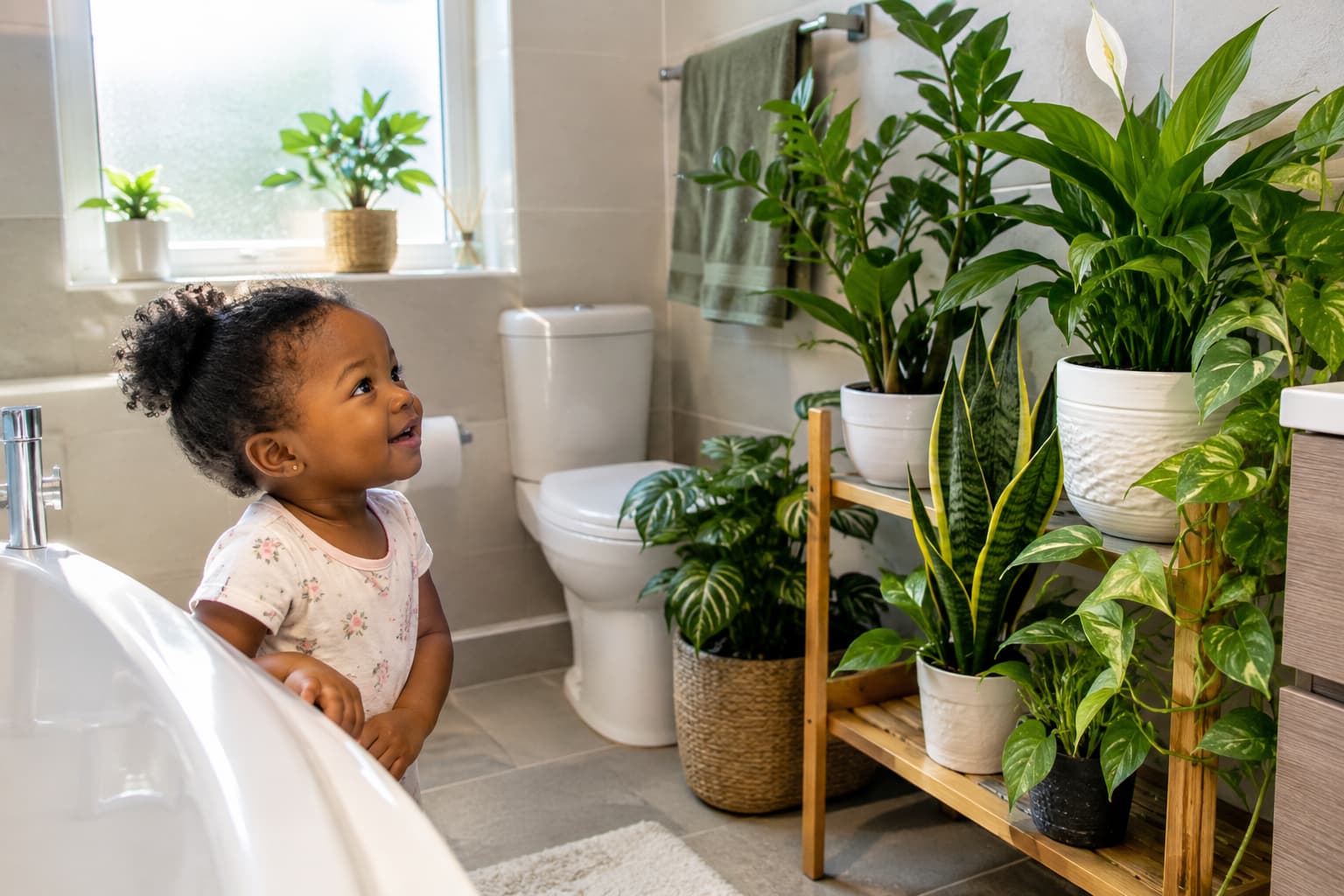
• A bathroom with a small or frosted window
• A room where buildings or trees block much of the sunlight
Plants placed in extremely dark areas may survive for a while but can eventually develop slow growth, pale or yellowing leaves, elongated stems, or leaf drop.
How Can These Plants Purify Air?
Plants can interact with their environment through their leaves, roots, and associated microorganisms in the growing medium. Some research has demonstrated that certain plants can remove or reduce specific volatile organic compounds (VOCs) under laboratory conditions.
However, the effectiveness depends on factors such as:
• The type and concentration of pollutant
• Plant species
• Amount of plant material
• Light availability
• Temperature and humidity
• Air movement
• Room size
• Ventilation and air-exchange rates
This is why it is more accurate to say that certain plants have air-purifying potential rather than claiming that they will substantially purify the air in a typical room.
A useful rule is:
If a room has no meaningful natural daylight at all, choose a different solution or provide a suitable grow light.
Plants cannot remain healthy indefinitely without enough usable light for photosynthesis.
Signs Your “Low-Light” Room May Actually Be Too Dark
Watch the plant rather than relying only on the room’s appearance.
Possible signs of insufficient light include:
• New leaves becoming smaller than previous growth
• Long, weak or stretched stems
• Wider spacing between leaves
• Slower-than-expected growth
• Loss of normal leaf coloration
• Variegated foliage becoming less pronounced
• Soil remaining wet for unusually long periods because the plant is using water more slowly
A plant may survive in low light while growing very slowly. Survival and healthy growth are not the same thing.
15 Best Air Purifying Plants for Low Light
The following choices were selected primarily for their combination of low-light tolerance, indoor adaptability and manageable care requirements. Their inclusion does not mean each plant has been proven to significantly purify the air of an ordinary home.
1. Snake Plant
Most suitable for very low-light rooms and forgetful waterers. Snake plant is one of the strongest choices when low light and minimal watering are your main concerns.
It tolerates a broad range of indoor light conditions and can cope with relatively dry periods between waterings. North Carolina State Extension describes it as tolerant of very low light and emphasizes the importance of well-drained soil and avoiding overwatering.
Its upright growth also makes it useful when floor space is limited.
Care essentials
• Light: Low to bright indirect light
• Water: Allow the potting mix to dry substantially between waterings
• Soil: Fast-draining mix
• Placement: Bedroom, office, hallway or living room
For reliable care tips, learn how to provide the right light, water, soil, and growing conditions with this complete guide to Snake Plant Care.
2. Cast Iron Plant
A practical option for darker corners, shaded rooms, and low-maintenance indoor growing.
Cast iron plant (Aspidistra elatior) is known for its ability to tolerate lower indoor light and less-than-perfect growing conditions. Its broad, dark-green leaves provide a substantial foliage display without requiring direct sunlight.
This makes it useful for areas where more light-demanding houseplants may struggle. Although cast iron plant is forgiving, growth can be slower in very dim conditions. Providing as much indirect daylight as the space allows will help maintain healthier foliage.
Care essentials
Light: Low to moderate indirect light
Water: Allow the upper portion of the potting mix to dry before watering
Soil: Well-draining, organic-rich potting mix
Placement: Hallway, bedroom, office, or shaded living room
Pet-friendly note: Cast iron plant is listed as non-toxic to dogs, cats, and horses by the American Society for the Prevention of Cruelty to Animals (ASPCA).
For more detailed care guidance, explore this expert guide to Cast Iron Plant Care, including watering, light, soil, and common problems.
3. Pothos
Works especially well on shelves, in hanging baskets, and in rooms with limited indirect light.
Pothos (Epipremnum aureum) is one of the more adaptable trailing houseplants for indoor spaces. It can tolerate lower light, although brighter indirect light generally encourages fuller growth and stronger foliage.
The cultivar also matters when choosing a plant for a dim room. Dark-green pothos varieties are generally better suited to lower-light conditions than heavily variegated forms. If a variegated pothos starts producing mostly green leaves or develops long gaps between leaves, move it to a brighter location.
Care essentials
Light: Low to bright indirect light, depending on cultivar
Water: Allow the upper portion of the potting mix to dry before watering
Soil: Well-draining indoor potting mix
Placement: Shelf, bookcase, hanging basket, or plant stand
Pet warning: Pothos contains insoluble calcium oxalates and can cause irritation if chewed or swallowed by cats or dogs.
For fuller growth and healthier foliage, explore this practical guide to Pothos Plant Care, covering light, watering, soil, pruning, and common problems.
4. Chinese Evergreen
A good fit for decorative foliage in bedrooms, offices, and living rooms with limited natural light.
Chinese evergreen (Aglaonema spp.) combines attractive foliage with a useful tolerance for lower-light indoor conditions. Depending on the cultivar, its leaves may be dark green, silver-patterned, or variegated.
When selecting a Chinese evergreen for a dim room, pay attention to the foliage pattern. Darker-green cultivars are generally better candidates for lower-light positions, while strongly variegated varieties may perform better with brighter indirect light.
Care essentials
Light: Low to medium indirect light
Water: Water when the upper layer of the potting mix begins to dry
Soil: Moisture-retentive but well-draining mix
Placement: Bedroom, office, hallway, or living room
Pet warning: Chinese evergreen contains insoluble calcium oxalates and can cause oral irritation if chewed or swallowed.
5. Peace Lily
Choose peace lily if you want lush foliage in a relatively dim room and appreciate the possibility of its distinctive white spathes.
Peace lily (Spathiphyllum spp.) can adapt to relatively low indoor light, making it a popular choice for bedrooms, living rooms, and other areas away from bright windows. Its dark foliage also provides an attractive contrast to its white flower-like spathes.
There is an important trade-off with lower light. A peace lily may remain healthy in a dim room while producing few or no flowers. If flowering is a priority, move the plant closer to bright filtered or indirect light.
Peace lily also prefers more consistent moisture than drought-tolerant choices such as snake plant and ZZ plant. Avoid allowing the potting mix to remain completely dry for extended periods.
Care essentials
Light: Low to medium indirect light
Water: Water when the upper layer of the mix begins to dry
Soil: Moisture-retentive but well-draining
Placement: Bedroom or living room with filtered daylight
Pet warning: Peace lily contains insoluble calcium oxalates and can cause significant irritation if ingested by cats or dogs.
For healthier growth and vibrant blooms, explore this practical guide to Peace Lily Care, covering light, watering, soil, humidity, and common problems.
6. ZZ Plant
Ideal for busy plant owners who want attractive foliage without a demanding watering routine.
ZZ plant (Zamioculcas zamiifolia) is particularly useful in lower-light interiors because it combines tolerance of reduced light with an impressive ability to withstand periods of dryness.
Its thick underground rhizomes store water, allowing the plant to cope with missed waterings better than many moisture-loving tropical houseplants. However, low light does not mean unlimited neglect. Growth generally becomes slower as light levels decrease, while excessive watering can still lead to root problems.
Care essentials
Light: Low to bright indirect light
Water: Allow the potting mix to dry well between waterings
Soil: Fast-draining, well-aerated mix
Placement: Office, bedroom, hallway, or living room
Best feature: Excellent tolerance of occasional missed watering.
For a low-maintenance indoor plant, explore this practical guide to ZZ Plant Care, covering light, watering, soil, pruning, and common problems.
7. Heartleaf Philodendron
This plant shines on shelves, in hanging baskets, and in rooms where trailing foliage can soften the appearance of the space.
Heartleaf philodendron (Philodendron hederaceum) produces attractive heart-shaped leaves and naturally cascading stems. It can tolerate lower indoor light, although brighter indirect light generally supports stronger and more compact growth.
Pay attention to the distance between leaves as the plant develops. Long stretches of bare stem or widely spaced leaves can indicate that the plant is reaching for more light. Moving it closer to a bright window while protecting it from harsh direct sunlight can improve growing conditions.
Care essentials
Light: Low to bright indirect light
Water: Allow part of the potting mix to dry before watering
Soil: Loose, well-draining indoor mix
Placement: Shelf, hanging basket, or support pole
Pet warning: Philodendrons contain insoluble calcium oxalates and should be kept away from pets that may chew the foliage.
8. Dracaena
Well suited to offices, bedrooms, hallways, and living rooms where upright foliage is needed without direct sunlight.
Dracaena includes several popular indoor species and cultivars that can adapt reasonably well to indoor conditions. Their upright growth habit makes them especially useful when you want vertical structure rather than trailing or spreading foliage.
Light requirements vary between Dracaena species and cultivars. Darker-green forms may cope better with lower illumination, while strongly variegated plants can benefit from brighter indirect light to maintain attractive foliage.
Care essentials
Light: Low to bright indirect light, depending on species and cultivar
Water: Allow some of the potting mix to dry between waterings
Soil: Well-draining indoor potting mix
Placement: Office, living room, bedroom, or hallway
Pet warning: ASPCA lists Dracaena species as toxic to cats and dogs if ingested.
9. Lucky Bamboo
A smart choice for desks, shelves, compact rooms, and decorative arrangements with limited natural light.
Despite its common name, lucky bamboo is not a true bamboo. It is Dracaena sanderiana, a tropical plant commonly grown indoors in water or potting media.
Its compact form makes it useful where floor space is limited. It can tolerate relatively low indoor light, although some natural or suitable artificial light is still important for maintaining healthy growth.
Care requirements depend partly on how the plant is grown. Water-grown plants need appropriate water management and a clean container, while plants grown in potting media need a well-draining growing mix.
Care essentials
Light: Low to medium indirect light
Water: Depends on whether it is grown in water or potting mix
Soil: If grown in soil, use a well-draining mix
Placement: Desk, shelf, or bathroom with suitable daylight
Important safety note: Lucky bamboo is a Dracaena, so households with cats or dogs should keep it out of reach.
10. Dumb Cane
Consider dumb cane when you want large, decorative foliage that can bring visual impact to a room without requiring direct sunlight.
Dumb cane (Dieffenbachia spp.) produces broad, patterned leaves that can become a strong focal point in a living room, office, or spacious bedroom. It generally performs best in medium to bright indirect light but can tolerate lower illumination.
In darker locations, growth may become slower and less compact. If the plant begins producing weak or stretched growth, moving it to a brighter indirect-light position can provide better growing conditions.
Care essentials
Light: Low to bright indirect light
Water: Keep the mix moderately moist but never consistently waterlogged
Soil: Moisture-retentive but well-draining mix
Placement: Living room, office, or spacious bedroom
Important safety note: Dumb cane contains insoluble calcium oxalates and can cause significant irritation if its foliage is chewed. Keep it away from children and pets who may bite the leaves.
For easy care and lush growth, explore this practical Dumb Cane Care guide, covering light, watering, soil, humidity, and common problems.
11. Bird’s Nest Fern
Where it performs best is in humid indoor spaces with filtered daylight and a reasonably consistent watering routine.
Bird’s nest fern (Asplenium nidus) brings lush, upright foliage to rooms where direct sunlight is limited. It can adapt to lower light, but adequate moisture and humidity become especially important for maintaining healthy growth.
This fern is less forgiving of drought than plants such as snake plant and ZZ plant. If you frequently forget to water your plants, it may not be the easiest option. Aim to keep the growing medium lightly moist without allowing it to become saturated.
Care essentials
Light: Low to medium indirect light
Water: Keep the growing medium lightly and evenly moist
Soil: Moisture-retentive but well-draining mix
Placement: Bright bathroom or naturally humid indoor area
Important tip: Water around the soil rather than repeatedly pouring water directly into the central crown, particularly where airflow is poor.
12. Parlor Palm
Particularly useful for bedrooms, offices, and living rooms where soft, tropical-looking foliage is desired without direct sun.
Parlor palm (Chamaedorea elegans) has a graceful, compact growth habit that works well in many indoor settings. It can adapt to lower light, although brighter filtered light generally supports healthier growth.
Its relatively slow growth is another advantage for smaller interiors because the plant is less likely to quickly outgrow its location.
Research has examined Chamaedorea elegans and its interaction with indoor pollutants under controlled conditions. However, these findings should not be interpreted as proof that one parlor palm can significantly purify the air in an ordinary home.
For practical indoor air quality, source control, ventilation, and appropriate filtration remain more meaningful strategies than relying on houseplants alone.
Care essentials
Light: Low to bright filtered light
Water: Water when the upper portion of the mix begins to dry
Soil: Well-draining indoor potting mix
Placement: Bedroom, living room, or office
13. Spider Plant
A great choice for beginners who want cascading foliage that can make good use of shelves and hanging containers.
Spider plant (Chlorophytum comosum) produces arching leaves and, under suitable conditions, develops small plantlets on long stems. Its naturally cascading growth makes it particularly useful when floor space is limited.
It can tolerate lower light, but brighter indirect light generally supports stronger growth and more vigorous production of plantlets. Extremely dim conditions may slow development and reduce the plant’s overall vigor.
Care essentials
Light: Low to bright indirect light
Water: Water when the upper portion of the mix begins to dry
Soil: Well-draining indoor potting mix
Placement: Shelf, hanging basket, or bedroom
Best feature: Naturally cascading growth that works well in small spaces.
14. English Ivy
Best suited to cooler indoor spaces with filtered light and plant owners who are willing to monitor its growing conditions.
English ivy (Hedera helix) can tolerate relatively low light, but it is less forgiving of warm, dry indoor conditions than tougher choices such as snake plant, ZZ plant, and cast iron plant.
Light is particularly important for maintaining compact growth. When illumination is insufficient, English ivy may become elongated and sparse. Regularly monitoring moisture, temperature, and airflow can therefore make a significant difference to its performance indoors.
Care essentials
Light: Low to bright indirect light
Water: Allow the surface to dry slightly while avoiding prolonged saturation
Soil: Well-draining potting mix
Placement: Cooler room with filtered daylight
Pet warning: English ivy can be harmful to pets if ingested and should be kept out of reach of cats and dogs.
15. Bamboo Palm
Works especially well in larger bedrooms, living rooms, and offices where there is enough space for a fuller tropical display.
Bamboo palm (Chamaedorea seifrizii) has feathery foliage that adds height and softness to an interior without requiring direct sunlight. It can tolerate filtered and relatively low indoor light better than many sun-loving palms.
However, bamboo palm is not as drought-tolerant as plants such as snake plant or ZZ plant. Consistent watering, suitable drainage, and reasonable humidity are therefore more important when growing it indoors.
Choose bamboo palm when you want a larger tropical presence and are prepared to provide more regular care than you would for a drought-tolerant houseplant.
Care essentials
Light: Low to medium indirect light
Water: Keep the growing medium moderately moist but well drained
Soil: Well-draining, moisture-retentive mix
Placement: Large living room, office, or spacious bedroom
Best for: Plant owners who want a larger tropical display and can maintain a consistent watering routine.
Light tolerance is not identical across all species, cultivars or growing conditions. A plant described as “low-light tolerant” still needs enough usable light to photosynthesize and grow.
New to houseplants? Start with this complete guide to Indoor Plant Care for Beginners, covering watering, light, soil, humidity, repotting, and essential care tips.
Do Air Purifying Plants Actually Clean Indoor Air?
This is where the popular houseplant conversation needs some qualification.
Early laboratory research showed that certain plants and their growing media can remove or reduce some volatile organic compounds under controlled conditions. Later reviews have confirmed that plant systems can interact with pollutants through plant tissues, roots, growing media and associated microorganisms.
The problem is scale.
A sealed laboratory chamber is very different from a living room with doors opening, windows, ventilation, furniture, changing temperatures and continuously generated pollutants.
A 2020 review and analysis of 12 chamber studies calculated that the clean-air delivery rate of individual potted plants was generally too small to produce the kind of pollutant removal associated with normal building air exchange. The authors estimated that extremely large numbers of plants would be required to match typical ventilation rates.
The practical conclusion is simple:
Buy these plants because they are attractive, adaptable indoor plants that may contribute to the indoor environment, not because they can replace ventilation or an air purifier.
For meaningful indoor-air-quality improvement, source control, adequate ventilation and appropriate filtration remain more important strategies. The EPA specifically recommends controlling pollution sources, ensuring adequate ventilation and using supplemental air cleaning when appropriate.
How to Make Low-Light Plants Actually Thrive
Choosing the right species is only half the job. A plant that tolerates shade can still decline if its basic growing conditions are wrong.
1. Put the Plant as Close to Useful Daylight as Practical
Low-light tolerance should not be interpreted as a preference for darkness.
A plant sitting several metres from a window may receive dramatically less usable light than one positioned close to the same window.
Start with the brightest location that meets the plant’s light tolerance without exposing sensitive foliage to harsh direct sunlight.
2. Reduce Watering as Light Falls
This is one of the most important adjustments for low-light growing.
Plants generally use water more slowly when light and growth are reduced. If you continue watering on the same schedule you used in a brighter room, the potting mix may stay wet for too long.
That creates conditions favorable to root problems.
Instead of watering according to the calendar, check the growing medium and the plant’s needs. Learn how to keep your plants healthy with this complete guide on How to Water Indoor Plants Properly, covering watering frequency, techniques, and common mistakes.
3. Use a Pot With Drainage
A drainage hole allows excess water to escape.
Decorative cachepots can still be used, but avoid allowing water to collect permanently around the nursery pot.
For beginners, a container with a functional drainage hole is one of the simplest ways to reduce watering mistakes.
Choosing the right container matters for healthy roots and growth. Explore this guide to Pots for Indoor Plants for practical tips on size, drainage, material, and style.
4. Keep Leaves Free of Heavy Dust
Large-leaved houseplants can accumulate dust indoors.
Gently cleaning appropriate foliage occasionally can improve the plant’s appearance and allow you to inspect the leaves for pests or other problems.
Do not use household cleaning products, oils or polishing substances on leaves unless the product is specifically intended for that purpose.
5. Rotate Plants When Growth Becomes Uneven
A plant positioned beside a window may grow more strongly on its brighter side.
Rotating the pot occasionally can help distribute light more evenly and encourage more balanced growth.
There is no need to rotate on an obsessive schedule. Simply pay attention to how the plant is developing.
What If Your Room Has Almost No Natural Light?
This is an important distinction.
A room can be low light without being lightless.
If a room receives virtually no daylight, even highly shade-tolerant houseplants will eventually struggle without supplemental lighting.
A suitable grow light can make it possible to grow plants in locations that otherwise receive insufficient natural illumination.
If you use artificial lighting, choose a horticultural grow light rather than assuming an ordinary decorative bulb will provide everything a plant needs.
For a completely dark bathroom, cupboard-like office or interior room, a timer-controlled grow light may be more practical than trying to find a mythical plant that “needs no light.”
How to Choose the Right Plant for Your Room
Instead of choosing purely by appearance, match the plant to your actual conditions.
Choose a snake plant or ZZ plant if:
- You frequently forget to water.
- The room is relatively dry.
- You want slow, manageable growth.
- You want a plant that tolerates lower light.
Choose cast iron plant if:
- The room is particularly shaded.
- You want broad foliage.
- You prefer a non-toxic option for cats and dogs.
Choose pothos or heartleaf philodendron if:
- You want trailing foliage.
- You have shelves or hanging space.
- You can provide at least moderate indirect light for stronger growth.
Choose peace lily or bird’s nest fern if:
- Your room has moderate humidity.
- You can monitor watering more consistently.
- You prefer softer, lush foliage.
Choose parlor palm or bamboo palm if:
- You want a tropical appearance.
- You have more floor space.
- You are willing to provide more consistent care.
Pet Safety Matters More Than “Air Purifying” Labels
If cats or dogs live in your home, plant selection should include a toxicity check.
Several popular plants marketed as air-purifying choices are not pet-safe.
ASPCA identifies pothos, peace lily, Chinese evergreen and dumb cane among plants containing insoluble calcium oxalates. Snake plant and Dracaena are also listed as toxic to cats and dogs.
This does not mean you cannot grow them. It means they should be positioned where pets cannot chew or ingest them.
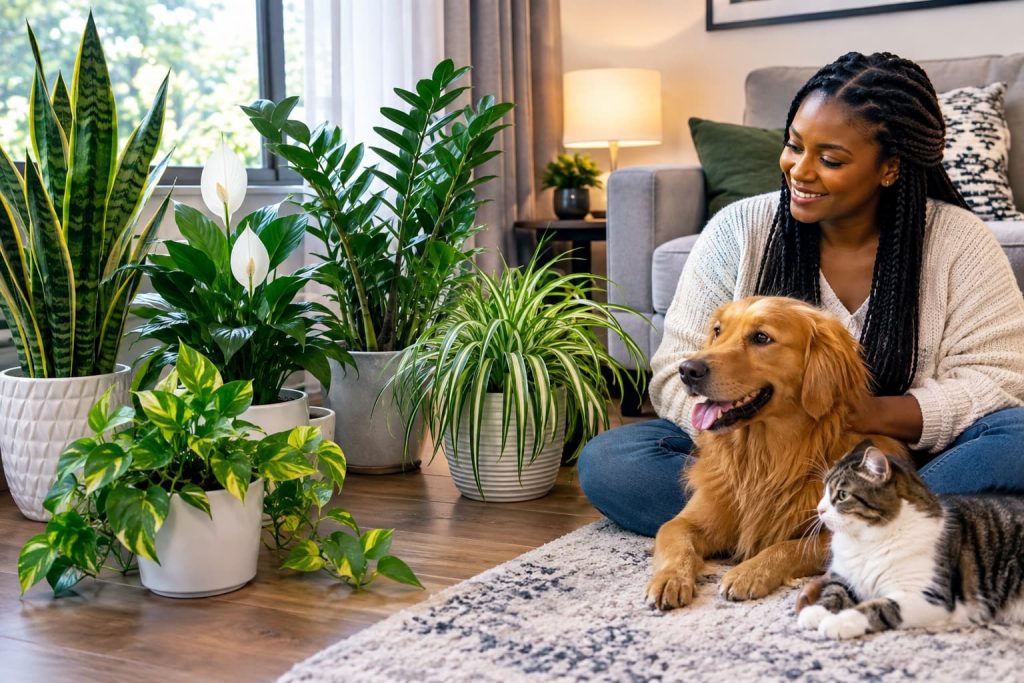
If pet safety is your priority, the cast iron plant is a particularly useful option because ASPCA lists it as non-toxic to dogs and cats.
For a broader selection, see our guide to 12 Pet-Friendly Indoor Plants Safe for Cats and Dogs.
Common Mistakes With Low-Light Houseplants
Even the best air purifying plants for low light can struggle when basic care mistakes are overlooked. Low-light plants are often considered easy to maintain, but too little light, excessive watering, poor drainage, and unsuitable placement can still lead to weak growth and other problems. Avoiding these common mistakes will help your plants stay healthier and adapt better to indoor conditions.
Mistake 1: Assuming Low Light Means No Light
No houseplant can thrive indefinitely without sufficient light.
Mistake 2: Watering on a Fixed Schedule
“Water every Sunday” sounds simple, but indoor conditions change. Check the plant and potting mix instead.
Mistake 3: Choosing Highly Variegated Plants for the Darkest Corner
Variegated leaves contain less chlorophyll in their lighter areas. Many highly variegated cultivars therefore perform better with stronger indirect light than their darker-green relatives.
Mistake 4: Expecting Fast Growth in Deep Shade
A plant can survive low light while producing very little new growth. That is normal physiological behavior rather than necessarily a sign of disease.
Mistake 5: Treating Plants as Air Purifiers
Plants are not substitutes for ventilation, source control or appropriate mechanical filtration. The evidence does not support treating ordinary houseplants as a primary indoor air-cleaning system.
FAQs About Air Purifying Plants for Low Light
1. Can I keep low-light plants in a room with no windows?
Not indefinitely without supplemental lighting. Plants require usable light for photosynthesis, so a genuinely windowless room will generally need an appropriate grow light.
2. Do low-light plants need less fertilizer?
Not necessarily, but plants growing slowly under lower light generally have lower nutrient demand than actively growing plants in brighter conditions. Avoid compensating for poor light by heavily fertilizing the plant.
3. Can low-light plants help with unpleasant cooking odors?
They should not be relied upon for odor removal. Persistent cooking odors are better addressed by source control, ventilation and suitable filtration.
4. Are artificial plants a better option for completely dark rooms?
Yes, if there is genuinely no practical way to provide enough light. An artificial plant will not grow, but it also will not decline because of insufficient illumination.
5. Can I use an ordinary LED bulb as a grow light?
Some ordinary LEDs can provide useful light, but a household bulb is not automatically suitable for plant growth. A grow light designed for horticultural use makes the more predictable choice.
6. Why does my low-light plant have brown leaf tips?
Brown tips can have several causes, including inconsistent watering, low humidity, salt accumulation, excessive fertilizer or environmental stress. The exact cause depends on the species and growing conditions.
7. Should I move a low-light plant outdoors occasionally?
Not without considering the transition. Sudden exposure to strong outdoor sunlight can scorch foliage that has adapted to indoor conditions. Any outdoor transition should be gradual and matched to the plant’s tolerance.
8. Can low-light plants grow in air-conditioned rooms?
Many can, provided they are protected from strong, continuous drafts and the temperature remains suitable for the species. Air conditioning can also make some interiors drier, which may affect humidity-sensitive plants.
9. Is a grow light necessary for variegated plants?
Not always. It depends on the cultivar and the amount of natural light available. However, many variegated plants maintain stronger growth and coloration with brighter indirect light.
10. Can I grow these plants in water instead of soil?
Some species can be propagated or maintained in water for periods of time, but long-term water culture has different nutritional and root-oxygen requirements from ordinary soil-based growing. Do not assume every houseplant will thrive indefinitely in plain water.
11. Can too many plants make indoor air worse?
Plants themselves are not generally the issue, but consistently overwatering them can keep potting media excessively wet. The EPA notes that overly damp soil may encourage microorganisms that can affect sensitive individuals.
Conclusion
The best air purifying plants for low light are not necessarily the plants with the strongest marketing claims. A better choice is one that matches your actual room conditions, watering habits, available daylight, and household safety needs.
For an easy starting point, snake plant, ZZ plant, and cast iron plant are particularly strong choices for lower-light interiors. If you prefer trailing foliage, consider pothos or heartleaf philodendron. For a softer tropical appearance, parlor palm can work well where there is sufficient filtered daylight.
It is also important to remember that houseplants should complement, rather than replace, proper ventilation and appropriate air filtration. For reliable guidance on selecting and caring for indoor plants, the Oregon State University Extension Service provides science-based gardening information and practical resources.
Ultimately, choose a plant you can realistically care for, give it the best light available, and adjust your watering routine as indoor conditions change. With the right plant and proper care, even a dim room can become a greener, more inviting space.

I’m Bon (aka Guider), an indoor gardening writer and houseplant enthusiast passionate about helping beginners successfully grow and care for indoor plants. I create practical, beginner-friendly guides covering indoor plant care, watering, lighting, soil, repotting, plant problems, and choosing suitable houseplants for different homes. My articles draw on research from trusted horticultural organizations, university extension resources, and botanical institutions, combined with practical plant-care principles and careful content review.