
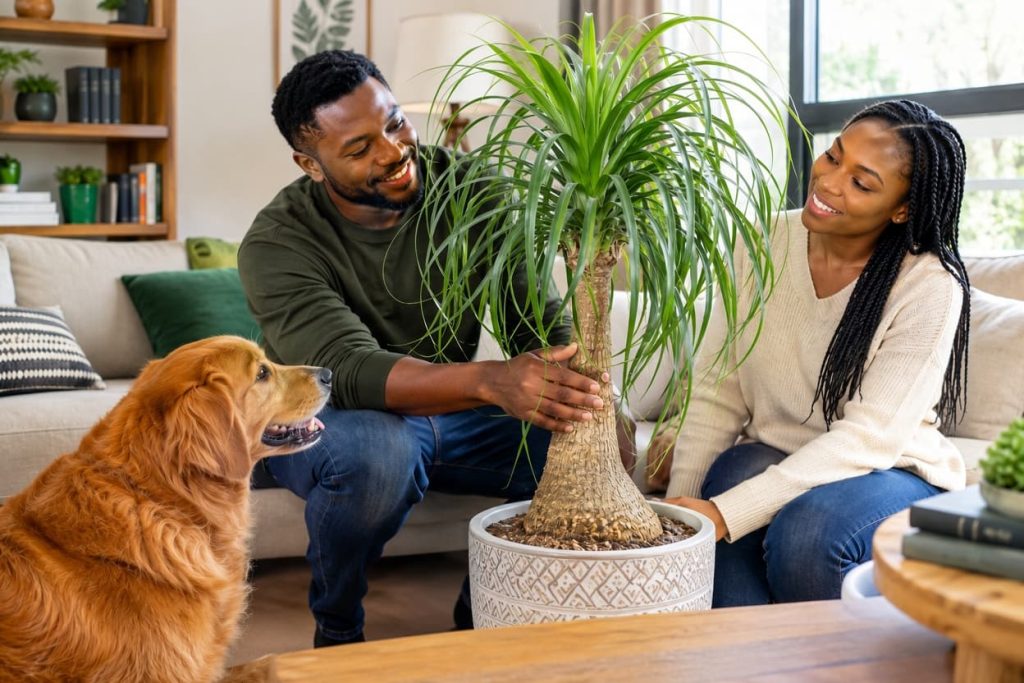
The ponytail palm is one of those indoor plants that looks dramatic and unusual without demanding constant attention. With its swollen, bottle-like base, narrow cascading leaves, and sculptural shape, it can add a striking touch to living rooms, offices, and other bright indoor spaces. With the right ponytail palm care, this hardy houseplant can stay healthy, attractive, and thriving for years, even with a relatively simple care routine.
Despite its common name, however, the ponytail palm is not a true palm. Its botanical name is Beaucarnea recurvata, and it is a drought-tolerant plant with a swollen stem base, called a caudex, that stores water. This adaptation is one of the most important things to understand when learning how to care for a ponytail palm: the plant is generally much more tolerant of temporary dryness than constantly wet soil.
The biggest mistake most people make with ponytail palm care is treating it like a typical thirsty tropical houseplant.
It is not.
A healthy ponytail palm needs bright light, excellent drainage, and a watering routine that allows the growing medium to dry appropriately between waterings. Get those fundamentals right, and this slow-growing plant can be a relatively low-maintenance addition to your indoor garden.
Ponytail Palm Care at a Glance
| Care Factor | What the Plant Generally Needs |
| Botanical name | Beaucarnea recurvata |
| Native origin | Eastern Mexico, particularly the states of Veracruz, San Luis Potosí, Tamaulipas, and Hidalgo |
| Common name | Ponytail Palm, Elephant Foot Tree, Elephant’s Foot, Bottle Palm |
| Plant type | Evergreen, drought-tolerant succulent-like caudiciform plant; commonly grown as an indoor houseplant |
| Light | Bright light; a sunny window is generally suitable |
| Watering | Water thoroughly, then allow the soil to dry before watering again |
| Soil | Fast-draining, well-aerated potting mix |
| Pot | A container with drainage holes |
| Humidity | Average indoor humidity is generally adequate |
| Growth rate | Slow |
| Major risk | Overwatering and poor drainage |
| Common indoor pests | Spider mites, mealybugs, and scale |
| Pet safety | Listed by the ASPCA as non-toxic to cats and dogs |
The exact care routine will vary with your light level, temperature, pot size, soil mix, and season. The goal is not to follow a rigid calendar. The goal is to understand what conditions the plant prefers and adjust your care accordingly.
What Is a Ponytail Palm?
The ponytail palm is native to dry regions of southeastern Mexico and nearby parts of Central America. It is commonly grown as a houseplant because of its unusual appearance and tolerance for relatively dry indoor conditions.
The plant’s most recognizable feature is its enlarged lower stem. This swollen base acts as a water-storage structure. Above it grows a trunk-like stem topped with long, narrow leaves that arch and cascade downward, creating the “ponytail” appearance.
This structure explains much of the plant’s care:
• It can tolerate periods of dryness.
• It is vulnerable to persistently wet conditions.
• It benefits from a fast-draining growing medium.
• Overwatering is generally a greater danger than occasional underwatering.
Ponytail palms are also slow-growing. A small indoor plant may remain compact for a long time, while older plants can gradually become impressive specimens. In containers, their growth is typically much more restricted than plants growing in suitable outdoor conditions.
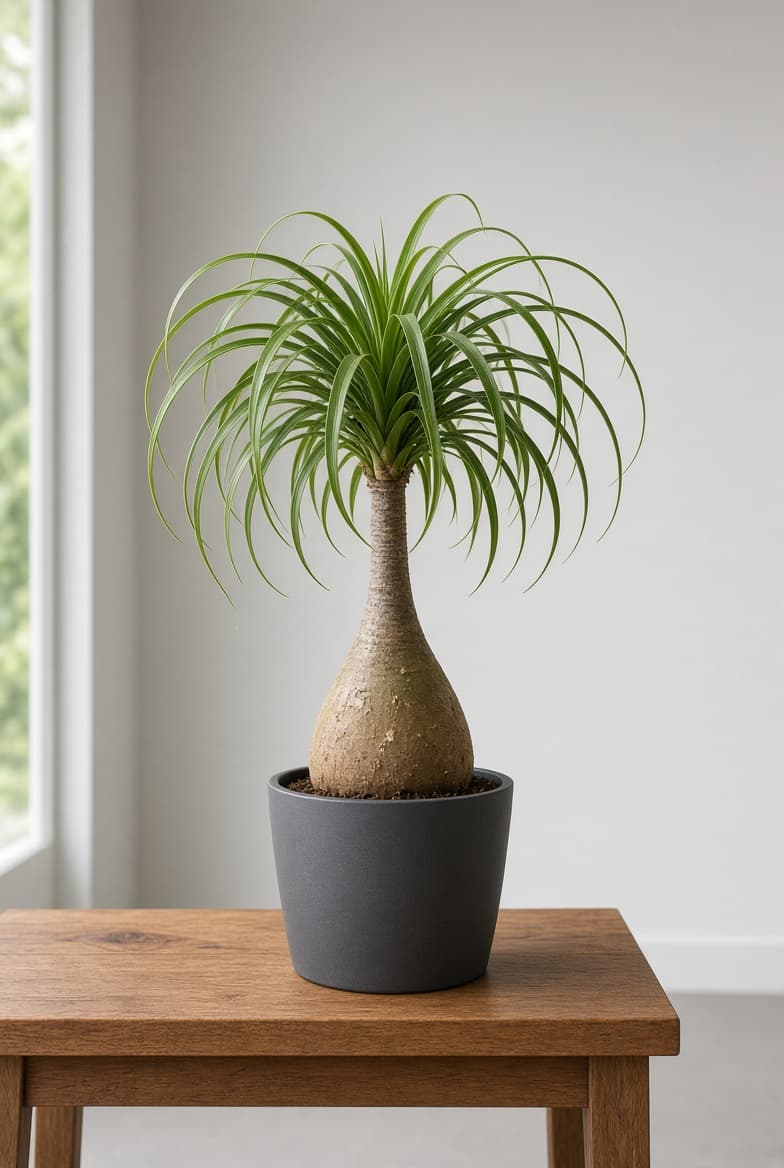
Is a Ponytail Palm Really a Palm?
No. The name can be misleading.
The ponytail palm has a palm-like appearance, but botanical references classify Beaucarnea recurvata separately from true palms. It belongs to the asparagus family, Asparagaceae, according to current references such as University of Florida IFAS Extension (Gardening Solutions) and North Carolina State Extension.
This matters because treating the plant according to its appearance rather than its biology can lead to poor care decisions.
For example, a beginner may see long leaves and assume the plant needs consistently moist soil. Its drought-adapted structure suggests the opposite approach: avoid keeping the root zone continuously wet.
Ponytail Palm Light Requirements
Light is one of the most important factors in successful ponytail palm care.
Ponytail palms generally perform best with bright light and can tolerate strong light conditions. Extension and botanical references commonly recommend a sunny window or well-lit conditions for houseplants, while outdoor plants can grow in full sun to partial shade.
The Best Indoor Location
A bright location near a sunny window is usually a good starting point.
Suitable locations may include:
• Near a bright south-facing or west-facing window where climate and window orientation make this practical
• Near an east-facing window with strong morning light
• A very bright room with several hours of useful daylight
The exact placement depends on the intensity of sunlight in your home.
Practical rule
Do not simply place the plant in a room described as “bright.”
Look at where the actual usable light falls.
A large room may appear bright to your eyes while the corner where the plant sits receives relatively little direct or strong indirect light.
If your ponytail palm is placed several metres away from a window, it may receive far less light than expected.
Can a Ponytail Palm Survive in Low Light?
It may tolerate less-than-ideal light for a period, but low light is not the condition to aim for.
Insufficient light can contribute to weaker growth and may make it harder for the soil to dry at an appropriate rate. When a plant receives less light, its growth and water use may slow, which means a watering schedule that was safe in a brighter location may become excessive.
This is an important principle for indoor plant care:
Light and watering are connected.
More active growth and brighter conditions generally increase water use. Lower light usually means slower drying and a greater risk of keeping the roots too wet.
For readers building a collection of plants for darker rooms, see 21 Best Low Light Indoor Plants for Beginners (Easy to Grow) rather than assuming a ponytail palm is an ideal low-light plant.
Ponytail Palm Watering: How Often Should You Water It?
There is no single watering schedule that works perfectly for every ponytail palm.
The safest approach is to check the condition of the potting mix before watering.
Ponytail palms tolerate drought well and require excellent drainage. NC State Extension recommends allowing the growing medium to dry between waterings, while UF/IFAS warns that poorly drained conditions can contribute to root rot.
The Basic Watering Method
Step 1: Check the soil
Before watering, check whether the potting mix has dried sufficiently.
You can do this by:
• Inserting a finger into the upper portion of the soil
• Using a wooden stick to check for moisture deeper in the pot
• Lifting the pot to compare its weight with how it feels after watering
• Using a moisture meter as an additional guide, not as your only source of information
Step 2: Water thoroughly
When the plant needs water, apply water evenly until excess begins to drain through the drainage holes.
Step 3: Allow excess water to drain
Do not allow the pot to sit for long periods in standing water.
Step 4: Wait before watering again
Allow the growing medium to dry before the next watering.
This approach is generally safer than giving the plant small amounts of water every few days.
Why Frequent Small Waterings Can Be a Problem
Small, frequent watering can create an uneven moisture pattern.
The surface may appear dry while deeper areas remain wet. If you respond only to the appearance of the topsoil, you may keep adding water to a root zone that has not yet dried adequately.
This is one reason many indoor plant problems develop gradually.
The plant does not necessarily fail immediately. Instead, the roots remain in consistently wet conditions over time, increasing the risk of root problems.
How Often Should You Water a Ponytail Palm?
Instead of following a fixed instruction such as “water every seven days,” use the following decision process:
Water sooner when:
• The plant is receiving stronger light.
• Temperatures are warmer.
• The plant is actively growing.
• The pot is relatively small.
• The growing mix dries quickly.
Water less often when:
• Light levels are lower.
• Temperatures are cooler.
• Growth has slowed.
• The pot is large relative to the plant.
• The soil remains damp for a long time.
A watering schedule is therefore a result, not a rule.
Your plant’s environment determines how quickly the soil dries.
For practical guidance on checking soil moisture and avoiding common watering mistakes, see How to Water Indoor Plants Properly: Complete Beginner’s Guide.
The Best Soil for Ponytail Palm
A ponytail palm needs a potting medium that drains well.
UF/IFAS notes that the plant can develop root rot in poorly drained soils, while NC State Extension specifically recommends well-drained soil such as mixes used for cacti and succulents.
What a Good Ponytail Palm Soil Mix Should Do
The ideal mix should:
• Allow excess water to drain readily
• Avoid remaining soggy for extended periods
• Provide enough aeration around the roots
• Still retain enough moisture for normal root function
A commercial cactus or succulent potting mix may be a practical starting point.
However, not all products labelled “cactus mix” behave the same way. Some remain surprisingly moisture-retentive depending on their ingredients and your growing conditions.
The real test is how the mix performs in your environment.
If water drains poorly or the pot remains wet for an unusually long time, consider whether the soil is too dense, the pot is too large, drainage is inadequate, or the plant is receiving insufficient light.
For a detailed explanation of potting media and drainage, see Best Soil for Indoor Plants: How to Choose the Right Potting Mix.
Avoid Heavy, Compact Soil
Dense garden soil is generally unsuitable for an indoor ponytail palm in a container.
It can compact, restrict airflow, and remain wet for too long.
The objective is not simply to find “nutrient-rich soil.” For this plant, drainage and root-zone aeration are equally important considerations.
Choosing the Right Pot for a Ponytail Palm
A suitable pot should have at least one functional drainage hole.
This is essential because even an excellent soil mix cannot perform properly if excess water has nowhere to escape.
Avoid Oversized Pots
A common beginner mistake is moving a small plant into a very large container.
The reasoning often sounds sensible:
“The plant will eventually grow, so I will give it plenty of room now.”
The problem is that a large volume of unused soil can remain wet for a long time after watering.
For a drought-tolerant plant such as a ponytail palm, that may create unnecessary moisture around a relatively small root system.
Choose a pot that is appropriate for the existing root system rather than dramatically increasing container size.
For step-by-step guidance on safely changing containers, see How to Repot Indoor Plants Without Damaging the Roots (Step-by-Step Guide).
Temperature and Humidity for Ponytail Palms
Ponytail palms generally adapt well to typical indoor temperatures.
Their natural adaptation to dry environments also means they do not require unusually high indoor humidity.
NC State Extension notes that the plant can tolerate dry winter conditions and indoor heated air that can be challenging for many moisture-loving houseplants.
Avoid Sudden Environmental Changes
While ponytail palms are hardy plants, abrupt changes can still cause stress.
Examples include:
• Moving the plant suddenly from low light to intense outdoor sun
• Placing it directly beside strong air-conditioning output
• Keeping it near persistent cold drafts
• Moving it outdoors without allowing time to adapt
Cornell University College of Agriculture and Life Sciences and Missouri Botanical Garden recommend gradually adjusting plants when moving them from indoor conditions to stronger outdoor light.
Practical Indoor Placement
Avoid placing the plant where it will experience:
• Repeated cold drafts
• Constant blasts of hot or cold air
• Very dark conditions
• Frequent relocation without reason
Once you find a suitable location, consistency is usually better than repeatedly moving the plant around your home.
How to Fertilize a Ponytail Palm
Ponytail palms are slow-growing, so they generally do not need aggressive fertilization.
The goal is to support healthy growth, not force rapid growth.
A practical approach is to fertilize lightly during periods of active growth using an appropriate balanced houseplant fertilizer according to the product’s instructions.
Avoid assuming that more fertilizer will produce a healthier or faster-growing plant.
Excess fertilizer can accumulate in potting media and may contribute to root stress or leaf-tip problems.
A Better Fertilizing Principle
Think of fertilizer as a supplement, not a cure.
Do not fertilize a struggling plant automatically.
First investigate:
• Is the plant receiving enough light?
• Is the soil staying wet too long?
• Is there evidence of pests?
• Has the plant been recently repotted?
• Is the root system healthy?
A nutrient problem is only one possible explanation for poor growth.
For a step-by-step guide to fertilizing indoor plants the right way, including fertilizer timing, proper dilution, application, and common mistakes, read How to Fertilize Indoor Plants the Right Way (Step-by-Step Guide).
How Fast Does a Ponytail Palm Grow?
Ponytail palms are slow-growing plants.
This can be an advantage for indoor gardeners because the plant is unlikely to outgrow its space quickly. UF/IFAS and NC State Extension both describe ponytail palm as slow-growing.
However, slow growth should not automatically be interpreted as a problem.
A healthy ponytail palm may still show modest growth rather than producing dramatic changes every month.
When Slow Growth Is Normal
Slow growth may be perfectly normal when:
• The plant is mature.
• The growing season is less active.
• Light is adequate but not extremely intense.
• The plant is maintaining a compact form.
When Slow Growth May Indicate a Problem
Investigate further if slow growth is accompanied by:
• Yellowing leaves
• Softening of the base
• Persistent soil moisture
• Leaf decline
• Severe pest infestation
• Very poor light
The difference between “naturally slow-growing” and “struggling” is the overall condition of the plant.
How to Repot a Ponytail Palm
Repotting should usually be done when there is a genuine reason rather than on an automatic annual schedule.
Possible reasons include:
• The plant has clearly outgrown its current container.
• Roots are heavily crowded.
• The potting mix has deteriorated.
• Drainage problems cannot be corrected without replacing the growing medium.
• The container has become unstable.
Repotting your plant doesn’t have to be difficult. Follow these simple steps to safely move your plant into a new pot, refresh its soil, and give its roots more room to grow.
1. Choose a pot with drainage: Select a container with drainage holes that is only moderately larger than the plant’s current root system.
2. Prepare fresh soil: Choose a well-draining potting mix that provides the nutrients and growing conditions your plant needs.
3. Remove the plant gently: Carefully slide the plant out of its old pot while supporting the stem and root ball to avoid damaging the roots.
4. Inspect the roots: Check the root system for damaged, dead, or rotten roots and trim them carefully with clean, sharp scissors.
5. Add fresh soil: Place a thin layer of fresh potting mix in the new pot, keeping the plant at the same depth as it was previously growing.
6. Fill around the roots: Add fresh soil around the root ball, gently filling the gaps without packing the soil too tightly.
7. Water thoroughly: Water the newly repotted plant until excess water flows freely through the drainage holes.
8. Allow the plant to adjust: Place the repotted plant in a suitable location and give it time to recover before fertilizing
Ponytail Palm Problems and How to Fix Them
Most ponytail palm problems are related to watering, light, environmental conditions, pests, or the natural aging of older leaves. Instead of treating every change in leaf color or texture the same way, look at the plant’s overall condition and the pattern of symptoms.
1. Brown Leaf Tips
Brown tips can develop for several reasons, including:
• Previous moisture stress
• Salt buildup from fertilizer or water
• Mechanical damage
• Environmental stress
• Natural aging of older foliage
Brown tips do not automatically mean your ponytail palm needs more water. Check the soil first and determine whether it is dry throughout the root zone or still holding moisture deeper in the pot.
If only the tips are affected and the rest of the plant looks healthy, the damage may be cosmetic. You can trim the brown portions carefully for appearance, but avoid cutting into healthy green tissue. Missouri Botanical Garden notes that brown leaf tips can be clipped off.
2. Yellow Leaves
Yellow leaves may result from:
• Excess moisture around the roots
• Natural aging
• Root stress
• Pest activity
• Sudden environmental changes
Look at the affected leaves in relation to the rest of the plant. If several leaves are yellowing while the soil remains wet for extended periods, poor drainage or overwatering may be responsible.
On the other hand, if an older leaf gradually turns yellow and declines while newer growth remains healthy, natural aging is more likely.
3. Soft or Rotting Base
A soft, mushy, or persistently wet-looking swollen base is a serious warning sign. Excess moisture and poorly drained soil can contribute to root and stem rot, so this symptom should not be ignored.
What to do:
• Stop watering while you determine the cause.
• Check that the pot has working drainage holes.
• Determine how long the soil stays wet after watering.
• Inspect the roots if rot is suspected.
• Remove severely damaged roots or plant tissue where practical.
• Repot into a fast-draining medium if the existing soil retains too much moisture.
Severe rot can be difficult to reverse, making proper drainage and careful watering essential for prevention.
4. Wrinkled or Shrunken Caudex
A noticeably wrinkled or deflated-looking caudex may indicate that the plant has used a significant amount of its stored moisture.
Check the soil before watering. If it is thoroughly dry and the plant shows other signs of dehydration, give it a thorough watering and allow excess water to drain away.
However, avoid watering automatically. A plant sitting in consistently wet soil can also develop an unhealthy-looking base because damaged roots are unable to function properly. In that situation, investigate the root system before adding more water.
5. Pale or Weak Leaves
Pale or weak-looking foliage may indicate that your ponytail palm is not receiving enough light.
Move it gradually toward a brighter location rather than suddenly placing a plant accustomed to low light in intense outdoor sunlight. Give it time to adjust and evaluate the condition of new growth, since existing leaves may not regain their original appearance.
6. Pests
Ponytail palms are generally easy to maintain, but indoor specimens can still be affected by pests. Missouri Botanical Garden lists spider mites, mealybugs, and scale among pests that can affect houseplants.
Check the foliage and stems regularly for:
• Fine webbing: May indicate spider mites
• White, cotton-like clusters: May indicate mealybugs
• Small, attached bumps: May indicate scale insects
Early detection makes pest problems easier to manage. Inspect your plant regularly, especially when bringing new plants into your home.
For more detailed identification and treatment methods, see 8 Common Indoor Plant Pests and How to Eliminate Them.
Common Ponytail Palm Care Mistakes
Even though the ponytail palm is considered a low-maintenance houseplant, a few common care mistakes can lead to weak growth, brown leaves, root problems, or other signs of stress. Avoid these mistakes to keep your plant healthy and attractive.
1. Watering on a Fixed Schedule
Watering every Sunday—or on any other fixed schedule—can easily lead to overwatering. Your plant’s water needs change with light, temperature, season, pot size, and soil conditions.
Instead, check the growing medium before watering. Water thoroughly when the soil has dried sufficiently, then allow excess water to drain away.
2. Keeping the Soil Constantly Moist
Constantly wet soil is one of the most serious ponytail palm care mistakes. This plant stores water in its swollen caudex and is adapted to periods of dryness rather than continuously moist conditions.
Use a well-draining potting mix and allow the soil to dry between waterings. Good drainage is especially important because prolonged moisture can contribute to root and stem rot.
3. Growing It in a Very Dark Corner
A ponytail palm may tolerate less-than-ideal light for a while, but consistently dark conditions can result in weak growth and poor overall appearance.
Place the plant in a bright location where it receives plenty of natural light. If moving it from a dim area to much stronger light, increase exposure gradually to help it adjust.
4. Using a Pot Without Drainage
A decorative container without drainage can trap excess water around the roots, increasing the risk of root problems.
If you prefer a decorative outer pot, keep the ponytail palm in a nursery pot with drainage holes. After watering, allow the excess water to drain completely and empty any water collected in the outer container.
5. Repotting Into an Excessively Large Container
Choosing a pot that is much larger than the existing root system may seem helpful, but it can create problems. The extra soil can hold moisture for longer, even after the roots have absorbed what they need.
When repotting, choose a container only moderately larger than the current root system and make sure it has adequate drainage.
6. Over-Fertilizing to Encourage Faster Growth
Ponytail palms are naturally slow-growing, so adding extra fertilizer will not safely transform them into fast-growing plants.
Too much fertilizer can contribute to salt buildup and may damage the roots. Use a balanced, diluted fertilizer during active growth and follow the product’s recommended application rate.
7. Assuming Every Brown Leaf Tip Means Underwatering
Brown leaf tips can have several causes, including moisture stress, salt buildup, environmental changes, physical damage, or natural aging.
Before changing your watering routine, examine the soil and consider the plant’s overall condition. If the plant is otherwise healthy and only the tips are affected, the damage may be cosmetic rather than a sign of serious dehydration.
8. Ignoring Changes in the Caudex or Root Health
The swollen caudex is one of the ponytail palm’s most important water-storage structures, so major changes in its condition should not be ignored.
A healthy plant should not have a persistently soft or mushy base. If the caudex becomes unusually soft, the soil stays wet for long periods, or the plant begins declining rapidly, check the drainage and investigate the roots for signs of rot.
Catching moisture-related problems early is much easier than trying to recover a plant after severe root or stem damage.
Is the Ponytail Palm Safe for Cats and Dogs?
The http://American Society for the Prevention of Cruelty to Animals (ASPCA) lists Beaucarnea recurvata as non-toxic to cats and dogs.
However, “non-toxic” should not be interpreted as meaning a plant is intended to be eaten.
A pet that repeatedly chews large amounts of any plant material may still experience digestive upset or physical problems.
If you want more plant options selected specifically for homes with animals, see 12 Pet-Friendly Indoor Plants Safe for Cats and Dogs.
Can You Grow a Ponytail Palm Indoors Successfully?
Yes. Ponytail palms are widely grown as houseplants and can adapt well to indoor environments when their fundamental needs are met. Botanical and extension references specifically describe their use as container plants and houseplants.
The most important requirements are straightforward:
• Give the plant plenty of useful light.
• Use a pot with drainage.
• Choose a fast-draining growing medium.
• Avoid keeping the roots constantly wet.
• Water according to soil conditions rather than a rigid calendar.
• Do not expect rapid growth.
• Watch for pests and early signs of rot.
For someone who tends to forget watering occasionally, a ponytail palm may be easier to manage than many moisture-loving houseplants.
However, drought tolerance does not mean neglect-proof.
The plant still needs adequate light, appropriate watering, and a healthy root environment.
Ponytail Palm Care Checklist
Use this checklist as a quick reference.
1. Light
Place in a bright location.
A sunny window can be suitable.
Avoid relying on a very dark corner.
2. Water
Check soil moisture before watering.
Water thoroughly when appropriate.
Allow excess water to drain.
Let the growing medium dry between waterings.
3. Soil
Use a fast-draining potting mix.
Avoid heavy, compact garden soil.
Monitor how quickly the mix dries in your home.
4. Pot
Use drainage holes.
Avoid dramatically oversized containers.
Do not allow the pot to remain in standing water.
5. Maintenance
Inspect periodically for pests.
Remove declining foliage when necessary.
Fertilize lightly rather than aggressively.
Repot only when there is a clear reason.
FAQs for the Ponytail Palm Care
1. How long can a ponytail palm live indoors?
With suitable growing conditions and proper care, ponytail palms can be long-lived plants. Their slow growth means an indoor specimen can remain attractive and manageable for many years.
2. Can a ponytail palm grow new leaves after losing them?
Yes. A healthy ponytail palm can produce new foliage when its growing point and root system remain viable. However, recovery depends on why the leaves were lost and whether the plant has suffered serious damage.
3. Can you cut the top off a ponytail palm?
Yes, ponytail palms can be pruned, and cutting the stem can sometimes encourage branching below the cut. Pruning should be done carefully with a clean, sharp tool because unnecessary cuts can create wounds and alter the plant’s natural form.
4. How do you make a ponytail palm grow multiple trunks?
Multiple trunks can develop through branching, particularly after the main growing point is damaged or pruned. However, branching is not guaranteed, so pruning should not be used with the expectation that every plant will produce multiple trunks.
5. Can a ponytail palm flower indoors?
Mature ponytail palms can produce flowers, but flowering is much more commonly associated with plants growing outdoors under favorable conditions. Indoor plants may rarely flower, particularly when they are young or grown primarily as foliage plants.
6. How tall can a ponytail palm get indoors?
Indoor ponytail palms generally remain much smaller than specimens growing outdoors in suitable climates. Their eventual size depends on the plant’s age, growing conditions, container, and available space.
7. Can you grow a ponytail palm from a cutting?
Propagation from stem cuttings is possible under suitable conditions, but ponytail palms are commonly propagated from seed or offsets. A cutting does not automatically produce a new plant simply because a piece of stem is placed in soil.
8. When is the best time to repot a ponytail palm?
The best time is generally during active growth rather than when the plant is under environmental stress. More importantly, repot when the plant actually needs it rather than following an annual schedule.
9. Can a ponytail palm be grown from seed?
Yes. Ponytail palms can be propagated from seed, although growing a mature specimen from seed requires considerably more time than purchasing an established plant.
10. Why is my ponytail palm leaning to one side?
Leaning can result from uneven light, the plant’s natural growth habit, an unstable container, or an uneven distribution of foliage. If the plant is consistently reaching toward a light source, gradually improving its light exposure may help encourage more balanced growth.
Conclusion
Successful ponytail palm care is less about doing more and more about avoiding the wrong conditions.
The plant’s swollen base and drought-tolerant nature provide an important clue about how it should be grown: it is better adapted to periods of dryness than to constantly wet soil.
Start with three fundamentals:
• Bright, useful light
• Excellent drainage
• Watering based on actual soil conditions
Once those are in place, most other aspects of care become easier.
A ponytail palm does not need daily attention, constant misting, or aggressive feeding. What it needs is a stable environment that respects its natural adaptation to dry, well-drained conditions.
If you’re building a collection of easy-care houseplants, you may also enjoy 11 ZZ Plant Care Secrets to Grow a Healthy and Thriving Indoor Plant, The Complete Beginner’s Guide to Snake Plant Care, and 10+ Expert Cast Iron Plant Care Tips to Keep It Healthy and Thriving for practical advice on growing and maintaining these resilient houseplants.

I’m Bon (aka Guider), an indoor gardening writer and houseplant enthusiast passionate about helping beginners successfully grow and care for indoor plants. I create practical, beginner-friendly guides covering indoor plant care, watering, lighting, soil, repotting, plant problems, and choosing suitable houseplants for different homes. My articles draw on research from trusted horticultural organizations, university extension resources, and botanical institutions, combined with practical plant-care principles and careful content review.



Hello Bon,
I’ve always loved ponytail palms, and this was such a helpful guide! I especially liked the practical tips on watering, light, and keeping the plant healthy indoors. Definitely saving this for reference.
Hi Rita! It’s so lovely to have you stop by and leave such an encouraging comment. Thanks so much for your support—I truly appreciate it! Hope to see you here again soon.