
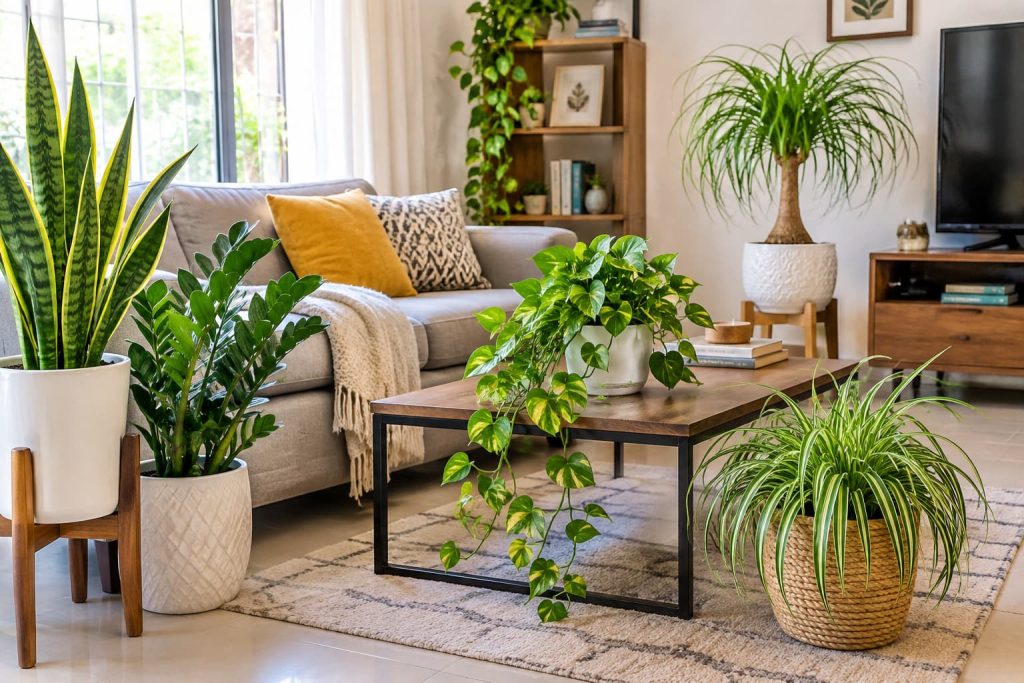
A busy schedule can make plant care difficult, especially when a plant needs frequent watering, constant humidity, regular pruning, or very specific light. The best easy indoor plants are not plants that require no care; they are plants that can tolerate an imperfect routine without quickly declining.
The 15 choices below were selected for their combination of resilience, manageable watering needs, tolerance of ordinary indoor conditions, and relatively low maintenance. Some prefer bright light, while others handle lower-light locations. The important point is to match the plant to the room rather than expecting one “easy” plant to thrive everywhere.
For a complete beginner-friendly guide, explore our Indoor Plant Care for Beginners guide for practical tips on keeping your houseplants healthy and thriving.
What are Easy Indoor Plants?
Easy indoor plants are houseplants that can thrive indoors without complicated care or constant attention. They are generally forgiving of common beginner mistakes and can adapt to everyday indoor conditions, including moderate light, limited space, and occasional missed watering.
The easiest indoor plants typically require less maintenance and can tolerate a wider range of growing conditions than more demanding houseplants. Their care needs still vary, so choosing plants that match your home’s light, temperature, and watering conditions is important. Read the entire article to discover examples of easy indoor plants and learn how to care for them successfully.
What Makes an Indoor Plant Truly Easy to Care For?
“Low maintenance” is not a botanical category. It is a practical description of how forgiving a plant is when grown under ordinary indoor conditions.
A plant may be easy because it:
• tolerates occasional missed watering;
• does not require high humidity;
• remains healthy in a range of indoor light conditions;
• grows slowly enough that frequent pruning is unnecessary;
• rarely needs immediate repotting;
• recovers reasonably well from minor care mistakes;
• does not require daily attention.
Light is particularly important. Missouri Botanical Garden recommends choosing indoor plants according to the actual light available because indoor conditions range from low light to bright, direct exposures. Plants that tolerate shade are not necessarily plants that grow vigorously in darkness.
That distinction matters for busy people. A plant can be forgiving while still needing enough light to remain healthy.
Easy does not mean “no care”
Even the toughest houseplant can fail if it is kept in unsuitable conditions for long enough.
For example, a drought-tolerant plant may tolerate being forgotten for a while but can still suffer if it is repeatedly watered before its soil dries. Likewise, a plant described as low-light tolerant may survive in a dim room but produce weaker or slower growth than it would in better light.
The goal is therefore not to find a plant that needs nothing.
The goal is to choose a plant whose natural requirements fit your routine.
Quick Reference Guide: Which Easy Indoor Plant Fits Your Routine?
| Plant | Botanical Name | Origin | Other Names | Pet Safety |
| Snake Plant | Dracaena trifasciata | Tropical West Africa | Mother-in-law’s tongue | Toxic to cats and dogs |
| ZZ Plant | Zamioculcas zamiifolia | Eastern Africa | Zanzibar gem | Toxic to cats and dogs |
| Pothos | Epipremnum aureum | French Polynesia | Golden pothos, devil’s ivy | Toxic to cats and dogs |
| Cast Iron Plant | Aspidistra elatior | China, Japan | Bar-room plant | Non-toxic to cats and dogs |
| Ponytail Palm | Beaucarnea recurvata | Mexico | Elephant foot tree | Non-toxic to cats and dogs |
| Spider Plant | Chlorophytum comosum | Tropical and southern Africa | Ribbon plant, airplane plant | Non-toxic to cats and dogs |
| Baby Rubber Plant | Peperomia obtusifolia | Tropical Americas | Blunt-leaved peperomia | Generally considered non-toxic |
| Heartleaf Philodendron | Philodendron hederaceum | Tropical Americas | Sweetheart plant | Toxic to cats and dogs |
| Dracaena | Dracaena spp. | Africa, Asia and Australia | Dragon tree | Toxic to cats and dogs |
| Chinese Evergreen | Aglaonema spp. | Tropical and subtropical Asia | Aglaonema | Toxic to cats and dogs |
| Parlor Palm | Chamaedorea elegans | Mexico and Central America | Neanthe bella palm | Non-toxic to cats and dogs |
| Hoya | Hoya spp. | Tropical and subtropical Asia, Pacific regions | Wax plant, wax flower | Species-specific; check exact plant |
| Jade Plant | Crassula ovata | South Africa and Mozambique | Money plant, lucky plant | Toxic to cats and dogs |
| Inch Plant | Tradescantia zebrina | Mexico and Central America | Wandering dude, zebrina | Can cause irritation; avoid pet ingestion |
| Rubber Plant | Ficus elastica | South and Southeast Asia | Rubber tree | Toxic to cats and dogs |
15 Easy Indoor Plants That Suit Busy Schedules
Let’s now explore each of these 15 easy indoor plants in detail and see which one best fits your lifestyle.
1. Snake Plant
If remembering to water is your biggest problem, the snake plant deserves serious consideration.
Snake plants have thick, succulent-like leaves and are remarkably forgiving of irregular watering. Penn State describes them as long-lived and low-maintenance, while Missouri Botanical Garden includes them among its tougher houseplants.
They tolerate a range of indoor light conditions, from relatively low light to brighter indirect light. However, tolerance should not be confused with maximum growth. A plant receiving more suitable light generally grows better than one placed in a very dark corner.
Best for: People who frequently forget watering.
Light requirement: Low to bright indirect light; brighter conditions generally support better growth.
Watering: Allow the potting mix to dry substantially between waterings.
Maintenance level: Very low.
Watch out for: Constantly wet soil. Excess moisture is a more serious concern than occasional dryness.
For a deeper understanding of its care needs, explore our Snake Plant Care: The Complete Beginner’s Guide for practical tips on keeping your plant healthy.
2. ZZ Plant
The ZZ plant is another strong choice for someone whose plant-care routine is inconsistent.
Its underground rhizomes help the plant tolerate periods between waterings, and Missouri Botanical Garden classifies it as a low-maintenance plant capable of growing in shaded conditions.
The glossy foliage also gives it a polished appearance without requiring frequent pruning.
A ZZ plant can live in lower light, but “survives in low light” does not mean it should be placed in a windowless room. Give it the brightest indirect light reasonably available if you want stronger growth.
Best for: Busy offices, bedrooms, hallways with usable ambient light, and people who tend to underwater.
Light requirement: Low to bright indirect light.
Watering: Allow the soil to dry between waterings.
Maintenance level: Very low.
Watch out for: Overwatering and poorly draining containers.
For a complete guide to keeping this low-maintenance plant healthy, see our detailed ZZ plant care guide for indoor plant lovers.
3. Pothos
Pothos combines resilience with rapid, attractive growth. Penn State describes pothos as a versatile, hardy and very easy-to-grow houseplant. It can tolerate lower light for considerable periods, although brighter indirect light is preferable for strong growth and for maintaining variegation in cultivars that have it.
One particularly useful characteristic for busy owners is its response to missed watering. Pothos can temporarily droop when dry and often recovers after watering, while consistently wet soil creates a greater risk of root problems.
Its trailing growth also means you do not have to keep reshaping it constantly. When stems become too long, they can simply be trimmed.
Best for: Shelves, cabinets, plant stands, hanging baskets, and beginners who want visible growth.
Light requirement: Moderate to bright indirect light; tolerates lower light.
Watering: Water when the potting mix has dried.
Maintenance level: Low.
Watch out for: Overwatering and loss of variegation in low light.
For more practical tips, explore our Pothos Plant Care guide, featuring 13 simple secrets for achieving fuller, healthier growth indoors.
4. Cast Iron Plant
Few names describe a plant’s reputation better than “cast iron plant.”
It is valued for its ability to tolerate relatively low light and less-than-perfect indoor conditions. Missouri Botanical Garden lists Aspidistra elatior among plants suitable for part shade to full shade, while its houseplant guidance identifies it as a low-light option.
It is also relatively slow growing. That can be an advantage for busy owners because the plant does not demand frequent pruning or reshaping.
Best for: Dimmer rooms, offices, and people who prefer plants that grow at a manageable pace.
Light requirement: Low to moderate indirect light.
Watering: Keep the soil moderately moist but avoid keeping it constantly saturated.
Maintenance level: Very low.
Watch out for: Excessive watering and sudden exposure to strong sunlight.
For more practical advice on keeping this hardy houseplant healthy, explore our detailed Cast Iron Plant Care guide with 11 expert tips.
5. Ponytail Palm
Despite its common name, the ponytail palm is not a true palm. It is a drought-adapted plant with a swollen base that stores water.
That adaptation makes it particularly useful for people who occasionally forget to water. Missouri Botanical Garden specifically highlights the plant’s water-storing base and its ability to tolerate missed watering.
The trade-off is light. Ponytail palms prefer bright conditions and are not among the best choices for dark rooms.
Best for: Sunny windows, bright rooms, and people who tend to underwater.
Light requirement: Bright light, including some direct sun when acclimated.
Watering: Allow the soil to dry between thorough waterings.
Maintenance level: Low.
Watch out for: Dark locations and chronically wet soil.
For more detailed care guidance, explore our Ponytail Palm Care guide for practical tips on growing and maintaining a healthy indoor ponytail palm.
6. Spider Plant
Spider plants are particularly useful when you want something forgiving that also produces an attractive, full display.
They form arching foliage and can produce small plantlets on long stems, giving the plant a naturally cascading appearance.
Spider plants generally prefer bright to moderate indirect light, although they can adapt to somewhat lower-light conditions. Their care requirements are straightforward, making them a practical option for beginners.
Best for: Bedrooms, shelves, hanging baskets, and homes where a fuller plant is preferred.
Light requirement: Bright to moderate indirect light.
Watering: Water when the upper portion of the potting mix has dried.
Maintenance level: Low.
Watch out for: Severe dryness, which can cause brown leaf tips, and prolonged waterlogging.
7. Baby Rubber Plant
Peperomias are an excellent choice for someone who wants a compact plant without committing to a fast-growing vine.
The baby rubber plant has thick leaves that hold some moisture, and its compact growth makes it suitable for desks, shelves, and small spaces.
Peperomias generally prefer medium to bright indirect light and a loose, well-draining growing medium. They should not be treated like plants that require constantly wet soil.
The University of Minnesota Extension describes peperomia as a compact, slow-growing houseplant with thick leaves and good tolerance of lower light, recommending that the soil dry somewhat between waterings.
Best for: Desks, shelves, apartments, and people who want a small plant.
Light requirement: Medium to bright indirect light.
Watering: Let the upper layer of soil dry before watering again.
Maintenance level: Low.
Watch out for: Heavy, poorly drained soil and excessive watering.
8. Heartleaf Philodendron
Heartleaf philodendron is a forgiving trailing plant that works especially well when you want foliage without demanding daily attention.
It is adaptable to indoor conditions and can tolerate relatively low light, although brighter indirect light generally produces better growth.
Its trailing stems can be allowed to cascade or trimmed when they become too long. That makes it useful for shelves and hanging containers.
Best for: Beginners who want a trailing plant.
Light requirement: Low to bright indirect light.
Watering: Allow the surface of the growing medium to dry before watering again.
Maintenance level: Low.
Watch out for: Saturated soil and very dark locations.
9. Dracaena
Dracaenas are useful when you want a taller, architectural plant without choosing something that demands intensive care.
Common indoor dracaenas can tolerate indoor light conditions that would be unsuitable for many flowering houseplants. Missouri Botanical Garden includes dracaenas among plants that perform in low-light indoor environments.
Their upright growth also means they generally require less shaping than trailing plants.
Best for: Living rooms, offices, corners, and people who want vertical growth.
Light requirement: Low to bright indirect light, depending on species and cultivar.
Watering: Allow the growing medium to dry somewhat between waterings.
Maintenance level: Low.
Watch out for: Excess water and sudden environmental changes.
Because “dracaena” covers many species and cultivars, check the exact plant label before buying.
10. Rubber Plant
Rubber plants are a good choice for someone who wants a substantial foliage plant but does not want a particularly delicate specimen.
They generally prefer bright, indirect light and can become quite large over time. Their thick leaves also give them a sturdy appearance compared with many soft-leaved tropical houseplants.
The main consideration is that a rubber plant is less forgiving of poor light than snake plants or ZZ plants. It belongs on this list because its routine care is relatively manageable when its basic light needs are met.
Best for: Bright rooms where a larger statement plant is wanted.
Light requirement: Bright indirect light.
Watering: Water when the upper portion of the soil has dried.
Maintenance level: Low to moderate as the plant becomes larger.
Watch out for: Dark rooms, excessive watering, and insufficient space.
This is an example of why “easy” should never be interpreted as “suitable for every room.”
11. Chinese Evergreen
Chinese evergreen is one of the more useful choices when low light is a major consideration.
According to the Missouri Botanical Garden, Chinese evergreen can grow successfully in low-light indoor conditions.
Different cultivars have different foliage colors and patterns. In general, plants with more pronounced variegation often benefit from brighter indirect light than darker green forms.
Chinese evergreen also gives beginners an attractive upright plant without requiring the bright sunlight demanded by many succulents.
Best for: Lower-light rooms and people who want decorative foliage.
Light requirement: Low to bright indirect light, depending on cultivar.
Watering: Allow some drying between waterings.
Maintenance level: Low.
Watch out for: Constantly wet soil and extremely dark locations.
12. Parlor Palm
Parlor palm is a practical choice if you want a softer, more tropical appearance without choosing one of the fussier palms.
It is relatively adaptable to indoor conditions and can tolerate lower light better than many sun-loving palms.
Its slower growth also reduces the need for frequent pruning.
Best for: Living rooms, bedrooms, offices, and shaded interiors.
Light requirement: Moderate to low indirect light.
Watering: Keep the growing medium lightly and evenly moist, allowing some drying rather than keeping it saturated.
Maintenance level: Low to moderate.
Watch out for: Extremely dry conditions, very poor light, and excessive watering.
Because palms can develop pest problems under stressful indoor conditions, keeping the plant reasonably healthy is still important. University of Minnesota Extension notes that houseplants experiencing unsuitable light, moisture, or temperature conditions can be more vulnerable to pests.
13. Hoya
Hoya is an excellent candidate for someone who wants a trailing or climbing plant but does not want a plant that requires frequent watering.
Its thick, somewhat succulent foliage allows it to cope with periods of drying better than many thin-leaved tropical plants.
However, hoyas should not be placed in a dark corner simply because they are considered easy. Good light is important for strong growth and flowering.
Best for: Bright windows, hanging baskets, and patient beginners.
Light requirement: Bright indirect light; some gentle direct light may be suitable depending on conditions and acclimation.
Watering: Allow the growing medium to dry partly between waterings.
Maintenance level: Low.
Watch out for: Overwatering and insufficient light.
Hoya is a good example of an “easy” plant whose biggest challenge is often not neglect but providing the right balance between light and watering.
14. Jade Plant
Jade plant is another option for people who naturally tend to underwater rather than overwater.
Its fleshy leaves and stems store water, so it does not need the frequent watering associated with many soft-leaved tropical houseplants.
The major requirement is light. Jade plants need a bright location, and insufficient light can lead to weak, stretched growth.
Best for: Bright windows and people who prefer drought-tolerant plants.
Light requirement: Bright light, with some direct sun when properly acclimated.
Watering: Allow the potting mix to dry well between waterings.
Maintenance level: Low.
Watch out for: Low light and frequent watering.
If your home has mostly dim rooms, choose a snake plant or ZZ plant instead.
15. Inch Plant
Inch plant is a fast-growing trailing plant with striped foliage and a strong ability to produce new growth from cuttings.
Missouri Botanical Garden describes Tradescantia zebrina as easy to grow and suitable for pots, hanging baskets, and shelves.
Its main drawback for a busy person is also one of its attractions: it grows quickly. You may not need constant care, but you may eventually need to trim long or sparse stems to keep the plant looking full.
Best for: Hanging baskets, shelves, and anyone who wants fast visual growth.
Light requirement: Bright indirect light is preferable.
Watering: Water when the surface begins to dry.
Maintenance level: Low, but pruning may be needed more often than with slow-growing plants.
Watch out for: Leggy growth when light is insufficient and root or stem rot when soil remains too wet.
Note: “Low light” means a plant can tolerate relatively low indoor light; it does not mean the plant can grow well in complete darkness. Missouri Botanical Garden emphasizes matching the plant’s light requirements to the actual location.
How to Choose the Right Easy Indoor Plant for Your Schedule
The best plant for you depends less on how busy you are and more on what kind of neglect is most likely to happen.
1. If you forget to water
Start with:
• Snake plant
• ZZ plant
• Ponytail palm
• Jade plant
• Hoya
These plants generally cope better with periods of drying than plants that require consistently moist growing media.
That does not mean you should intentionally neglect them. It means an occasional missed watering is less likely to cause immediate damage.
2. If your room has limited natural light
Consider:
• Cast iron plant
• ZZ plant
• Snake plant
• Chinese evergreen
• Pothos
• Heartleaf philodendron
Penn State and Missouri Botanical Garden both identify several of these plants as suitable for lower-light indoor environments.
But remember: low light is not no light.
A room with no meaningful natural light may require a suitable grow light if you want a plant to grow rather than merely persist.
3. If you want a plant that stays relatively compact
Choose:
• Baby rubber plant
• Snake plant
• ZZ plant
• Chinese evergreen
4. If space is your primary limitation
If you want a trailing plant
Choose:
• Pothos
• Heartleaf philodendron
• Hoya
• Inch plant
These are especially useful on shelves, cabinets, plant stands, and hanging baskets.
Want to make the most of a small home? Discover 15 Best Indoor Plants for Small Spaces and Apartments that add greenery without taking up valuable room.
The Real Secret to Keeping Easy Houseplants Healthy
Even the most forgiving plant becomes difficult when it is placed in the wrong environment.
A simple rule is:
Choose the plant according to the room first, then build your care routine around the plant.
For example, suppose you have a bright living room but routinely forget to water. A ponytail palm, snake plant, ZZ plant, or jade plant may make more sense than a moisture-loving fern.
Now suppose you have a shaded bedroom and forget to water. A snake plant or ZZ plant is likely to be a more practical choice than a plant that needs consistently moist soil.
This is the principle of right plant, right place. Texas A&M AgriLife Extension identifies light and humidity as two of the most important environmental considerations when choosing houseplants.
7 Habits That Make Plant Care Easier for Busy People
Choosing a forgiving plant is only half the solution. Your setup can also reduce the amount of work required.
1. Group plants with similar needs
Do not put a drought-tolerant snake plant next to a plant that needs consistently moist soil simply because both look attractive together.
Grouping plants with similar requirements makes watering and monitoring easier.
2. Use pots with drainage
A container should allow excess water to escape.
A decorative pot without a drainage hole can become a problem if water accumulates around the roots. UMN Extension specifically recommends houseplant pots with drainage when growing conditions require them.
If you prefer decorative containers, use a suitable nursery pot inside the decorative outer container. For practical guidance on choosing the best container for your plants, explore our guide on How to Choose the Right Pots for Indoor Plants.
3. Stop watering by the calendar
“Every Sunday” sounds convenient, but plants do not use water according to the calendar.
Temperature, light, pot size, soil composition, plant size, and season all affect how quickly a plant dries.
Instead, check the growing medium and respond to its condition.
4. Give each plant enough light
Light is not just about growth speed. Insufficient light can weaken plants and contribute to poor overall condition.
Royal Horticultural Society (RHS) recommends matching a plant’s growing requirements to its environment, including light, humidity, and temperature.
5. Do not compensate for neglect with excessive watering
This is one of the easiest mistakes to make.
If you realize you forgot to water a plant, flooding the pot repeatedly is not necessarily the solution. Excess water can displace air from the growing medium and create conditions that encourage root problems.
A better approach is to assess the soil and water appropriately. For practical guidance on watering your houseplants correctly, explore our complete beginner’s guide on how to water indoor plants and avoiding common mistakes.
6. Inspect plants occasionally
You do not need to spend an hour examining every leaf.
A quick inspection while watering can reveal:
• pests;
• yellowing leaves;
• damaged stems;
• unusually dry soil;
• signs of root problems;
• sudden changes in growth.
American Horticultural Society (AHS) recommends examining houseplants regularly and isolating plants when pests are detected.
7. Buy a healthy plant in the first place
A struggling plant is harder to manage than a healthy one.
When buying an indoor plant, examine the leaves, stems, growing medium, and visible portions of the plant for obvious signs of pests, disease, severe damage, or poor condition.
Penn State similarly recommends starting with a healthy plant and rejecting plants showing signs of pests or disease.
What “Low Maintenance” Does Not Mean
The phrase hard to kill can be useful conversationally, but it can also create unrealistic expectations.
A snake plant can tolerate dry soil, but that does not mean it can tolerate waterlogged roots indefinitely.
A ZZ plant can handle low light, but that does not mean it can grow normally in a dark cupboard.
Pothos can survive periods of dryness, but repeated severe drought can still cause leaf loss and poor growth.
Ponytail palms store water, but they still require adequate light.
Cast iron plants tolerate shade, but they still need an appropriate growing environment.
The difference between a successful indoor garden and a frustrating one is often understanding these limits.
Are Easy Indoor Plants Better for Beginners?
Usually, yes.
Beginners benefit from plants that give them room to learn.
A forgiving plant can make mistakes less costly while you learn how light, watering, potting mix, temperature, and seasonal growth affect indoor plants.
That does not mean difficult plants are bad choices. It simply makes sense to learn basic plant-care principles with species that are less sensitive to occasional errors.
Looking for more easy-care options? Explore 21 Best Indoor Plants That Are Easy to Grow All Year Long and discover beginner-friendly plants that can thrive with simple, consistent care.
Easy Plants Still Need the Right Potting Mix
Plant resilience cannot compensate for a poor root environment.
Most indoor plants benefit from a growing medium that provides both moisture and air around the roots. The exact mixture depends on the plant.
For example, drought-adapted plants such as jade, ponytail palms, snake plants, and ZZ plants generally benefit from a mix that drains efficiently rather than remaining wet for long periods.
Plants with somewhat higher moisture requirements need a different balance.
If you are unsure which growing medium to use, see our guide to the best soil for indoor plants.
What About Fertilizer?
Easy plants still need nutrients.
The important distinction is that low maintenance does not mean “never fertilize.”
A healthy plant growing in a suitable potting mix may require less attention than a heavily flowering plant, but nutrient availability still matters over time, especially as repeated watering removes soluble nutrients from the growing medium.
Avoid the temptation to compensate for slow growth with excessive fertilizer. More fertilizer is not automatically better.
For practical guidance on timing, dilution, and application, see How to Fertilize Indoor Plants the Right Way.
What About Easy Indoor Plants in Low-Light Rooms?
This is where plant selection becomes particularly important.
Low light is one of the most misunderstood terms in indoor gardening.
A plant beside a bright north-facing window is experiencing something very different from a plant several metres away from a window in a room with heavy curtains.
Missouri Botanical Garden recommends assessing light based on intensity, duration, and quality before selecting an indoor plant.
If your home has genuinely dim rooms, start with plants known for better low-light tolerance rather than buying a sun-loving succulent and hoping it adapts.
For more beginner-friendly options, explore our guide to the 21 Best Low Light Indoor Plants for Beginners and find the right plant for your space
What About Busy People Who Have Pets?
Ease of care and pet safety are separate considerations.
Some of the easiest plants on this list are not appropriate for homes where cats or dogs regularly chew foliage.
For example:
• snake plant is toxic to dogs and cats according to ASPCA;
• pothos contains insoluble calcium oxalates;
• ZZ plant also contains insoluble calcium oxalates;
• cast iron plant is listed as non-toxic to dogs and cats;
• spider plant is listed as non-toxic to dogs and cats;
• ponytail palm is listed as non-toxic to dogs and cats;
• several peperomias are listed as non-toxic.
If pets are part of your household, never choose a plant solely because it is easy to care for. Check its toxicity profile as well.
Our guide to pet-friendly indoor plants safe for cats and dogs can help with that decision.
11 FAQs About Easy Indoor Plants
1. Can easy indoor plants live in air-conditioned rooms?
Yes, many can, but avoid placing a plant directly in the path of a strong stream of cold or hot air. Air-conditioning can also change the humidity and drying rate around plants. The important factors are the plant’s temperature tolerance, light, and how quickly its growing medium dries.
2. Can I use artificial light for easy indoor plants?
Yes. A suitable grow light can supplement or replace inadequate natural light for many foliage plants. The light needs to be appropriate for plant growth and positioned according to the manufacturer’s recommendations. This can be particularly useful in rooms with very little natural light.
3. Should I quarantine a new houseplant before placing it beside my other plants?
Quarantining a newly purchased plant is a sensible precaution, especially if you already have a collection. Keep the newcomer separate while you inspect it for insects, webbing, suspicious spots, or other signs of pests or disease. This can reduce the chance of introducing a problem to established plants.
4. Can I grow two different easy houseplants in the same container?
Usually, it is better not to combine unrelated houseplants simply because they look good together. Their roots may have different moisture, light, and growth requirements. Plants with similar needs can sometimes share a container, but separate pots are generally easier to manage.
5. Why do some easy indoor plants become expensive to maintain?
The plant itself may be inexpensive, but maintenance costs can increase if it requires specialty lighting, frequent replacement, large containers, unusual growing media, or repeated pest treatment. A truly practical low-maintenance plant should fit both your care routine and your available growing environment.
6. Do variegated easy-care plants require different care?
Often, yes. Variegated foliage contains areas with less chlorophyll, so some variegated cultivars grow more slowly or require brighter light than their predominantly green counterparts. Always consider the particular cultivar rather than assuming that every form of a species has identical requirements.
7. Can an easy indoor plant become too large for my home?
Absolutely. “Low maintenance” does not mean “small.” Plants such as pothos, dracaena, rubber plants, and some philodendrons can become substantial over time. Check the mature size before buying rather than choosing solely on the appearance of a young nursery plant.
8. Why does a plant sold as low-maintenance sometimes fail quickly after I bring it home?
A change in environment can expose weaknesses that were not obvious at the nursery. Differences in light, temperature, watering, humidity, and potting conditions can all affect a plant. Sudden environmental changes can be stressful, so give newly purchased plants time to adjust while maintaining appropriate conditions.
9. Is a self-watering pot automatically better for easy-care plants?
No. Self-watering systems can be useful for some plants, but they are not universally appropriate. Plants that prefer drying between waterings may remain too wet if a reservoir constantly supplies moisture. The container should match the plant’s root-zone requirements rather than being chosen simply for convenience.
10. Can easy indoor plants survive when I travel for several weeks?
Some can tolerate a longer absence better than others, particularly plants that prefer their soil to dry between waterings. However, the risk depends on the plant, pot size, light, temperature, and length of the trip. Test your setup before relying on it for an extended absence.
11. Are mature houseplants easier to care for than small plants?
Not necessarily. Larger plants can have more established root systems and may tolerate environmental changes well, but they also consume more water and occupy more space. A small, healthy plant that matches your environment may be easier to manage than a large plant that is poorly suited to your home.
Conclusion
The best easy indoor plants are not necessarily the plants with the fewest requirements. They are the plants whose needs fit your home, your available light, and your daily routine.
If you often forget to water, consider forgiving choices such as the snake plant, ZZ plant, ponytail palm, jade plant, or hoya. If your room receives limited natural light, look more closely at the cast iron plant, ZZ plant, snake plant, Chinese evergreen, or pothos. For trailing foliage, pothos, heartleaf philodendron, hoya, and inch plant are practical options.
The key is to start with the room rather than the plant.
Assess how much natural light the space receives, consider how frequently you can realistically provide care, and then choose a plant whose natural preferences match those conditions. This “right plant, right place” approach is more reliable than searching for a houseplant that is supposedly “impossible to kill.”
For additional guidance on houseplant lighting, watering, and choosing plants suited to different indoor conditions, consult trusted horticultural resources such as University of Illinois Extension and Iowa State University Extension and Outreach.
With the right plant in the right location, indoor gardening does not have to become another demanding task on your schedule. Choose wisely, keep the care routine simple, and enjoy the beauty of healthy indoor plants with confidence.

I’m Bon (aka Guider), an indoor gardening writer and houseplant enthusiast passionate about helping beginners successfully grow and care for indoor plants. I create practical, beginner-friendly guides covering indoor plant care, watering, lighting, soil, repotting, plant problems, and choosing suitable houseplants for different homes. My articles draw on research from trusted horticultural organizations, university extension resources, and botanical institutions, combined with practical plant-care principles and careful content review.


Hi Bon,
Feel great to be here, as someone who loves indoor plants but doesn’t always have time for high-maintenance care, I really enjoyed this list. These choices make keeping a green home feel much more manageable. Great tips you have here!
Hi Rita! So lovely to have you stop by and share such an encouraging comment. Thank you for your kind words and support. Hope to see you around again soon!