
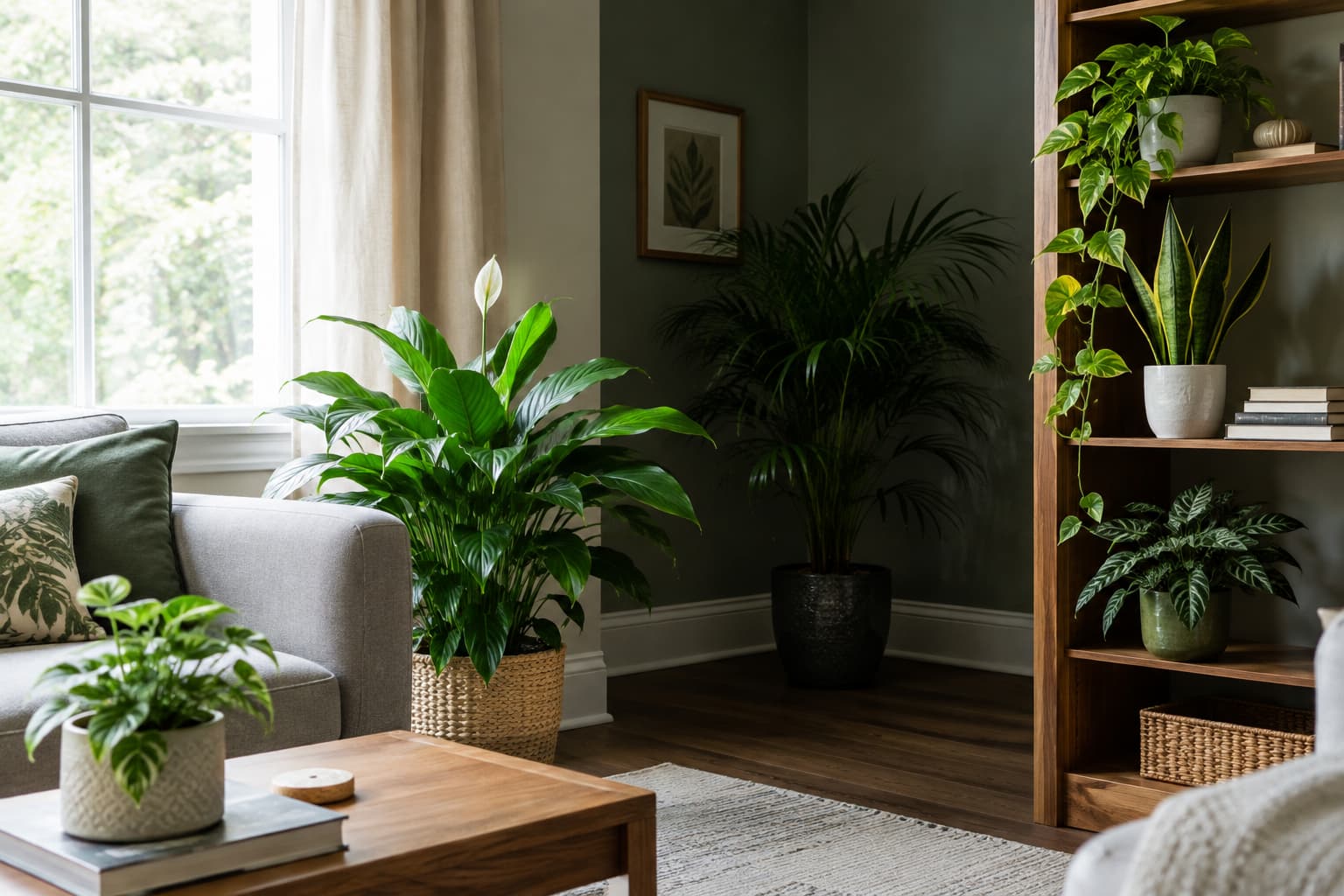
Not every room or office enjoys bright sunlight or sunny windows, but that doesn’t mean you have to miss out on the beauty and benefits of healthy indoor plants. The benefits of low light plants include making it easier to add natural greenery to rooms with filtered daylight, shaded windows, or spaces located several feet from a window. By choosing plants that tolerate lower light conditions, you can create a more practical and attractive indoor garden without needing ideal sunlight throughout your home.
The important distinction is that low light does not mean no light. Plants still need enough light for photosynthesis, and a location that is genuinely dark may require artificial lighting. But when you match a plant to the light already available, you can use parts of the home that would otherwise be difficult to plant successfully.
The benefits go beyond decoration. The right low light plants can give you more flexibility when arranging your home, reduce the temptation to force sun-loving plants into unsuitable locations, and make plant care easier to fit around everyday life.
Explore our guide to indoor plant types to discover popular houseplants, their growing needs, care requirements, and the best choices for different rooms and light conditions too.
What Are Low Light Plants?
Low light plants are indoor plants that can tolerate relatively low levels of natural light compared with plants that require bright direct or bright indirect light.
That does not mean they prefer complete darkness. Every green plant needs light to photosynthesize. A plant may survive in a dim location while growing slowly, becoming less compact, or producing fewer new leaves than it would in better light.
The term “low light” is also relative. A room that looks bright to your eyes may still provide considerably less light than an outdoor environment. Illinois Extension notes that indoor light intensity is much lower than outdoor light and identifies several houseplants that can tolerate low-light conditions.
This is why choosing the right plant for the location matters more than simply choosing a plant described as “shade tolerant.”
Benefits of Low Light Plants
Here are 15 practical benefits to consider, along with the limitations that matter before you choose a plant.
1. Makes dimmer rooms more suitable for indoor gardening
One of the clearest advantages of low light plants is their ability to bring living greenery into spaces where many conventional houseplants would struggle.
A room with a shaded window, a hallway receiving borrowed daylight, or a corner several feet from a window may not be suitable for sun-loving plants. A plant adapted to lower light can give you more options.
That does not turn a dark room into a suitable growing environment. Instead, it expands the range of locations where you can reasonably keep plants.
This distinction is important because moving a bright-light plant into a dim corner simply because the space needs greenery can result in weak growth over time.
2. Gives you more flexibility when arranging your home
Furniture placement often determines where a plant can go.
A sunny window may already be occupied by a desk, sofa, television, curtain, or other household item. You may not want every plant competing for the same bright location.
Low light plants give you greater flexibility because some can be positioned farther from windows than plants with demanding light requirements.
You can therefore distribute greenery throughout a room instead of concentrating every pot around one bright window.
The best placement still depends on the individual plant. A low-light-tolerant plant should not automatically be placed in the darkest corner available.
3. Helps you use awkward indoor spaces perfectly
Some areas are difficult to decorate with living plants because they receive inconsistent or limited daylight.
Think about:
• A hallway near a window
• A shaded sitting-room corner
• A home office away from the main window
• A bedroom with filtered daylight
• A landing or stair area receiving borrowed light
• A room partly shaded by curtains or nearby buildings
These spaces can benefit from plants selected specifically for their light conditions.
The plant should be treated as part of the room’s environmental conditions, rather than as an ornament that can be placed anywhere.
If you have limited room, explore our guide to Indoor Plants for Small Spaces for practical ideas on choosing plants that fit comfortably in apartments and compact homes.
4. Makes indoor plant ownership more practical for beginners
New plant owners often make the mistake of choosing a plant they like visually without considering whether their home can provide the required light.
That mismatch can create problems before watering, feeding, or repotting even becomes relevant.
Choosing a plant whose light requirements match the available location removes one major source of failure.
Penn State Extension‘s discussion of low-light houseplants notes that several familiar indoor plants can adapt to lower illumination. It also points out that plants with darker green foliage can often be better suited to lower-light conditions because of their greater concentration of chlorophyll.
For a beginner, “right plant, right place” is usually a more useful starting point than trying to compensate for an unsuitable location with frequent maintenance.
If your home has limited natural light, explore our guide to Low Light Indoor Plants for Beginners to discover easy-to-grow plants that can thrive in lower-light conditions.
5. Reduces the risk of putting shade-tolerant foliage in harsh direct sun
Low light plants are not necessarily protected from sun damage, but plants adapted to shaded environments can be more appropriate for locations where intense direct sunlight would be excessive.
This matters particularly when a plant is moved from a protected indoor position to a much brighter window or outdoors.
University of Minnesota Extension warns that suddenly moving houseplants into strong sunlight can scorch foliage, particularly on plants accustomed to lower light.
Choosing a plant that naturally tolerates moderate or lower indoor light can therefore make it easier to work with rooms where strong sunlight is not available or desirable.
6. Makes better use of shaded bedrooms
Bedrooms frequently have filtered daylight because of curtains, blinds, neighboring buildings, or the orientation of the windows.
A low-light-tolerant plant can be a practical choice when you want greenery without placing a plant directly in a bright window.
However, the benefit is primarily placement flexibility, not a special ability to improve sleep or clean the bedroom air.
Be cautious with exaggerated claims about plants transforming indoor air quality. The U.S. Environmental Protection Agency notes that there is not currently evidence that a reasonable number of ordinary houseplants remove significant quantities of pollutants from homes and offices.
For a bedroom, choose a plant because it fits the available light, size, maintenance requirements, and household circumstances rather than because of unsupported “air-cleaning” promises.
If you have a dimly lit home, explore our guide to Air Purifying Plants for Low Light to discover indoor plants that combine low-light tolerance with attractive foliage.
7. Works well in home offices with limited daylight
A home office may have a perfectly usable desk but poor access to natural light. The desk may be positioned against an interior wall, while the nearest window is several metres away.
Low light houseplants can provide a way to introduce foliage without rearranging the entire workspace.
A compact plant can sit on a shelf or cabinet, while a trailing type can be positioned where its growth habit is appropriate.
The important consideration is not whether the plant looks attractive beside a computer. It is whether the location provides enough usable light for that particular plant.
If growth becomes weak and elongated, the plant may be telling you that the location is too dim.
8. Easier to combine with a busy lifestyle
Some plants that tolerate low light also happen to be relatively forgiving about watering, although these characteristics should never be treated as interchangeable.
A plant’s water requirement depends on its species, pot size, soil, temperature, humidity, root system, and light exposure.
Lower light can also mean slower growth and lower water use for some plants. That does not mean you should water on a fixed “low-light schedule.” The soil should still be assessed according to the plant’s requirements.
For example, snake plants and ZZ plants are widely recognized as durable choices for lower-light interiors, while many low-light plants still require careful watering to avoid prolonged wet soil.
The practical benefit is therefore not “low light plants need no care.” It is that several plants suited to lower light can also fit reasonably well into a lower-maintenance indoor gardening routine.
9. Reduces the temptation to overwater
This is an indirect benefit that deserves attention.
People sometimes respond to slow growth by assuming a plant needs more water, fertilizer, or attention. In reality, insufficient light can limit growth even when the soil contains adequate moisture.
A plant sitting in low light may use water more slowly than the same plant growing vigorously in brighter conditions. If watering continues on an unnecessarily frequent schedule, the growing medium may remain wet for too long.
University of Florida IFAS Extension (EDIS) advises allowing the plant and soil to guide watering rather than relying solely on the calendar.
So, when you grow an appropriate low-light plant, understanding its slower growth pattern can encourage a more measured approach to watering.
Learn How to Water Indoor Plants Properly to understand when to water, how much water your plants need, and how to avoid common watering mistakes.
10. Complements minimalist and shaded interior designs
Low light plants can be particularly useful in rooms where you want greenery without turning the space into a dense collection of pots.
Their foliage can provide contrast against plain walls, wooden furniture, shelving, neutral furnishings, or darker interior finishes.
The advantage is visual rather than horticultural, but it matters because plant selection is partly about how successfully a living plant fits into the space.
Upright plants can occupy narrow vertical areas, while trailing plants can soften shelves or elevated surfaces. Compact foliage plants can fill smaller gaps without demanding a large footprint.
The key is to choose the growth habit for the space rather than choosing a plant solely because it tolerates low light.
11. Gives you more choices for shaded corners
A plant collection does not need to be organized entirely around the brightest windows.
If every plant requires bright light, the brightest parts of the home quickly become crowded while other areas remain empty.
Low light plants help distribute the collection more evenly.
For example, a bright window might be reserved for plants with higher light requirements, while a shaded section of the room can accommodate plants that tolerate lower illumination.
This creates a more balanced indoor garden and prevents you from forcing high-light plants into locations where they cannot perform well.
12. Useful when outdoor conditions are unsuitable
People sometimes assume that an indoor plant should receive as much sun as possible because outdoor plants commonly grow under strong daylight.
Indoor conditions are different.
Glass filters and reduces some incoming light, while walls, curtains, buildings, trees, and neighboring structures can further reduce illumination.
Some indoor plants originate from habitats where they naturally grow beneath taller vegetation or in filtered woodland conditions. Their ability to function with less light makes them more suitable for indoor environments where intense direct sunlight is unavailable.
That does not mean all tropical plants are low-light plants. Their natural habitat and cultivated requirements still vary considerably.
13. Makes plant placement easier in rented homes
Renters may have little control over window orientation, exterior shading, wall modifications, or the location of built-in lighting.
You may love plants but have to work with whatever light the property provides.
Low light plants can make that limitation less restrictive.
Instead of trying to redesign the property around your plants, you can select plants that fit the existing environment.
This is especially useful when moving between apartments or houses with different window orientations. A plant that performed well in a bright previous home may need to be repositioned after a move.
14. Encourages better plant-selection habits
Perhaps the most useful long-term benefit is that growing low light plants encourages you to think about the environment before buying a plant.
Instead of asking only, “Do I like this plant?” you begin asking:
• How much light does it need?
• Where will I place it?
• How quickly does it grow?
• How often is it likely to need water?
• How large will it become?
• Does its preferred humidity fit my home?
• Is the plant suitable around children or pets?
• Will its appearance change under lower light?
That approach is useful for every houseplant, not just those adapted to lower illumination.
Wisconsin Horticulture similarly recommends matching plants to the conditions available in the intended location and considering factors such as light, humidity, watering, and space.
15. Makes an indoor garden possible where bright-light plants cannot
The biggest practical benefit is simple: low light plants expand your indoor gardening options.
A home does not have to contain multiple sunny windows to support a worthwhile collection of houseplants.
When the available light is genuinely low but still sufficient, plants adapted to those conditions can occupy locations that would be unsuitable for many bright-light species.
That can make indoor gardening more accessible to people living in apartments, shaded homes, offices, bedrooms, or rooms with limited window exposure.
The important qualification is that a plant can tolerate low light without necessarily thriving in extremely dark conditions. There is a point where the available light is simply insufficient.
16. Provides options for spaces with filtered or indirect daylight
Not every indoor location receives direct sunlight, but some spaces still benefit from natural light reflected from nearby walls, windows, or open rooms.
Low-light-tolerant plants can make use of these conditions when their specific light requirements are met.
For example, a plant positioned near a north-facing window, behind a sheer curtain, or in a room receiving reflected daylight may perform better than a sun-loving species placed in the same location.
This gives indoor gardeners more flexibility when working with indirect lighting rather than trying to create bright conditions throughout the entire home.
However, filtered daylight should not be confused with complete darkness. Even shade-tolerant plants require sufficient light for photosynthesis and sustained growth.
17. Helps create a more consistent indoor plant-care routine
Growing plants suited to your home’s available light can make it easier to establish a manageable care routine.
When a plant is placed in an environment that meets its basic needs, you may spend less time correcting problems caused by unsuitable placement, such as persistent weak growth, pale foliage, or excessive stretching toward a light source.
This allows you to focus more consistently on essential tasks such as checking soil moisture, inspecting leaves, removing damaged foliage, and monitoring new growth.
The benefit does not mean low-light plants are maintenance-free. Every species has its own requirements, and some may still need adjustments as seasons, indoor temperatures, and daylight levels change.
The practical advantage is that selecting an appropriate plant from the beginning can reduce unnecessary troubleshooting and make indoor gardening easier to manage over time.
18. Allows you to enjoy greenery in windowless or nearly windowless areas with supplemental lighting
Some indoor spaces receive very little natural daylight, yet they may still accommodate plants when suitable artificial grow lighting is provided.
This creates additional possibilities for offices, interior rooms, bathrooms, and other areas where conventional window light is limited.
Certain low-light-tolerant plants can adapt well to indoor environments supported by supplemental lighting, provided the light intensity, duration, and placement meet their needs.
For example, a compact foliage plant may perform reasonably well on a shelf illuminated by a suitable grow light, even when the surrounding room receives minimal daylight.
However, low-light tolerance does not mean a plant can survive indefinitely without light. Artificial lighting should supplement or replace inadequate natural light when necessary, rather than being treated as an optional decoration.
The practical benefit is that low-light plant selection, combined with appropriate supplemental lighting, can expand indoor gardening opportunities beyond traditionally bright locations.
Low Light Does Not Mean No Light
This is the most important qualification when discussing the benefits of low light plants.
A room may look perfectly visible to a person while being too dark for sustained healthy plant growth.
Human vision is remarkably adaptable. Our eyes compensate for changes in brightness, but plants cannot do that in the same way. They depend on available light to power photosynthesis.
Texas A&M AgriLife Extension identifies low-light conditions for houseplants using measurable light intensity and notes that some indoor plants can tolerate moderate to low light. This is a useful reminder that “low light” describes a growing condition, not a complete absence of illumination.
If a room has no meaningful natural light, you may need artificial plant lighting rather than simply choosing a more shade-tolerant plant.
The RHS also notes that plants from naturally low-light habitats can be maintained under suitable artificial lighting.
What Makes a Good Low Light Plant? 5 Things to Consider
When choosing among low light indoor plants, do not look at light tolerance alone.
A genuinely practical choice should also match your care habits and the conditions inside your home.
1. Look for reasonable light tolerance
The plant should be capable of maintaining acceptable growth under the light available in the intended location.
A plant that merely survives in low light may not be the right choice if you want rapid growth or strong coloration.
2. Consider the watering relationship
A plant that tolerates low light but demands consistently moist soil may require more attention than a drought-tolerant plant.
Your watering habits therefore matter as much as the label “low light.”
3. Consider growth rate
Lower light can reduce growth. If you want a large plant quickly, a very dim location may work against that goal.
For a decorative corner where slow growth is acceptable, however, this may not be a serious disadvantage.
4. Consider foliage color
Dark green foliage is often associated with plants that can make effective use of lower light. Variegated plants can sometimes require brighter conditions to maintain their strongest coloration.
This does not mean every dark-green plant is a low-light plant or every variegated plant needs bright sun. Check the requirements of the individual plant.
5. Consider the plant’s mature size
A plant that fits a shelf when purchased may eventually become too large for that location.
Think about the mature form before bringing it home, especially for upright or trailing plants.
Low Light Plants vs. Plants That Simply Tolerate Shade
These terms are sometimes used as though they mean the same thing, but there is an important distinction.
A plant may tolerate low light without producing its best growth there.
For example, a plant might survive in a dim room but grow slowly, develop longer spaces between leaves, lose some variegation, or produce fewer flowers.
Another plant may be genuinely well adapted to lower illumination and maintain better foliage under the same conditions.
American Horticultural Society (AHS) describes this kind of response in its discussion of houseplants moved into lower light: some plants adapt, but growth may become less vigorous.
That is why “can survive low light” is a weaker criterion than “performs reasonably well in the available light.”
How to Tell When a Location Is Too Dark
You do not always need specialist equipment to notice that a plant is struggling.
Watch the plant over time rather than judging the room on a single day.
Possible signs of inadequate light include:
• Very slow or stalled growth
• Long spaces between leaves
• Stems stretching toward the nearest window
• Smaller new leaves
• Loss of normal leaf coloration
• Reduced flowering in plants that normally flower indoors
• A plant consistently leaning toward one direction
Leggy growth is particularly useful as a clue. When one side of a plant receives more light than another, growth can become uneven as the plant responds to the stronger light source.
However, these symptoms can have several causes. Do not assume every yellow leaf or slow-growing plant has a light problem.
Why Low Light Can Change How You Care for a Plant
Light affects more than appearance.
When light levels change, plant growth and water use can change as well. A plant growing actively in brighter conditions may use water faster than the same plant growing slowly in a dimmer location.
This is one reason a watering schedule copied from another room may not work.
Instead:
1. Check the plant’s specific watering requirements.
2. Assess the growing medium before watering.
3. Consider the amount of light the plant receives.
4. Check whether the container drains properly.
5. Adjust as the seasons and indoor conditions change.
Overwatering is not solved simply by buying a low-light plant. The potting medium, drainage, temperature, plant type, and watering behavior all matter.
The Best Places to Use Low Light Plants at Home
Low light plants can be particularly useful in locations such as:
1. Bedrooms
Use them where daylight is filtered or indirect, while avoiding claims that they are a substitute for ventilation or an air purifier.
2. Living rooms
A shaded corner can often accommodate a suitable foliage plant without moving all your greenery beside the brightest window.
3. Home offices
A low-light-tolerant plant can soften a workspace that does not receive direct sunlight.
4. Hallways
A hallway receiving some natural light can be a useful location for plants that do not require bright conditions.
5. Shelves and cabinets
Compact or trailing plants can work well where their mature size and available light are appropriate.
6. Apartments with shaded windows
Buildings, balconies, trees, and neighboring structures can reduce incoming daylight. A plant selected for the resulting conditions may perform better than a bright-light species.
Common Mistakes to Avoid With Low Light Plants Indoors
Let’s look at some common mistakes to avoid when growing low light plants indoors, so you can provide better care and create healthier, more attractive indoor greenery.
Mistake 1: Treating Low Light as Darkness
No amount of shade tolerance can replace the light required for photosynthesis. Low-light plants still need some usable light to produce energy and maintain healthy growth.
A room that feels dark to you may provide enough indirect light for certain plants, but a location with almost no natural or artificial light may not support healthy long-term growth. If a plant becomes unusually leggy, produces smaller leaves, or stops growing, inadequate light may be contributing to the problem.
Choose a plant that matches the actual light available rather than assuming it can survive anywhere indoors.
Mistake 2: Assuming Slow Growth Means the Plant Needs More Water
Low light can reduce a plant’s growth and water use. When growth slows, the growing medium may also take longer to dry, increasing the risk of overwatering.
Instead of watering according to a fixed schedule, check the moisture level of the growing medium and consider the plant’s specific requirements. A plant sitting in consistently wet soil may experience root problems even though its leaves appear to need attention.
Let the plant’s moisture needs—not its slow growth—guide your watering decisions.
Mistake 3: Choosing a Plant Solely Because It Is Advertised as “Low Light”
The term “low light” can be used broadly in plant descriptions, and not every plant marketed this way will perform equally well in every dim location.
Before choosing a plant, consider its light requirements alongside watering needs, humidity preferences, mature size, growth habit, and the amount of care you can realistically provide. A plant may tolerate lower light but still grow better when placed in a brighter area with indirect light.
Look beyond the low-light label and consider the plant’s complete care requirements.
Mistake 4: Putting Every Low-Light Plant in the Darkest Corner
A plant described as tolerant of low light may still perform better with moderate indirect light. Low-light tolerance generally means a plant can cope with less light than many other houseplants, not that it prefers the darkest possible location.
Moving a plant slightly closer to a window, while keeping it away from harsh direct sunlight when necessary, may provide enough additional light to support better growth and foliage development.
Use the lowest-light location that still provides enough usable light for the particular plant.
Mistake 5: Expecting the Same Appearance at All Light Levels
Light affects more than whether a plant survives. It can also influence growth rate, leaf size, internode length, foliage density, and the intensity of certain leaf colors or patterns.
Some plants may grow more slowly or become less compact in lower light, while variegated plants may show less pronounced coloration under inadequate conditions. A plant can therefore remain alive while looking noticeably different from the same species grown under more favorable light.
Choose your lighting conditions based not only on survival, but also on the appearance and growth habit you want.
Mistake 6: Using Low-Light Plants as a Substitute for Ventilation
Houseplants can add greenery and make indoor spaces more inviting, but they should not be treated as a replacement for adequate ventilation or appropriate indoor air-quality measures.
The University of Florida IFAS Extension (Gardening Solutions) notes that ordinary numbers of houseplants have not been shown to remove significant quantities of indoor pollutants in real homes and offices. Indoor air quality is better addressed through appropriate ventilation, source control, filtration, and other measures suited to the specific pollutant or concern.
A Simple Way to Choose Low Light Plants
Before purchasing a plant, assess the location first.
Step 1: Observe the room: Look at how much natural light reaches the proposed location during the day.
Step 2: Identify what blocks the light: Curtains, tinted glass, buildings, trees, balconies, and deep room layouts can significantly change the available light.
Step 3: Decide what type of plant you want: Do you need something upright, compact, trailing, large-leaved, or slow-growing?
Step 4: Match care requirements: Compare watering, humidity, temperature, feeding, and space requirements with your routine.
Step 5: Watch the plant after placement: The plant’s growth is valuable feedback. If it repeatedly stretches toward a window or becomes unusually sparse, reconsider the location.
Step 6: Adjust gradually: When increasing light, avoid moving a plant abruptly from low light into intense direct sunlight. Sudden changes can scorch foliage.
Are Low Light Plants Really Easier to Care For?
Sometimes, but not automatically.
“Low light” describes a plant’s light tolerance. “Low maintenance” describes the amount of care required to keep it healthy.
The two characteristics can overlap, but they are not synonyms.
A low-light plant may still need careful watering, suitable humidity, occasional feeding, pest monitoring, pruning, and repotting.
The good news is that several durable houseplants combine lower-light tolerance with relatively forgiving care requirements. Chicago Botanic Garden identifies snake plant, cast iron plant, pothos, and Chinese evergreen among durable choices for lower-light conditions.
For someone with a busy schedule, the better strategy is to match both light requirements and maintenance requirements to the home and routine.
Do Low Light Plants Have Special Health Benefits?
It is worth separating established benefits from popular marketing claims.
Indoor plants can contribute to the visual and experiential quality of a living space, and horticultural care can be a meaningful everyday activity for many people. However, claims that ordinary houseplants dramatically purify indoor air should be treated cautiously.
The National Center for Complementary and Integrative Health (NCCIH) states that evidence does not currently show that a reasonable number of houseplants remove significant amounts of indoor pollutants in homes and offices.
Therefore, the strongest reason to choose low light plants is not that they are magical air cleaners.
Their practical value is that they allow you to grow and enjoy living greenery in locations where many other plants would struggle.
That is already a useful benefit.
Are Low Light Plants Good for Homes With Pets?
This depends entirely on the plant.
“Low light” does not mean “pet safe.”
If cats or dogs can reach your plants, check the individual plant against a reliable toxicity database before purchasing it. The American Society for the Prevention of Cruelty to Animals (ASPCA) maintains separate toxic and non-toxic plant resources for pets.
For example, ASPCA lists spider plant, parlor palm, cast iron plant, and several peperomia types as non-toxic to cats and/or dogs. However, pet safety should always be checked for the exact plant rather than assumed from a common name.
Even a plant listed as non-toxic should not be treated as food for pets.
Frequently Asked Questions About Low Light Plants
1. Can low light plants grow in a room with tinted windows?
They can, provided enough usable light still reaches the plant. Tinted glass reduces incoming light, so a location that was adequate near an ordinary window may become marginal after tinting. Watch the plant’s growth and consider supplemental lighting if it becomes consistently weak or elongated.
2. Do low light plants need a period of darkness at night?
Yes. Plants use light for photosynthesis during the light period, but they also carry out important metabolic processes in darkness. There is generally no need to leave artificial plant lighting on continuously. A consistent day-night cycle is more appropriate than uninterrupted illumination.
3. Can low light plants grow in air-conditioned rooms?
Many can, but the issue is not simply the air conditioner itself. Cold drafts, rapid temperature changes, and very dry air can stress some plants. Keep sensitive foliage away from direct airflow and choose plants whose temperature and humidity preferences fit the room.
4. Can low light plants be grown in hanging baskets?
Yes. Some low-light-tolerant plants have trailing or cascading growth habits that make them suitable for hanging containers. The basket should still be positioned where the plant receives adequate light, and watering can become more difficult if the container is inaccessible.
5. Can low light plants be grown in glass containers?
Some can, but the container design matters. A decorative glass container without drainage can make watering more difficult because excess moisture has nowhere to escape. Plants that require well-drained growing media should not be placed in containers that encourage prolonged waterlogging.
6. Do low light plants need less fertilizer than plants in bright light?
Often, a plant growing slowly in lower light will have lower nutrient demand than one growing vigorously in brighter conditions. However, fertilizer requirements vary by plant, growing medium, season, and growth rate. Avoid increasing fertilizer simply because growth seems slow when insufficient light may be the real limitation.
7. Can low light plants be propagated successfully?
Yes, many houseplants can be propagated, but success depends on the species and propagation method. Cuttings, division, offsets, and other methods have different requirements. Lower light can slow the development of new plants, so propagation should be given adequate conditions rather than assuming the parent plant’s tolerance applies equally to every propagation method.
8. Do low light plants grow well in north-facing rooms?
A north-facing room can provide suitable conditions for some low-light-tolerant houseplants, but orientation alone does not determine the amount of light. Window size, distance from the glass, obstructions, curtains, season, and the surrounding buildings all matter.
9. Can low light plants live in rooms with blackout curtains?
They can only grow successfully if they still receive sufficient light for their needs during part of the day. If blackout curtains remain closed most of the time, the location may become too dark for long-term healthy growth. Consider opening the curtains regularly or using suitable artificial lighting.
10. Are slow-growing low light plants suitable for propagation businesses?
They can be, but slow growth affects production time, space requirements, and the rate at which saleable plants can be produced. Commercial propagation should therefore consider growth rate, propagation method, market demand, environmental control, and production costs rather than light tolerance alone.
11. Can low light plants flower indoors?
Some can, but flowering usually depends on more than simply keeping a plant alive. Species-specific light intensity, day length, temperature, nutrition, maturity, and seasonal conditions can influence flowering. A plant that survives in low light may produce foliage without flowering reliably in that location.
Conclusion
The benefits of low light plants begin with their ability to make indoor gardening more flexible. They allow you to work with the light your home actually provides instead of forcing every plant into the brightest available window. This can make it easier to add greenery to shaded corners, rooms with filtered daylight, shelves, and other spaces where bright-light plants may struggle.
However, low light does not mean no light or no maintenance. Plants still need conditions that match their individual requirements, and growth may be slower when available light is limited. Before choosing a plant, assess the location, consider its light and watering needs, and think about how large it will become.
For additional plant information and horticultural resources, explore the Missouri Botanical Garden and Cornell University College of Agriculture and Life Sciences. Their plant-science and educational resources can help you make more informed decisions about growing plants in different indoor and environmental conditions.
Ultimately, the best approach is simply start with the space, understand its conditions, and then choose a plant that can realistically thrive there.

About the Author: Emebu Blessing Oghale
Emebu Blessing Oghale is an expert SEO content writer, digital creator, and indoor gardening enthusiast based in Asaba, Nigeria. Combining horticultural principles with years of digital media experience, he founded Indoor Plant Guide to provide practical, beginner-friendly troubleshooting tips for plant parents across West Africa and beyond. When he isn’t cultivating tropical houseplants, he serves his local community as a pastor at Living Faith Church.

Hi,
This is such an informative and practical post! I never realized how many benefits low-light plants can offer beyond simply adding beauty to indoor spaces.
I especially appreciate how these plants make it easier for people living in apartments or rooms with limited natural light to enjoy indoor gardening.
Definitely a helpful guide for beginners looking to create a healthier and more inviting home environment. Great work, Mr. Bon!
Hello Danielle, it’s wonderful to have you visit my blog and take the time to leave such encouraging words. I truly appreciate it! I hope to see you here more often. I also visited your Facebook profile and discovered that you’re a fellow lover of indoor plants. It’s always great to connect with people who share the same passion.
Hello Bon,
I really enjoyed this post, especially because I have a few rooms in my home that don’t get much natural light. I used to think low-light plants would struggle indoors, but the benefits explained here make them much more appealing.
I also like that the article focuses on practical benefits rather than simply calling every low-light plant “air-purifying.”
The tips about choosing plants based on the actual conditions in a room are especially helpful. Definitely a useful guide for anyone who wants to bring more greenery into darker indoor spaces.
Hi Oghale, thank you so much for the comment
Good Morning Mr. Bon,
This is such an informative and helpful article! I never realized that low-light indoor plants could offer so many benefits beyond simply beautifying a space. The tips are practical, especially for people living or working in rooms with limited natural sunlight. I’m definitely considering adding a few low-light plants to my office. Thanks for sharing this valuable guide.
Hi Payne, good to have you dropping an inspiring comment on my post, keep visiting, and keep sharing.
Hi Bon,
I really enjoyed reading this article! I’ve always believed that you need a bright, sunny room to keep indoor plants, but this post has shown me otherwise. The benefits of low-light indoor plants for offices and homes are impressive, especially for people working with limited natural light. A very informative guide for both beginners and plant lovers. Thanks for sharing!
Good to hear from you again on this post, thanks for coming.
Hi Bon,
I love how this article highlights the amazing benefits of low-light plants for homes and offices! Not every room gets enough sunlight, so it’s great to learn that we can still enjoy beautiful indoor greenery with the right plant choices. This is the second article i am reading in your site today, and I must say everything I have read are helpful guides for beginners and plant lovers alike. Thanks, Bon, for sharing these wonderful insights!
Hi Frost, happy to have you again. Thanks for your encouraging comment. I will be glad if you could read one more of our articles.