
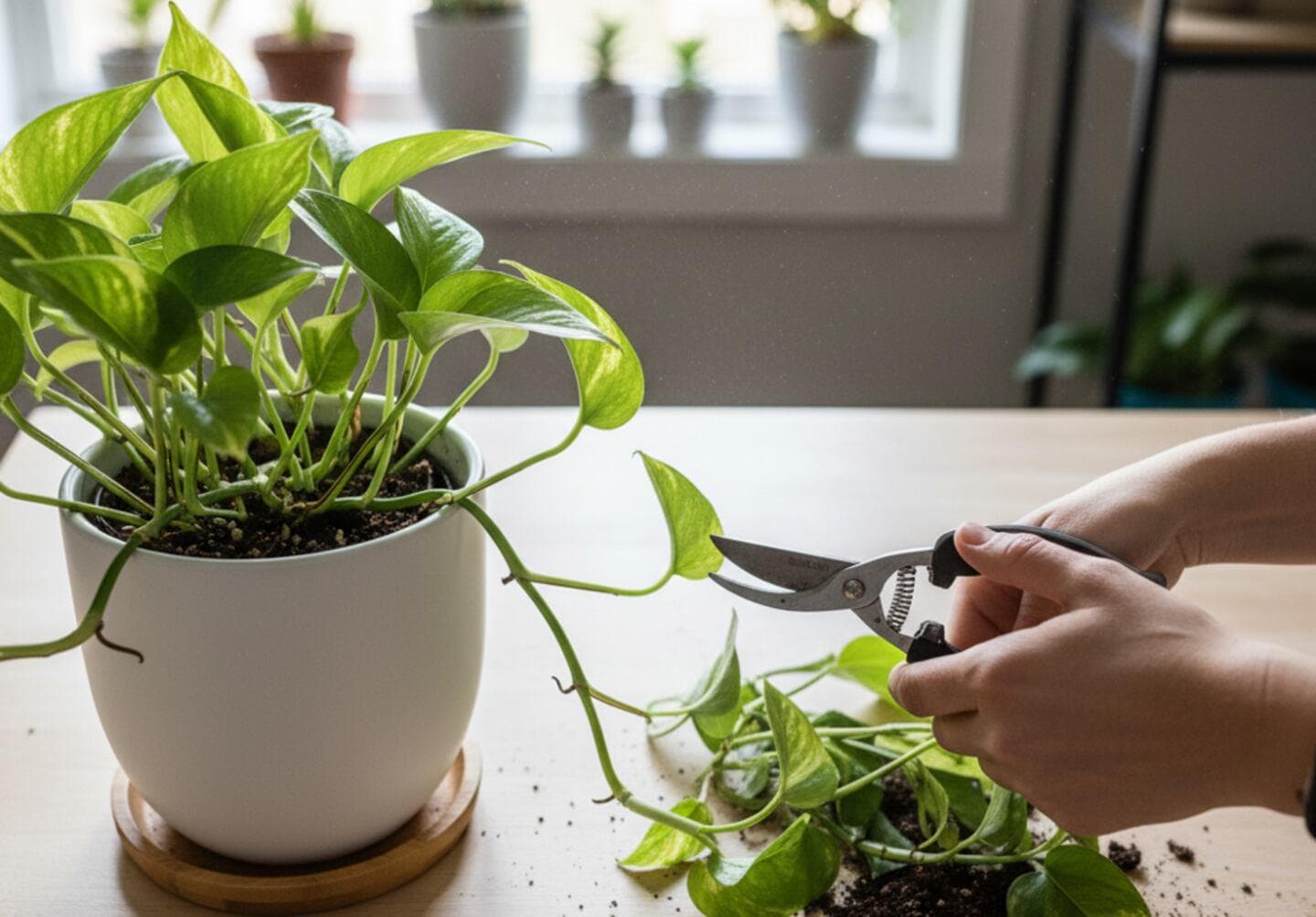
A once-full houseplant can become leggy, uneven, or crowded with damaged leaves when its growth goes unchecked. Learning how to prune indoor plants is about more than just making them look tidy. The right cuts remove damaged tissue, improve shape, manage excessive growth, and encourage a fuller, healthier appearance.
The challenge for beginners is knowing what to remove, where to cut, and when pruning may do more harm than good. Cutting healthy stems indiscriminately can reduce the plant’s ability to photosynthesize, while poorly timed or excessive pruning may delay recovery.
This guide explains how to prune indoor plants safely and effectively, including the tools to use, different cutting techniques, suitable timing, common mistakes, and practical ways to encourage healthier-looking growth without stressing your plants unnecessarily.
What Is Pruning, and Why Do Indoor Plants Need It?
Pruning is the deliberate removal of selected plant parts, such as stems, leaves, shoots, or damaged growth, to achieve a specific horticultural purpose.
For indoor plants, those purposes commonly include:
• Removing dead, diseased, or severely damaged tissue.
• Controlling excessive or uneven growth.
• Improving the plant’s overall shape.
• Managing stems that have become too long or sparse.
• Encouraging branching in species that respond well to strategic cuts.
• Keeping plants from interfering with windows, walkways, or nearby furniture.
Pruning is different from routine leaf cleaning. Wiping dust from a healthy leaf preserves its appearance without removing living tissue. Pruning, on the other hand, changes the plant’s structure.
Does pruning make indoor plants grow faster?
Not necessarily.
Pruning does not automatically accelerate growth. Its benefit depends on the plant species, the part removed, the season, and the plant’s growing conditions.
Removing a damaged stem may allow the plant to redirect resources toward remaining healthy growth. Cutting a growing shoot may also encourage branching in some plants because of changes in apical dominance, the influence of a leading shoot over nearby buds.
However, a plant growing slowly because of inadequate light, poor roots, nutrient problems, or unsuitable watering will not necessarily become vigorous simply because you prune it.
The practical principle here is to correct the underlying growing conditions first, then prune for a clear reason.
When Is the Best Time to Prune Houseplants?
For many common tropical foliage plants, the most suitable pruning period is during active growth, when the plant can recover and produce new shoots more readily.
In homes with consistently warm temperatures and adequate light, some indoor plants may grow throughout much of the year. Nevertheless, growth often slows during darker months or when indoor conditions become less favorable.
A practical timing guide
| Situation | Generally Suitable Approach |
| Active growth and healthy plant | Good time for planned shaping or selective pruning |
| Dead or diseased tissue | Remove promptly when identified |
| Plant recovering from repotting stress | Delay nonessential pruning |
| Plant affected by pests or disease | Address the underlying problem and remove clearly affected tissue as appropriate |
| Very low light or slow growth | Avoid heavy shaping cuts unless necessary |
| Plant already severely stressed | Prioritize stabilization before major pruning |
When should you avoid pruning?
Postpone substantial pruning when the plant is:
• Severely dehydrated or repeatedly wilting.
• Recovering from major root disturbance.
• Exposed to unusually cold conditions.
• Struggling because of inadequate light.
• Experiencing an unresolved pest or disease problem.
This does not mean you must leave dangerous or diseased tissue untouched. Removing clearly dead or affected material may still be necessary.
The distinction is between essential corrective pruning and optional pruning intended mainly to improve appearance.
Tools and Materials You Need Before Pruning
You do not need an expensive gardening kit to prune most indoor plants. A few clean, sharp tools are sufficient for routine maintenance.
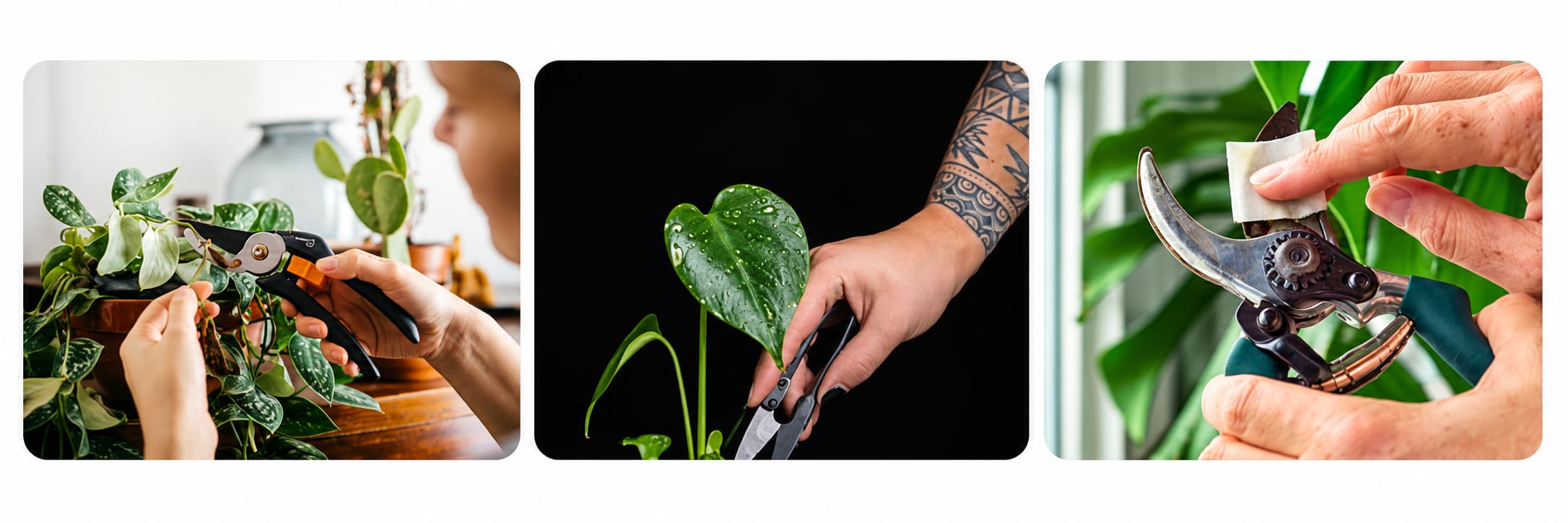
Essential pruning tools
| Tools | Purpose |
| Sharp pruning scissors | Cutting small stems, soft shoots, and individual leaves |
| Bypass pruners | Handling thicker stems that require more cutting strength |
| Clean cloth | Wiping tools and removing plant debris |
| Household disinfectant or rubbing alcohol | Cleaning cutting surfaces between plants |
| Gloves | Protecting hands when handling irritating sap or rough foliage |
| Small container or waste bag | Collecting removed plant material |
Why sharp tools matter
A sharp blade makes a cleaner cut with less crushing of the stem. Damaged, ragged cuts may heal poorly and create unnecessary tissue injury.
Choose a tool that matches the thickness of the material. Do not force small scissors through woody stems, and avoid using blunt household scissors when a proper pruning tool is available.
Clean your tools before and between plants
Dirty cutting tools can transfer pathogens from one plant to another.
A practical routine is:
1. Remove visible dirt from the blades.
2. Clean the cutting surfaces with an appropriate disinfectant.
3. Allow the tool to dry when necessary according to the product instructions.
4. Repeat the cleaning process before moving to another plant, particularly when disease is suspected.
Do not assume that a tool is clean simply because it looks shiny.
How to Prune Indoor Plants: 9 Simple Steps
The most reliable way to prune a houseplant is to begin with a clear objective rather than cutting whatever appears untidy.
1. Inspect the plant before making any cuts
Look at the entire plant from different angles.
Identify:
• Dead leaves and stems.
• Yellowing or damaged foliage.
• Long, bare stems.
• Crowded branches.
• Shoots growing in unwanted directions.
• Signs of pests or disease.
• Areas receiving insufficient light.
Also examine the plant’s overall health. If most of the foliage is healthy and the plant is growing well, extensive pruning may be unnecessary.
As a beginner, ensure to take a photograph before pruning. It provides a useful reference when evaluating the plant’s shape after new growth develops.
2. Decide what you want pruning to accomplish
Every cut should have a reason.
You may want to:
• Remove dead material.
• Reduce excessive height.
• Encourage branching.
• Improve symmetry.
• Clear a walkway or window.
• Remove damaged growth.
Avoid treating pruning as a competition to see how much foliage you can remove.
A plant with a naturally upright growth habit may not become bushy simply because you cut its tallest stem. Its response depends on its species and growing points.
3. Select the stems or leaves to remove
Start with material that is clearly dead, badly damaged, or interfering with the plant’s structure.
For healthy stems, consider whether removing them will improve the plant or unnecessarily reduce its foliage.
When pruning for shape, look for:
• Overly long stems.
• Weak or poorly positioned shoots.
• Growth crossing into other branches.
• Stems that make the plant visually unbalanced.
Do not remove healthy leaves merely because they are older. Mature foliage often continues contributing to photosynthesis.
4. Locate a suitable cutting point
For many branching houseplants, a useful place to cut a stem is just above a healthy node.
A node is the point on a stem where a leaf, bud, or branch emerges.
When a plant can produce side shoots from that area, cutting above a node may help direct future growth toward nearby buds.
However, not every plant responds in the same way. Some species grow from basal rosettes, underground structures, or specialized growing points rather than branching readily from ordinary stem cuts.
5. Make a clean, deliberate cut
Position your sharp tool so you can cut through the selected stem without crushing it.
For a healthy stem:
• Make the cut cleanly.
• Avoid repeatedly sawing through soft tissue.
• Leave enough stem structure to protect the nearby growing point.
• Do not make unnecessary cuts into the main stem.
The exact cutting angle is less important than a clean cut placed appropriately for the plant’s structure.
6. Remove dead leaves carefully
Dead leaves can usually be removed once they are fully dry or clearly nonviable.
If a leaf is attached by a flexible stalk, follow that stalk toward its base and cut or remove it without damaging the main stem.
Do not pull forcefully on leaves that resist removal. Tearing can injure healthy tissue.
For partially damaged leaves, you have two options:
• Remove the entire leaf if the damage is extensive.
• Trim only the damaged portion if enough healthy tissue remains and the leaf still contributes meaningfully to the plant.
A brown leaf tip does not automatically mean the entire leaf must go.
7. Thin crowded growth when necessary
Some indoor plants develop dense clusters of stems that overlap or compete for space.
Selective thinning involves removing a few poorly positioned stems rather than shortening everything equally.
This can help:
• Improve the plant’s appearance.
• Reduce overcrowding.
• Make inspection easier.
• Prevent the plant from becoming difficult to manage.
However, do not assume that removing foliage automatically improves air circulation enough to solve fungal or pest problems. Environmental conditions, watering practices, and humidity also matter.
8. Step back and reassess the shape
After a few cuts, pause.
Look at the plant from a normal viewing distance. Ask:
• Does the plant look more balanced?
• Have I removed too much foliage from one side?
• Are the remaining stems healthy?
• Is another cut genuinely necessary?
This pause prevents over-pruning, especially when working with a plant for the first time.
9. Clean up and monitor recovery
Collect the removed material and inspect it for signs of pests or disease.
Return the plant to suitable growing conditions. Avoid immediately compensating for pruning with excessive fertilizer or watering.
Over the following weeks, watch for:
• New shoots.
• Continued leaf health.
• Stem discoloration.
• Wilting or unexpected decline.
• Signs that the plant needs improved light or watering.
Pruning is complete when the intended task has been achieved, not when every imperfect leaf has disappeared.
How to Prune Different Parts of an Indoor Plant
Different plant structures require different approaches. A method suitable for a trailing vine may be inappropriate for a rosette-forming plant.
1. Pruning stems
Stem pruning is commonly used to reduce length, improve shape, or encourage branching in suitable species.
For plants such as pothos and some vining philodendrons, selective stem cuts can help manage long growth and create opportunities for branching.
Do not expect identical results from all cultivars. Some plants branch readily, while others naturally produce a more limited number of growing points.
2. Pruning leaves
Remove leaves that are:
• Completely dead.
• Severely damaged.
• Diseased, when removal is appropriate.
• Interfering with the plant’s structure.
Healthy leaves should generally remain unless there is a specific reason to remove them.
A plant relies on its foliage to capture light and produce energy. Removing too much healthy leaf area can weaken its ability to support growth.
3. Pruning roots
Root pruning is a separate operation from routine above-ground pruning.
It may sometimes be considered during repotting for specific reasons, but it is not a standard step in ordinary houseplant maintenance.
Do not cut healthy roots simply because you are already trimming the leaves. Root damage can reduce water uptake and create additional recovery stress.
For guidance on changing containers and handling roots, see How to Repot Indoor Plants Without Damaging the Roots.
How to Encourage Bushy Growth in Houseplants
One of the most common reasons beginners search for pruning advice is the desire to turn a thin, stretched plant into a fuller one.
Pruning can help, but bushier growth depends on more than cutting stems.
1. Provide enough suitable light
Light strongly influences how plants develop.
When a plant receives insufficient light, it may produce elongated stems and widely spaced leaves as it grows toward a brighter source. This is commonly called etiolation or leggy growth.
Pruning the stretched stems may improve the shape, but new growth can become leggy again if lighting remains inadequate.
If you are new to growing houseplants in rooms with limited natural light, choosing adaptable species can make indoor gardening much easier. Our guide to 21 Best Low Light Indoor Plants for Beginners covers beginner-friendly options that can handle lower-light conditions.
2. Prune above suitable nodes
For branching plants, cutting above a healthy node may encourage growth from nearby buds.
This is particularly useful when managing trailing or vining houseplants that have become uneven.
However, the response varies by species and growing conditions.
3. Rotate plants when appropriate
If a plant receives light primarily from one direction, rotating it occasionally can help maintain more balanced exposure.
Rotation does not replace adequate light, but it may help reduce one-sided development in suitable plants.
4. Avoid excessive nitrogen fertilizer
Fertilizer is not a substitute for light or proper pruning.
Excessive nitrogen can encourage soft, lush growth in some circumstances, but it does not guarantee a compact plant. Overfertilization may also damage roots or create nutrient imbalances.
Follow the fertilizer label and the plant’s actual growth requirements.
Proper fertilizing is an important part of maintaining healthy indoor plants, but applying too much fertilizer can cause problems. If you want to learn how to feed your plants safely and effectively, see our Step-by-Step Guide on How to Fertilize Indoor Plants the Right Way for practical instructions.
5. Be patient after pruning
New branches do not always appear immediately.
Depending on the plant, season, light, temperature, and growing point, visible regrowth may take time. Avoid repeatedly cutting the same stem because you do not see instant results.
How to Prune Common Indoor Plants
Pruning techniques become easier to understand when applied to familiar houseplants. The following examples focus on how each plant grows and what beginners should realistically expect.
Pothos: Pothos is a vining plant that can develop long stems, making it a practical candidate for selective pruning.
Where to prune:
• Long stems that have become sparse.
• Damaged leaves.
• Vines growing beyond the desired shape.
How to approach it:
Cut selected vines above healthy nodes when you want to manage length or encourage branching. Avoid removing too much foliage at once, especially if the plant is already growing slowly.
Pothos can also produce new plants from suitable stem cuttings, but propagation is a separate goal from routine pruning.
If you are growing Pothos indoors, proper light, watering, pruning, and feeding can make a significant difference in its appearance and overall growth. For more detailed care advice, see Pothos Plant Care: 13 Secrets for Fuller, Healthier Growth.
Spider plant: Spider plants produce long, narrow leaves from a central crown and may also develop flowering stalks with plantlets.
Pruning priorities:
• Remove fully brown or dead leaves.
• Trim damaged leaf sections when appropriate.
• Remove unwanted runners if they become difficult to manage.
Avoid cutting into the central crown unnecessarily. The crown is the plant’s primary growing region.
For species-specific guidance, see Spider Plant Care: How to Grow a Healthy Indoor Spider Plant.
Snake plant: Snake plants have stiff, upright leaves that arise from underground structures.
Their pruning needs are generally limited.
Suitable tasks include:
• Removing completely damaged leaves.
• Cutting away diseased tissue when appropriate.
• Removing leaves that have collapsed or become unsightly.
Do not expect routine tip trimming to transform a snake plant into a branching shrub. Its growth pattern is fundamentally different from that of a vining plant.
Snake plants are relatively adaptable, but they still benefit from appropriate light, watering, soil, and general maintenance. If you are growing one at home, our Snake Plant Care: The Complete Beginner’s Guide to Growing Healthy Indoor Snake Plants provides more detailed care guidance.
Peace lily: Peace lilies grow from a clumping base and produce leaves on individual stalks.
When pruning:
• Remove fully yellow or dead leaves at their base.
• Cut off spent flower stalks when the blooms have finished.
• Avoid removing healthy foliage without a reason.
Peace lilies may wilt when thirsty, but pruning should not be used as a substitute for correcting watering problems.
For more detailed guidance on keeping this popular houseplant healthy, see our Peace Lily Care: 11 Simple Tips to Keep Your Plant Healthy and Thriving.
ZZ plant: ZZ plants have thick leaf stalks arising from underground rhizomes.
Routine pruning is usually minimal.
Remove:
• Severely damaged stalks.
• Dead leaves.
• Diseased material when necessary.
Avoid cutting healthy stalks merely to make the plant appear shorter unless you have a clear design reason. ZZ plants do not respond like typical branching vines.
If you’re growing a ZZ plant indoors, proper light, watering, soil, and routine care can help maintain healthy growth. For more detailed guidance, see our ZZ Plant Care: 11 Secrets to Grow a Healthy, Thriving Indoor ZZ Plant.
Monstera: Monstera plants can develop long stems and aerial roots as they mature.
Pruning may be useful for:
• Managing excessive size.
• Removing damaged leaves.
• Controlling stems that extend into unsuitable spaces.
Do not remove aerial roots simply because they look unusual. They are part of the plant’s natural growth system.
If you’re growing Monstera indoors, proper light, watering, humidity, support, and regular maintenance can help it develop healthy, vigorous growth. For more detailed care guidance, see our Monstera Indoor Plant Care: 11 Secrets to Growing a Lush, Healthy Plant.
Common Pruning Mistakes Beginners Should Avoid
Even a healthy plant can suffer when pruning is done without understanding its structure or current condition.
Mistake 1: Cutting too much at once
Removing a large proportion of healthy foliage can reduce the plant’s photosynthetic capacity and create unnecessary stress.
The better approach is to make selective cuts, then allow the plant time to respond.
Mistake 2: Pruning because a leaf is slightly imperfect
A small tear, minor blemish, or isolated brown tip does not automatically justify removing an otherwise productive leaf.
Consider whether the leaf is still healthy enough to contribute to the plant.
Mistake 3: Using dirty scissors
Unclean tools can transfer pathogens between plants.
Clean your cutting tools regularly, particularly when moving between plants or dealing with suspected disease.
Mistake 4: Ignoring the cause of leggy growth
Pruning a stretched plant without addressing inadequate light often produces only temporary improvement.
The plant may become elongated again.
Mistake 5: Treating every houseplant the same way
A pothos vine, snake plant, peace lily, and palm have different growth structures.
A technique that works well for one may be unsuitable for another.
Mistake 6: Fertilizing heavily immediately after pruning
Freshly pruned plants do not automatically need extra fertilizer.
If growth conditions are already suitable, allow the plant to recover naturally. Fertilize according to its normal requirements rather than assuming that more nutrients will speed up healing.
Mistake 7: Pruning during severe environmental stress
A plant struggling with root damage, extreme dryness, or inadequate light may have limited ability to recover from major cuts.
Correct the primary problem before undertaking optional shaping.
Pruning Safety: Important Considerations for Indoor Gardeners
Pruning is generally straightforward, but certain plants require additional care.
Be cautious with irritating plant sap
Some houseplants, including several members of the aroid family, produce sap that can irritate skin or eyes.
Examples include:
• Dumb cane.
• Pothos.
• Philodendrons.
• Peace lilies.
Wear gloves when handling unfamiliar plants, avoid touching your eyes during pruning, and wash your hands afterward.
If sap contacts your eyes or causes significant irritation, rinse the affected area with clean water and seek appropriate medical advice if symptoms persist.
Keep pruning waste away from children and pets
Some indoor plants contain compounds that can cause adverse reactions if chewed or swallowed.
Do not assume that discarded leaves are harmless simply because they have been removed from the plant. Dispose of plant material responsibly, particularly in homes with curious children or pets.
If you share your home with cats or dogs, plant selection is another important part of indoor plant care. Choose species that are appropriate for homes with pets, and always consider where plants are placed. See our guide to Pet-Friendly Indoor Plants Safe for Cats and Dogs for more options.
Frequently Asked Questions About Pruning Indoor Plants
These questions address additional practical concerns that are not covered in the main sections above.
1. Can I prune indoor plants with regular kitchen scissors?
Yes, kitchen scissors may work for very small, soft stems if they are sharp and thoroughly clean. However, dedicated pruning scissors are generally more convenient for repeated gardening tasks and thicker plant material.
2. Should I sterilize pruning tools after every cut?
Not necessarily after every cut on the same healthy plant, but cleaning tools between plants is a sensible precaution. When disease is suspected, disinfect the blades between cuts involving affected and healthy tissue.
3. Can I prune an indoor plant while it is flowering?
It depends on your objective and the plant species. Removing dead flowers may be appropriate, but extensive pruning during flowering can remove developing buds or reduce the plant’s display. For ornamental flowering plants, avoid unnecessary structural pruning while valuable blooms are developing.
4. Is it safe to prune indoor plants in an air-conditioned room?
Yes, pruning can be performed indoors in an air-conditioned room. However, avoid exposing freshly cut plants to unusually cold drafts or sudden temperature changes. Normal, suitable growing conditions remain important during recovery.
5. Can pruning change the natural shape of a houseplant permanently?
Pruning can influence a plant’s structure over time, but the extent depends on its growth habit and ability to produce new shoots. Some plants branch readily, while others retain a naturally upright, rosette, or single-stem form.
6. Should I remove aerial roots when pruning a monstera?
Not simply because they are visible. Aerial roots are normal structures that help climbing plants attach to supports and access moisture from their surroundings. Remove one only when there is a specific horticultural or practical reason.
7. Can I prune a houseplant that has recently been moved to a new home?
It is usually sensible to allow the plant to acclimate before undertaking major optional pruning. Relocation can expose plants to changes in light, temperature, humidity, and watering patterns. Remove clearly dead or hazardous material when necessary, but delay extensive shaping until the plant settles.
8. Do grow lights eliminate the need for pruning?
No. Grow lights can improve light availability, but they do not eliminate the need to remove damaged growth, manage excessive size, or maintain a suitable shape. Pruning and lighting serve different purposes.
9. Can pruning help an indoor plant recover from sunburn?
Pruning can remove severely damaged tissue, but it does not reverse the injury or correct the cause. Move the plant away from excessive direct sunlight when appropriate and allow healthy remaining foliage to continue supporting recovery.
10. Should I prune a plant before giving it to someone as a gift?
Light grooming may improve presentation, but avoid major pruning immediately before gifting. Fresh cuts can alter the plant’s appearance, and the recipient may prefer to see its natural form. Remove dead or damaged material and transport the plant carefully.
11. Can I use pruning to make a mature houseplant smaller permanently?
Pruning can help manage size, but it does not always keep a plant permanently small. Many species will continue producing new growth when conditions are favorable. Long-term size control may require selecting a naturally compact cultivar, regular maintenance, or choosing a container and placement suitable for the plant’s mature dimensions.
Conclusion
Pruning indoor plants becomes much easier when you stop viewing it as routine cutting and start treating it as a deliberate plant-care decision. Remove dead or damaged growth, manage excessive stems selectively, and make clean cuts that suit the plant’s structure. For fuller, healthier growth, combine appropriate pruning with adequate light and consistent general care. For a broader foundation, see our complete guide to indoor plant care for beginners.
For additional guidance on pruning and maintaining healthy plants, see the University of Florida IFAS Extension’s Gardening Solutions and Colorado State University Extension gardening resources.
Your next step is to choose one healthy houseplant, identify a single clear pruning objective, and make only the cuts necessary to achieve it. Observe how the plant responds before attempting more extensive shaping.

I’m Bon (aka Guider), a dedicated indoor gardening writer and houseplant specialist with years of hands-on experience cultivating diverse indoor flora. I author comprehensive, data-backed guides designed to help beginners master indoor plant care, including advanced soil science, precise watering schedules, lighting optimization, and pest troubleshooting. To ensure the highest level of accuracy and editorial integrity, every article integrates practical horticulture principles with peer-reviewed research from university extension services, botanical institutions, and trusted horticultural organizations.
Hello Bon,
I found this guide really helpful, especially because pruning can seem intimidating when you’re new to caring for indoor plants.
I like that it focuses on practical steps rather than simply telling beginners to “cut off dead leaves.” The explanation of where and how to make cuts makes the process much easier to understand.
I’ll definitely be more confident about pruning my houseplants after reading this.
Hi AmakaDigital, thanks for stopping by with a comment, i hope to see you again.