
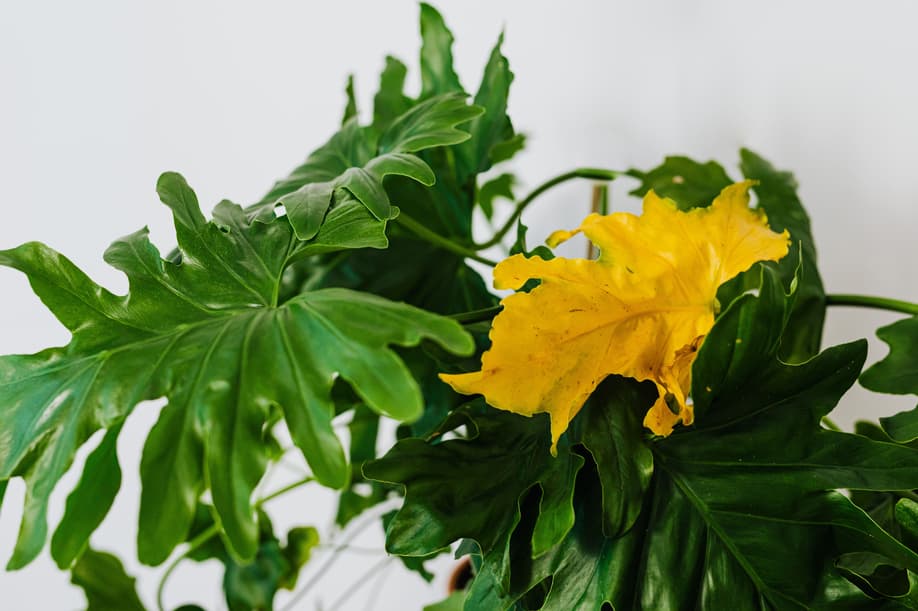
You notice yellow patches on your houseplant this morning. A few days later, those areas turn crisp and dead, leaving you with a chaotic mix of yellow and brown plant leaves. Should you grab the watering can, move the pot away from the window, or reach for fertilizer?
When multiple symptoms strike at once, guessing the cure can accidentally kill your plant. Leaves act as a plant’s dashboard, and changing colors are distinct distress signals. This diagnostic guide will help you decode these visual warnings, find the exact environmental stressor, and nurse your houseplant back to health without making the damage worse.
When you see yellow and brown plant leaves together, the pattern of damage can tell you more than the colors alone. The problem may involve watering, damaged roots, excessive sunlight, fertilizer salts, pests, or a combination of stresses.
The key is to identify what is happening before changing your plant-care routine. This guide explains how to interpret common patterns, distinguish similar symptoms, and choose a practical solution without accidentally making the problem worse.
What Do Yellow and Brown Plant Leaves Tell You?
Yellowing and browning describe different changes in leaf tissue, but neither color identifies a single cause.
Yellowing, sometimes called chlorosis, occurs when leaves lose some of their normal green appearance. Browning often indicates that tissue has become damaged or died, although the cause and progression vary.
A leaf may develop both symptoms because the underlying stress is continuing. However, yellow tissue does not always turn brown, and brown patches can appear without any preceding yellowing.
The most useful clues are:
• Location: Are the affected leaves at the bottom, at the top, or on one side of the plant?
• Pattern: Is the damage concentrated at the tips, along the edges, between the veins, or in separate spots?
• Texture: Are the affected areas soft, dry, crispy, or water-soaked?
• Soil condition: Is the potting mix persistently wet or extremely dry?
• Progression: Is the damage spreading rapidly, or is one old leaf gradually dying?
These clues help narrow the possibilities. They are not a substitute for examining the plant’s growing conditions and, where necessary, its roots.
7 Causes of Yellow and Brown Plant Leaves
Let’s now examine the 7 hidden causes behind this leaf discoloration, how to fix the damage, and save your dying houseplants today.
1. Overwatering and Poor Drainage
Excess moisture is one of the first problems to investigate when several leaves are yellowing and browning while the soil remains wet.
Overwatering does not necessarily mean you poured too much water into the pot on one occasion. It often means the growing medium stays wet for too long because of frequent watering, poor drainage, unsuitable potting mix, or a container that is too large for the root system.
Roots need oxygen as well as water. When the root zone remains saturated, roots can become damaged and may no longer absorb water and nutrients effectively. The plant can then show symptoms that resemble drought stress.
Clues that suggest excessive moisture include:
– Several lower or inner leaves turning yellow.
– Yellowing accompanied by wilting, even though the soil is wet.
– Potting mix that remains wet for an unusually long time.
– A pot without adequate drainage holes.
– Roots that are dark, soft, or deteriorating when inspected.
Not every yellow lower leaf indicates overwatering. Natural aging and other stresses can produce similar symptoms, so check the soil before deciding.
What to do:
1. Check the moisture several centimeters below the surface rather than judging the soil by its appearance alone.
2. If the growing medium is still wet, do not add more water simply because the leaves are wilting.
3. Check whether the container allows excess water to escape.
4. If the soil stays saturated for prolonged periods, investigate the growing medium and root condition.
5. If you find substantial root decay, follow a proper root-rot treatment process rather than merely waiting for the soil to dry.
- For a more detailed treatment procedure, read How to Fix Root Rot in Houseplants: A Step-by-Step Guide.
2. Underwatering and Repeated Drying
A plant can also develop yellow leaves and brown edges when it does not receive enough water.
When the roots cannot supply water as quickly as the leaves lose it, foliage may wilt, curl, yellow, or develop dry, crispy margins. Severe or repeated drying can cause leaves to become entirely brown and fall.
This problem is particularly likely when the potting mix has pulled away from the sides of the container or feels very dry below the surface.
How to distinguish it from overwatering
The soil condition is the first clue. An underwatered plant typically has a dry growing medium, while an overwatered plant may wilt despite having wet soil.
However, a plant with severely damaged roots can also struggle to absorb water from wet soil. That is why moisture alone does not always settle the diagnosis.
What to do
If the growing medium is dry and the plant’s symptoms are consistent with water stress, water it thoroughly enough to moisten the root zone and allow excess water to drain.
If the soil has become difficult to rewet, water may run down the sides without properly moistening the root ball. Apply water gradually and check whether the growing medium is actually absorbing it.
Afterward, adjust watering according to the plant’s needs and how quickly its soil dries. Do not automatically adopt a daily watering routine.
- For more guidance, see How to Water Indoor Plants Properly: Complete Beginner’s Guide.
Editorial note: The homepage link above is a general starting point, not a verified direct URL to the watering article. Replace it with the article’s exact permalink before publishing.
3. Excessive Sunlight and Leaf Scorch
If yellow and brown patches appear mainly on the side of a plant facing a bright window, excessive sunlight may be responsible.
Plants adapted to filtered light can suffer damage when exposed suddenly to intense direct sunlight. The affected areas may first appear pale or bleached and later become brown and dry.
This can happen after moving a plant to a sunnier location or placing it outdoors without gradually adjusting it to the stronger light.
Signs to look for:
– Damage concentrated on the sun-facing side.
– Pale or bleached patches that later turn brown.
– Dry, brittle tissue in exposed areas.
– Symptoms that began after a change in location.
What to do:
Move the plant to a position that suits its light requirements. If it needs brighter conditions, introduce the change gradually rather than exposing it immediately to harsh midday sun.
In Nigerian homes, direct sunlight through a window can be much more intense than the light reaching a plant farther inside the room. However, actual exposure depends on the window’s direction, shading, season, and surrounding buildings.
Do not assume every plant near a window is receiving too much light. Some species need bright light to remain healthy.
- Explore these 21 best low-light indoor plants for beginners, including easy-care houseplants that thrive in low-light spaces and bring natural beauty to your home.
4. Fertilizer Salt Buildup or Excessive Feeding
Brown leaf tips and margins can develop when fertilizer is applied too heavily or too frequently. Soluble salts can accumulate in the growing medium and interfere with the roots’ ability to absorb water properly.
This may cause crispy brown edges, tip burn, reduced growth, and, in more severe cases, broader leaf damage.
The problem is not limited to synthetic fertilizers. Any fertilizer can cause damage if it is used inappropriately.
Clues that make fertilizer injury worth investigating:
– Browning began after a recent feeding.
– Fertilizer was applied more frequently than the label recommends.
– The plant received a stronger solution than intended.
– A crust or residue has accumulated on the growing medium or container.
– Several leaf tips or margins have become brown.
These signs are suggestive rather than conclusive. Poor watering, damaged roots, water quality, and other conditions can produce similar symptoms.
What to do:
Pause additional feeding while you assess the plant.
If excessive fertilizer is the likely cause and the potting medium drains freely, flushing the medium with clean water may help remove excess soluble salts, and ensure you allow the water to drain completely.
Do not flush a plant whose soil is already saturated or whose roots are badly damaged without first addressing the drainage problem.
Resume feeding only when appropriate for the plant, using the correct product and label directions.
- Learn how to fertilize indoor plants the right way with this step-by-step guide covering fertilizer types, feeding schedules, and common mistakes to help your houseplants grow healthier.
5. Nutrient Deficiency or Poor Nutrient Availability
Nutrient deficiencies can cause yellowing, but they are often mistaken for watering problems.
The pattern varies according to the nutrient involved. For example, some deficiencies affect older leaves first, while others are more apparent in new growth. Yellowing between green veins may also indicate a nutrient-related problem, although it is not proof of one.
A plant can have nutrients in its growing medium and still struggle to absorb them if the roots are damaged or the soil conditions are unsuitable.
What to do:
Before adding fertilizer, check whether the plant receives suitable light, whether the soil drains properly, and whether its watering needs are being met.
If those conditions are satisfactory, consider whether the growing medium has been depleted or whether the plant has a specific nutritional requirement.
Use a suitable fertilizer according to its label. Avoid combining several fertilizers or applying concentrated mixtures in an attempt to correct yellow leaves quickly.
- For reliable background information, the Royal Horticultural Society’s guide to nutrient deficiencies explains how nutrient problems can affect foliage and why growing conditions also matter.
6. Pests and Leaf Diseases
Not every brown patch is caused by watering or sunlight. Pests and diseases can also damage indoor foliage.
Spider mites, for example, can cause fine pale speckling that may develop into a bronzed or dry appearance. Other sap-feeding insects can weaken leaves and contribute to yellowing.
Leaf diseases may produce spots, blotches, or expanding areas of dead tissue. Some lesions have yellow margins, while others turn brown without a clear yellow border.
Inspect the plant for:
– Tiny pale speckles or bronzed foliage.
– Fine webbing on leaves or around growing points.
– Visible insects on the undersides of leaves.
– Separate brown spots that are enlarging.
– Distorted new growth or unexplained leaf damage.
– Similar symptoms appearing on neighboring plants.
What to do:
If you find pests, isolate the affected plant while you identify the pest and choose a suitable treatment. Inspect nearby plants as well.
If you suspect a leaf disease, remove severely affected fallen material, avoid keeping foliage unnecessarily wet, and improve air circulation where appropriate. Do not assume every brown spot is fungal, and avoid applying fungicides without a reasonable diagnosis.
Plant problems caused by pests and diseases require a different response from simple watering stress.
- Discover 8 common indoor plant pests, how to identify them early, and practical ways to eliminate them before they damage your houseplants.
7. Low Humidity, Heat, and Environmental Changes
Some houseplants develop crispy brown edges when water is lost from their leaves faster than the roots can replace it. Low humidity can contribute to this problem, especially in plants that prefer moist air.
Heat, drafts, abrupt changes in light, and other environmental stresses can also cause leaf discoloration or drop.
In Nigeria, the conditions inside a home may differ considerably from the weather outside. A naturally ventilated room, an air-conditioned bedroom, and a room exposed to strong afternoon sun can create different growing environments.
What to do:
Consider humidity or temperature when brown edges appear alongside other signs of environmental stress.
• Move plants away from direct blasts of air-conditioning or fans if these appear to be contributing to drying.
• Avoid placing sensitive plants against excessively hot window glass.
• Maintain suitable light and watering conditions.
• If humidity is genuinely too low for the species, consider a humidifier or another appropriate way to improve the local environment.
Do not assume humidity is the cause merely because the leaves are brown. Check the growing medium, roots, light, and fertilizer history as well.
- Learn how to increase humidity for indoor plants with 10 practical methods, from pebble trays to humidifiers, to prevent dry leaf tips and help moisture-loving houseplants thrive.
How to Diagnose the Problem by the Pattern of Damage
When several possible causes produce similar symptoms, comparing the pattern can help you decide what to investigate first.
| What You Notice | Possible Explanation | First Check |
| Lower leaves yellow while the soil remains wet | Excess moisture or root stress | Soil moisture and drainage |
| Yellowing with dry, crispy margins | Underwatering or another source of leaf stress | Root-zone moisture |
| Pale patches followed by brown, dry areas | Excessive sunlight or heat | Recent light exposure |
| Brown tips following fertilizer application | Possible salt buildup or fertilizer injury | Feeding history |
| Yellowing between green veins | Possible nutrient or root-related issue | Leaf age, roots, and growing conditions |
| Brown spots with yellow borders | Possible disease or other localized injury | Spot progression and leaf undersides |
| Fine pale speckling with webbing | Possible spider mites | Undersides of leaves |
| One older leaf gradually turns yellow | Natural aging may be responsible | Overall plant health |
| Widespread yellowing after relocation | Environmental adjustment or stress | Changes in light, temperature, and watering |
These patterns help prioritize your investigation; they do not establish a diagnosis on their own. More than one factor can be responsible at the same time.
How to Fix Yellow and Brown Plant Leaves Without Making Things Worse
Once you have a likely explanation, make targeted changes rather than changing the entire care routine at once.
Step 1: Identify the most likely cause
Start with the easiest checks: soil moisture, drainage, light exposure, and recent changes in care.
Inspect the leaves for pests or distinct lesions. If the plant is wilting despite wet soil, consider whether root damage may be involved.
Step 2: Correct the underlying problem
Match the response to the evidence:
• If the soil is too wet, address the watering frequency and drainage.
• If the root zone is too dry, rehydrate it appropriately.
• If sunlight is causing scorch, reduce excessive exposure.
• If fertilizer injury is likely, stop unnecessary feeding and address possible salt buildup.
• If pests are present, identify and treat them appropriately.
• If nutrient deficiency is plausible, confirm that basic growing conditions are suitable before feeding.
Avoid applying several treatments simultaneously unless the situation clearly requires them. Otherwise, you may make it harder to identify what is helping.
Step 3: Remove badly damaged leaves when appropriate
Leaves that are completely brown, dead, or badly diseased may be removed with clean cutting tools.
However, do not remove every leaf with a small yellow patch. Partly healthy leaves can still contribute to photosynthesis.
Pruning improves appearance and may help with sanitation, but it does not correct the cause of discoloration.
Step 4: Monitor new growth
Previously damaged tissue may remain yellow or brown even after the plant-care problem has been corrected.
Look instead for signs that the decline has stopped:
• Fewer new leaves developing symptoms.
• More stable stems and foliage.
• Normal growth returning when conditions permit.
• No further spread of suspicious spots.
• Improved soil moisture behavior.
Recovery time depends on the species, the severity of the damage, and the growing conditions. Avoid repeatedly repotting, fertilizing, or moving the plant just because old leaves have not recovered.
Discover how to repot indoor plants without damaging their roots. Follow these expert-backed steps to choose the right pot, avoid transplant shock, and help your houseplants recover faster and grow healthier.
Common Mistakes to Avoid
Several well-intentioned responses can make leaf discoloration worse.
1. Watering immediately: Yellowing does not automatically mean the plant is thirsty. Check the soil first.
2. Adding fertilizer to every yellow plant: Fertilizer will not repair damaged roots or correct unsuitable light, and excess salts can cause additional damage.
3. Moving the plant into stronger sunlight without adjustment: A plant already suffering from leaf scorch may develop more damage.
4. Repotting unnecessarily: Repotting can disturb healthy roots and introduce further stress. Do it when the container, growing medium, or root condition justifies it.
5. Treating every brown spot with a pesticide: Spots can result from environmental injury, physical damage, disease, or other causes. Identify the likely problem before treating it.
6. Expecting damaged leaves to become green again: The most useful recovery indicator is healthy new growth, not the restoration of every damaged leaf.
Frequently Asked Questions
1. Why are my plant leaves turning yellow and brown at the same time?
The plant may be experiencing a stress that affects both leaf color and tissue health. Watering problems, root damage, excessive sunlight, fertilizer injury, pests, and environmental changes are among the possibilities. Check the pattern of damage and the growing conditions before choosing a treatment.
2. Can overwatering cause brown leaf edges as well as yellow leaves?
Yes. Excess moisture can damage roots and interfere with water and nutrient uptake, resulting in yellowing, browning, wilting, or leaf drop. However, brown edges also occur with underwatering, fertilizer salts, low humidity, and other stresses.
3. Should I cut off yellow and brown leaves?
Remove leaves that are completely dead or badly damaged when appropriate. Partly healthy leaves can still support the plant, so do not remove them automatically. Address the underlying cause to prevent further damage.
4. How do I know whether my plant needs water or has root rot?
Check the moisture of the growing medium. A dry root zone may indicate underwatering, while wet soil combined with wilting raises concern about root stress or rot. If the symptoms justify it, inspect the roots for abnormal softness and deterioration.
5. Can a dying houseplant recover from yellow and brown leaves?
Sometimes. Recovery depends on the cause, the severity of the damage, and how much healthy root and stem tissue remains. Correcting the problem early improves the plant’s chances, but severely damaged plants may not survive.
6. Why are only the tips of my indoor plant leaves turning brown?
Brown tips can result from inconsistent watering, excessive fertilizer salts, low humidity, water-quality issues in sensitive species, or other environmental stresses. Check the plant’s care history and growing conditions rather than assuming humidity is always responsible.
Conclusion
Yellow and brown plant leaves are warning signs, not a diagnosis. The most reliable way to respond is to examine where the damage appears, check the soil and roots when appropriate, consider recent environmental changes, and look for evidence of pests or disease.
Correct the most likely cause first, avoid unnecessary treatments, and monitor the plant’s new growth. That approach gives you a better chance of helping the plant recover without introducing another problem.

About the Author: Emebu Blessing Oghale
Emebu Blessing Oghale is an expert SEO content writer, digital creator, and indoor gardening enthusiast based in Asaba, Nigeria. Combining horticultural principles with years of digital media experience, he founded Indoor Plant Guide to provide practical, beginner-friendly troubleshooting tips for plant parents across West Africa and beyond. When he isn’t cultivating tropical houseplants, he serves his local community as a pastor at Living Faith Church.


Hi Bon,
I must say this was really helpful! I’ve noticed yellowing leaves on a few of my indoor plants and wasn’t sure whether I was overwatering or underwatering them. I especially like how you explained the different causes instead of assuming it’s always a watering problem.
Definitely going to check the soil and lighting before making any changes. Thanks for sharing!
Hi Seabed, thanks for your visit, and comment, hope to see you more.
Hello EMEBU,
Thanks for this well detailed guide, I now discovered that I used to overwater my Pothos plant hence the discoloration.
I am happy my friend recommended your site.
Hi Ujunwa, good to have you here with a comment, thanks a million