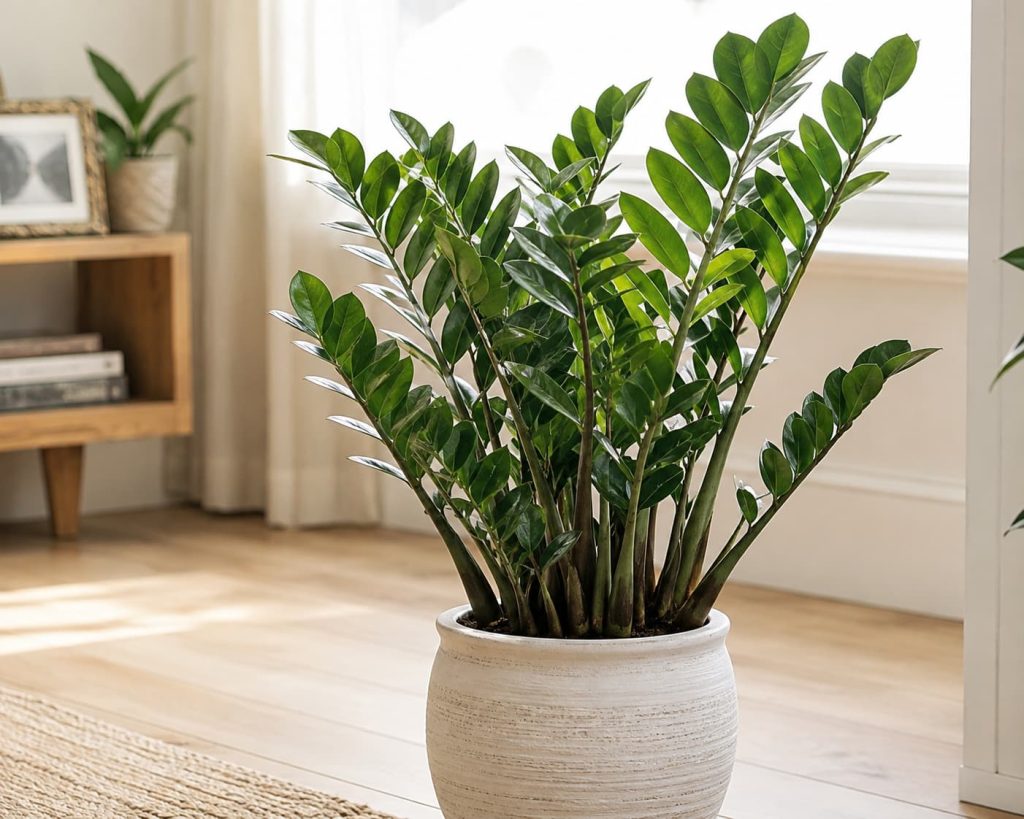
The ZZ plant is one of the most forgiving houseplants you can grow indoors, but easy care doesn’t mean no care. Understanding proper ZZ plant care is essential if you want healthy, glossy foliage and steady growth. The biggest mistake beginners make is treating this drought-tolerant plant like a thirsty tropical houseplant. In reality, ZZ plants prefer less frequent watering, indirect light, and a well-draining potting mix.
ZZ plant care is mainly about getting three things right: providing enough light, using fast-draining soil, and resisting the urge to water too often. Its thick underground rhizomes store water, allowing the plant to tolerate periods of dryness far better than many common houseplants.
Want a broader foundation for keeping houseplants healthy? This guide to indoor plant care for beginners covers light, watering, soil, feeding, repotting, pests, and everyday maintenance.
With the right conditions, a ZZ plant can maintain glossy foliage and produce new shoots with surprisingly little maintenance. This complete guide explains exactly how to care for a ZZ plant, including light, watering, soil, temperature, humidity, fertilizing, repotting, pruning, propagation, common problems, and the mistakes most likely to damage it.
ZZ Plant at a Glance
| Care Requirement | Best Approach |
| Scientific name | Zamioculcas zamiifolia |
| Family | Araceae |
| Light | Low to bright indirect light; brighter indirect light generally supports better growth |
| Watering | Water thoroughly, then allow the growing medium to dry before watering again |
| Soil | Loose, well-draining potting mix |
| Temperature | Normal warm indoor temperatures; protect from cold |
| Humidity | Average household humidity is usually sufficient |
| Fertilizer | Light feeding during active growth; avoid excessive fertilizer |
| Growth Rate | Slow |
| Difficulty | Beginner-friendly |
| Propagation | Division and leaf or stem cuttings |
| Pet Safety | Not considered pet-safe if ingested |
What Is a ZZ Plant?
The ZZ plant, scientifically known as Zamioculcas zamiifolia, is a rhizomatous evergreen perennial in the arum family, Araceae. It is native to parts of eastern and southern tropical Africa and has become a popular indoor plant because of its glossy foliage, tolerance of low light, and ability to withstand dry conditions.
Unlike plants that rely heavily on frequent watering, ZZ plants have thick underground rhizomes that function as water-storage organs. Their fleshy leaf stalks and rhizomes help the plant cope with periods of drought.
That adaptation explains one of the most important rules of ZZ plant care:
When in doubt, check the soil before adding more water.
A ZZ plant is generally much more likely to suffer from persistently wet soil than from a short period of dryness. University extension guidance specifically warns against allowing the plant to sit in water and recommends allowing the growing medium to dry between waterings.
The 11 Secrets to Successful ZZ Plant Care
Learn the 11 secrets to successful ZZ plant care, from providing the right light and watering properly to choosing suitable soil, managing temperature, fertilizing wisely, and avoiding common mistakes that can harm your plant.
1. Give Your ZZ Plant the Right Amount of Light
ZZ plants are famous for tolerating low-light conditions, but there is an important distinction between tolerating low light and growing vigorously in low light.
A ZZ plant can survive in relatively dim interiors, including offices and other spaces with limited natural light. However, brighter indirect light generally provides better conditions for active growth. RHS guidance describes ZZ plants as adaptable from low light through bright, indirect light, while North Carolina State University notes that they perform best with bright indirect light even though they can tolerate very low light.
Ideal indoor placement
Good locations include:
• Near a bright window with filtered light
• A few feet away from a sunny window
• A bright office
• A room receiving plenty of ambient daylight
• A location exposed to bright indirect light for much of the day
Be more cautious with intense direct sunlight, particularly through hot glass. Excessive direct exposure can scorch or brown the foliage.
What happens in very low light?
A ZZ plant may remain alive but grow very slowly. New growth can take longer to appear, and the plant may become less compact as it responds to limited light.
Practical rule: If your ZZ plant is surviving but barely growing, consider improving the light before changing your watering or fertilizer routine.
For more plant choices that tolerate limited natural light, see our guide to 21 Best Low Light Indoor Plants for Beginners.
2. Master the Watering Routine
If you learn only one thing about ZZ plant care, make it this:
Do not water on a rigid schedule simply because a certain number of days has passed.
Instead, check the growing medium.
ZZ plants store water in their rhizomes, which is why they can tolerate considerable drying between waterings. Extension and botanical-garden guidance consistently emphasizes allowing the soil to dry between waterings and avoiding waterlogged conditions.
How to know when to water
Before watering, check the soil several centimeters below the surface. If the growing medium is still noticeably moist, wait.
If it has dried substantially and the plant is otherwise healthy, water thoroughly.
When watering:
• Pour water slowly over the soil.
• Continue until excess water begins draining from the bottom.
• Allow the pot to drain completely.
• Empty standing water from the saucer or decorative container.
• Return the plant to its normal position.
The goal is not to give the plant a tiny amount of water every few days. The goal is to thoroughly hydrate the root zone when it is dry enough, then allow it to dry again.
How often should you water a ZZ plant?
There is no universal weekly schedule.
Watering frequency changes according to:
• Light intensity
• Temperature
• Pot size
• Potting mix
• Drainage
• Plant size
• Season
• Indoor airflow
• Humidity
As a practical starting point, a ZZ plant in a typical indoor environment may go considerably longer between waterings than plants such as peace lilies or ferns. North Carolina State Extension current guidance gives roughly one to two waterings per month as a general reference, but stresses that the medium should be completely dry before watering.
That should be treated as a starting point—not a calendar rule.
Your soil is a better indicator than the calendar.
Watering mistakes are among the most common causes of unhealthy houseplants. Learn how to water indoor plants properly by checking soil moisture, watering thoroughly, and preventing excess moisture.
3. Use a Fast-Draining Potting Mix
A ZZ plant does not need a complicated soil recipe. What matters most is that the growing medium drains efficiently and does not remain saturated for long periods.
University of Florida recommends a well-drained peat- or bark-based potting soil, while Clemson Extension recommends a coarse, well-draining mix.
A practical indoor mix can contain:
• Quality indoor potting mix
• Perlite or another material that improves drainage
• Coarse material such as bark, depending on the mix
The exact recipe is less important than the finished physical structure.
You want a medium that:
• Holds enough moisture for roots to absorb water
• Allows excess water to drain
• Contains air spaces around the roots
• Does not stay saturated for prolonged periods
Avoid heavy garden soil in an indoor pot. It can compact and drain poorly in containers.
Repotting at the wrong time or using the wrong technique can stress a plant. Learn how to repot indoor plants safely, from choosing the right container to handling roots and refreshing the potting mix.
4. Never Let the Pot Sit in Standing Water
Good soil cannot compensate for a container that continually holds water around the roots.
Always use a pot with drainage holes.
After watering, allow excess water to escape freely. If your ZZ plant sits inside a decorative cachepot, check that water has not collected at the bottom.
Persistent waterlogging reduces the amount of oxygen available around the roots and can contribute to root and rhizome decay.
This is why drainage is not merely a convenience—it is a central part of ZZ plant care.
A common beginner mistake
A plant owner notices that the surface of the soil is dry and immediately waters again.
But the upper layer can dry faster than the lower portion of the pot.
Instead of judging moisture only from the surface, check deeper into the root zone.
5. Keep Temperatures Warm and Stable
ZZ plants prefer warm indoor conditions.
University of Florida gives a preferred indoor temperature range of approximately 65–90°F (18–32°C), while University of Connecticut recommends keeping plants around 55–80°F (13–27°C). RHS gives 15–24°C (59–75°F) for its ZZ Raven guidance. These ranges vary somewhat among sources, but they agree on the important practical point: ZZ plants prefer warm conditions and should be protected from cold.
For an ordinary home, aim for comfortable room temperatures rather than trying to maintain a precise number.
Protect your plant from:
• Cold drafts
• Very cold windows
• Air-conditioning vents blowing directly onto the foliage
• Sudden temperature extremes
• Frost or freezing conditions
ZZ plants are not frost-tolerant.
6. Don’t Waste Time Trying to Create Tropical Humidity
This is one of the reasons ZZ plants are so convenient indoors.
They generally tolerate ordinary household humidity and do not require the high humidity that some tropical houseplants need.
Missouri Botanical Garden specifically notes that average household humidity is adequate for ZZ plants.
You therefore do not need to automatically buy a humidifier, mist the plant daily, or create a miniature greenhouse.
If your home is comfortable for people, your ZZ plant will usually tolerate the humidity quite well.
What matters more than humidity?
For ZZ plants, prioritize:
• Good light
• Appropriate watering
• Well-draining soil
• Warm temperatures
• Adequate drainage
These factors have a much greater influence on successful care than constantly adjusting humidity.
7. Fertilize Lightly—More Is Not Better
ZZ plants are slow growers, so they do not require heavy feeding.
University of Florida IFAS Extension (Gardening Solutions) recommends low-dose liquid fertilizer twice a year, while University of Connecticut recommends fertilizing once or twice during the growing season or using a less frequent full-strength application.
A simple approach is to use a balanced houseplant fertilizer according to the manufacturer’s instructions, avoiding excessive doses.
When should you fertilize?
Feed primarily when the plant is actively growing.
Avoid trying to force growth with frequent heavy fertilizer applications. Excess fertilizer can contribute to salt accumulation in the growing medium and may damage roots.
A ZZ plant that is growing slowly is not necessarily deficient.
Its naturally slow growth rate is part of its normal biology. Cornell University College of Agriculture and Life Sciences and Missouri Botanical Garden both describe ZZ as a slow-growing plant.
Fertilizer can support healthy growth, but too much can cause problems. Learn how to fertilize indoor plants correctly, including when to feed, how much to use, and common mistakes to avoid.
8. Understand Why ZZ Plants Grow Slowly
One of the biggest mistakes is assuming that a ZZ plant must be unhealthy simply because it does not produce new leaves quickly.
ZZ plants are naturally slow-growing.
Under favorable conditions, they can produce new shoots, but growth speed depends on light, temperature, nutrition, plant maturity, pot conditions, and general health.
If your ZZ plant is barely growing
Check these factors in order:
1. Light: Is the plant receiving enough bright indirect light?
2. Watering: Are you watering too frequently?
3. Roots: Is the plant severely root-bound or experiencing root damage?
4. Temperature: Is it consistently exposed to cold conditions?
5. Nutrition: Has it been growing actively without any fertilizer for a very long time?
6. Season: Is the plant naturally less active because conditions are less favorable?
Do not respond to slow growth by automatically increasing water and fertilizer.
That can create a bigger problem.
9. Repot Only When the Plant Needs It
ZZ plants do not need frequent repotting.
Because they are relatively slow-growing and tolerate being somewhat root-bound, repotting should be based on the condition of the plant and container rather than a rigid annual schedule.
Consider repotting when:
• Roots are becoming severely crowded
• The plant is repeatedly drying out unusually quickly
• The growing medium has deteriorated significantly
• The container has become unstable
• Rhizomes are pressing heavily against the container
• Drainage has become poor
When repotting, choose a container only modestly larger than the existing root system.
A huge pot can hold substantially more wet soil than the plant can use, increasing the risk of prolonged moisture around the roots.
How to repot a ZZ plant
1. Prepare a clean container with drainage holes.
2. Use a fresh, well-draining potting mix.
3. Carefully remove the plant from its old container.
4. Inspect the roots and rhizomes.
5. Remove obviously damaged or rotting material with clean tools.
6. Place the plant at approximately the same depth as before.
7. Fill around the root ball with fresh mix.
8. Water appropriately and allow excess water to drain.
For detailed, step-by-step instructions, see our guide on how to repot indoor plants safely without damaging the roots.
10. Keep the Leaves Clean and Prune Strategically
The glossy leaves of a ZZ plant are one of its main attractions.
Dust can accumulate on broad leaf surfaces, making the plant appear dull and potentially interfering with normal leaf function.
A gentle cleaning with water and a soft cloth can help keep the foliage looking fresh.
Avoid aggressive rubbing.
Should you prune a ZZ plant?
Pruning is generally simple.
Remove:
• Completely yellow or dead leaves
• Damaged foliage
• Rotten or severely diseased portions
• Shoots that are genuinely unwanted
Use clean, sharp pruning tools.
Do not cut healthy leaves merely because the plant is growing slowly.
Pruning cannot magically make a ZZ plant grow faster. Its growth rate is largely determined by its biology and growing conditions.
11. Choose the Right Propagation Method
ZZ plants can be propagated, but patience is essential.
Common methods include:
• Division
• Stem cuttings
• Leaf cuttings
Division is generally the most direct method when a mature plant has multiple rhizomes or natural divisions. North Carolina State University and Missouri Botanical Garden both identify division and leaf-cutting propagation as viable approaches.
Propagating by division
Division is most useful when you already have a mature, multi-rhizome plant.
Carefully remove the plant from its container and identify natural sections containing roots and rhizomes. Separate these sections carefully and pot them individually into appropriate containers.
Avoid damaging the rhizomes unnecessarily.
Propagating from leaf or stem cuttings
Cuttings can work, but they are much slower than many beginners expect.
A cutting must develop roots and, eventually, new rhizome growth before producing a substantial new plant.
This is a patience project rather than a quick way to create a mature ZZ plant.
How to Tell If Your ZZ Plant Is Healthy
A healthy ZZ plant generally has:
• Firm, glossy foliage
• Strong upright or slightly arching growth
• Firm stems or petioles
• No persistent foul smell from the pot
• No mushy rhizomes
• Gradual production of new shoots under favorable conditions
New growth can also look different from mature foliage.
For example, Raven ZZ produces new growth that emerges lighter green and gradually darkens as it matures.
This is normal and should not automatically be interpreted as a nutrient deficiency.
Common ZZ Plant Problems and How to Fix Them
Let’s now learn how to identify and fix common ZZ plant problems, from yellow leaves and root rot to slow growth, pests, and drooping stems, with simple solutions that restore healthy, vigorous growth.
1. Yellow Leaves
Yellow leaves can have several causes, so avoid assuming that every yellow leaf means “needs fertilizer.”
One of the most important possibilities is excessive moisture.
Overwatering and poorly drained conditions can damage roots and rhizomes. University of Connecticut specifically identifies yellow leaves and rotting rhizomes as signs associated with overwatering.
What to check:
• Is the soil staying wet for a long time?
• Does the pot have drainage holes?
• Is water collecting in the saucer?
• Is the potting mix compacted?
• Does the plant have a damaged or rotting root system?
If the soil is consistently wet, correcting the watering and drainage problem is more important than adding fertilizer.
2. Brown or Scorched Leaves
Brown patches may result from excessive direct sunlight, particularly when the plant is suddenly exposed to strong sun.
Alabama Cooperative Extension System notes that scalding and browning can occur under direct sunlight.
Move the plant toward bright filtered or indirect light rather than putting it in a completely dark location.
3. Drooping or Leaning Stems
A ZZ plant may lean because of:
• Uneven light
• Low light
• Natural growth habit
• Weak or damaged growth
• Root problems
If the plant consistently leans toward a light source, rotating the pot periodically can encourage more even exposure.
If the stems are soft and the soil is persistently wet, investigate root or rhizome problems instead of simply adding support.
4. Root or Rhizome Rot
This is one of the most serious ZZ plant problems because the plant’s water-storage system is underground.
Possible warning signs include:
• Persistently wet soil
• Yellowing leaves
• Soft or mushy rhizomes
• Unpleasant odor
• Sudden decline despite wet soil
If rot is suspected, remove the plant from the container and inspect the roots and rhizomes.
Healthy tissue should be firm. Remove clearly rotten material using a clean tool, then repot into fresh, well-draining medium.
Most importantly, correct the underlying watering and drainage problem.
Otherwise, the plant may rot again.
Yellow leaves, drooping stems, brown foliage, and slow growth can have several causes. Learn how to identify common indoor plant problems and take practical steps to restore healthier growth.
ZZ Plant Pests
ZZ plants are relatively resistant to serious pest problems, but no houseplant is completely immune.
Possible pests include:
• Scale insects
• Mealybugs
• Aphids
• Fungus gnats, particularly where soil stays excessively moist
North Carolina State University specifically lists scale as a pest to watch for, while general houseplant pest problems can become more likely when plants are stressed or growing conditions are poor.
Inspect leaves, stems, and leaf joints periodically.
If you see:
• Sticky residue
• Cotton-like clusters
• Small insects
• Scale-like bumps
• Distorted new growth
isolate the affected plant from nearby houseplants and identify the pest before choosing a treatment.
Even healthy houseplants can develop pest problems. Learn about common indoor plant pests, how to recognize early warning signs, and practical ways to protect your plants from recurring infestations.
Is the ZZ Plant Safe for Cats and Dogs?
No. ZZ plants should not be considered pet-safe.
ASPCA identifies ZZ plants (Zamioculcas spp.) among houseplants containing insoluble calcium oxalates. These microscopic crystals can cause oral irritation when plant material is chewed or swallowed. Reported signs can include drooling, retching, nausea, vomiting, diarrhea, and irritation or swelling of the mouth and throat.
That does not mean every exposure will produce severe illness, but it does mean the plant should be kept away from pets that chew plants.
If you have cats or dogs that regularly nibble houseplants, choose a plant specifically identified as pet-friendly instead.
If pets share your home, plant safety matters. Explore pet friendly indoor plants that can bring natural greenery indoors while offering safer options for homes with cats and dogs.
ZZ Plant Care Mistakes to Avoid
Mistake 1: Watering every week automatically
ZZ plants do not need a fixed weekly watering schedule.
Better: Check the soil and water according to actual moisture conditions.
Mistake 2: Keeping the soil constantly damp
The plant’s rhizomes store water, so constantly wet soil is unnecessary and potentially harmful.
Better: Use well-draining soil and allow it to dry between waterings.
Mistake 3: Putting the plant in intense direct sun
A ZZ plant tolerates a broad range of light but excessive direct sunlight can scorch foliage.
Better: Bright indirect or filtered light is a safer target.
Mistake 4: Assuming low light means no light
ZZ plants tolerate low light, but that does not mean they thrive equally well in darkness.
Give the plant the brightest suitable indirect light available.
Mistake 5: Fertilizing too often
More fertilizer does not automatically mean faster growth.
Better: Feed lightly and primarily during active growth.
Mistake 6: Using a huge pot
A large container can retain more moisture than the plant needs.
Better: Increase pot size gradually when repotting.
Mistake 7: Repotting every year
ZZ plants are naturally slow-growing and generally do not require frequent repotting.
Better: Repot based on plant and container conditions.
Mistake 8: Expecting rapid growth
ZZ plants are slow growers.
Judge success by healthy foliage and gradual new growth rather than weekly changes.
How to Make a ZZ Plant Grow Better
If your main goal is healthier, more vigorous growth, focus on the fundamentals rather than searching for a miracle fertilizer or secret additive.
Give it more usable light
If the plant is sitting in a very dark corner, move it toward a brighter indirect-light location.
Get watering right
Allow the growing medium to dry before watering again.
Improve drainage
If water remains trapped around the roots for too long, address the pot and potting mix.
Feed modestly
A small amount of appropriate fertilizer during active growth can support the plant, but excessive feeding is unnecessary.
Keep temperatures comfortable
Avoid prolonged cold exposure and harsh drafts.
Be patient
This is perhaps the most overlooked part of ZZ plant care.
A healthy ZZ plant may simply be slow.
The goal is not to force rapid growth. The goal is to create conditions in which the plant can grow normally.
Can ZZ Plants Grow in Low Light?
Yes.
ZZ plants are among the better choices for indoor locations with limited natural light. University extension resources specifically recognize their ability to remain healthy under low-light interior conditions.
However, low-light tolerance should not be confused with an ideal growth environment.
Think of light tolerance as a spectrum:
Very low light → survival and very slow growth
Low to moderate indirect light → reasonable maintenance
Bright indirect light → generally better conditions for active growth
If your ZZ plant is alive but has shown almost no growth for a long time, improving its light may be more useful than increasing water or fertilizer.
Does a ZZ Plant Flower Indoors?
ZZ plants can produce an unusual flower structure called an inflorescence, consisting of a spadix surrounded by a spathe.
However, flowering indoors is uncommon, particularly under low-light conditions.
University of Florida notes that ZZ plants will not bloom under low-light indoor conditions, while Missouri Botanical Garden describes flowering as seasonal.
Therefore, do not judge the health of your ZZ plant by whether it flowers.
For most indoor growers, attractive foliage is the main reason to grow this plant.
ZZ Plant Care by Season
Your watering routine should respond to environmental conditions rather than follow a rigid calendar.
During brighter, warmer periods
When light levels and temperatures increase and the plant is actively growing:
• Check the soil more frequently.
• Water when the medium has dried sufficiently.
• Monitor new growth.
• Fertilize modestly if appropriate.
During darker or cooler periods
When growth slows:
• Expect longer intervals between watering.
• Reduce or pause fertilizer if the plant is not actively growing.
• Monitor the soil carefully.
• Protect the plant from cold drafts.
The important principle is simple:
When the plant uses water more slowly, you should also water less frequently.
A Simple ZZ Plant Care Routine
If you want a low-maintenance routine, use this checklist.
Weekly:
• Look at the leaves.
• Check for pests.
• Observe new growth.
• Check the soil rather than automatically watering.
Every few weeks:
• Check moisture deeper in the pot.
• Water only when appropriate.
• Make sure excess water drains completely.
Every few months:
• Inspect the plant’s overall shape.
• Remove dead or damaged foliage.
• Clean dusty leaves gently.
• Check whether roots or rhizomes are becoming severely crowded.
During active growth:
• Consider light fertilization according to the product instructions.
This routine is intentionally simple.
The ZZ plant does not benefit from constant attention.
Frequently Asked Questions About ZZ Plant Care
1. How often should I water a ZZ plant?
Water when the growing medium has dried sufficiently rather than following a strict weekly schedule. ZZ plants store water in their rhizomes and are drought tolerant, so they generally require less frequent watering than many houseplants.
2. Does a ZZ plant need direct sunlight?
No. Bright indirect light is generally a better indoor target. ZZ plants tolerate low light, while excessive direct sunlight can scorch the leaves.
3. Why is my ZZ plant turning yellow?
Overwatering is an important possibility, especially when yellow leaves occur alongside persistently wet soil or declining roots. Check drainage, soil moisture, and the condition of the rhizomes before changing fertilizer.
4. Why is my ZZ plant not growing?
ZZ plants are naturally slow-growing. Insufficient light, unsuitable temperatures, root problems, poor nutrition, and seasonal changes can also reduce growth. Improve the fundamentals before assuming the plant is unhealthy.
5. Can ZZ plants survive in dark rooms?
They can tolerate very low light better than many houseplants, but extremely low light is not an ideal environment for vigorous growth. If possible, provide brighter indirect light.
6. Do ZZ plants need high humidity?
No. Average household humidity is generally adequate, making ZZ plants easier to maintain than many humidity-demanding tropical houseplants.
7. How do I make my ZZ plant grow faster?
Give it suitable bright indirect light, well-draining soil, appropriate watering, warm conditions, and modest nutrition during active growth. Avoid trying to force growth with excessive water or fertilizer.
8. How often should I fertilize a ZZ plant?
ZZ plants generally need little fertilizer. University extension guidance supports light feeding roughly once or twice during active growth, depending on the fertilizer and application method.
9. Can I propagate a ZZ plant from a leaf?
Yes. ZZ plants can be propagated from leaf cuttings, although this method can be slow. Division is another propagation option, particularly for mature plants with multiple rhizomes.
10. Are ZZ plants safe for cats and dogs?
No. ZZ plants contain insoluble calcium oxalates and should not be treated as pet-safe plants. Keep them away from pets that chew foliage.
Conclusion
Successful ZZ plant care is surprisingly simple. This resilient houseplant does not need constant attention or a complicated routine—just the right growing conditions and a little restraint.
For a healthy, thriving ZZ plant, provide bright, indirect light when possible, while remembering that low-light tolerance is not the same as a preference for low light. Allow the potting mix to dry between waterings, never leave the pot sitting in standing water, and use a loose, well-draining potting mix. Keep the plant comfortably warm and protect it from cold drafts, but do not worry about maintaining unusually high humidity, as average indoor humidity is usually sufficient. Fertilize lightly and sparingly rather than frequently, expect slow and gradual growth, and repot only when the plant becomes root-bound or the container is no longer suitable. Finally, keep the plant away from pets and children who may chew the foliage, as ZZ plants contain calcium oxalate crystals that can cause irritation if ingested.
The secret to successful ZZ plant care is not complicated. Provide adequate light, let the soil dry before watering again, ensure excellent drainage, and resist the temptation to overcare for your plant.
A ZZ plant does not need constant attention to thrive. In fact, one of the most important parts of caring for this remarkably resilient houseplant is knowing when to leave it alone. Give your ZZ plant the conditions it needs, avoid unnecessary watering and fussing, and it can remain an attractive, low-maintenance addition to your home for years.

I’m Bon (aka Guider), an indoor gardening writer and houseplant enthusiast passionate about helping beginners successfully grow and care for indoor plants. I create practical, beginner-friendly guides covering indoor plant care, watering, lighting, soil, repotting, plant problems, and choosing suitable houseplants for different homes. My articles draw on research from trusted horticultural organizations, university extension resources, and botanical institutions, combined with practical plant-care principles and careful content review.