Pothos plant care is often described as easy—and it is. But “easy to grow” doesn’t mean impossible to get wrong. A pothos can survive missed waterings, less-than-perfect conditions, and occasional neglect, but survival is not the same as thriving.
If you want long, healthy vines, lush leaves, and steady growth, a few simple care details make all the difference. In this guide, you’ll learn exactly how to care for a pothos plant, from lighting and watering to soil, fertilizing, pruning, propagation, and common problems.
The most important parts of pothos plant care are providing suitable light, watering according to soil moisture rather than a fixed calendar, using a well-draining growing medium, feeding during active growth, and pruning strategically.
Pothos (Epipremnum aureum) is a tropical climbing vine in the Araceae family. It is native to the Society Islands and is naturally adapted to warm, humid environments. In cultivation, it can be grown as a trailing plant or trained upward using a support.
This guide explains exactly what your pothos needs, how to encourage fuller growth, why leaves turn yellow, how to water correctly, and how to propagate new plants from healthy stems.
Pothos care becomes easier when you understand the fundamentals of indoor gardening. For broader guidance, explore this complete indoor plant care guide covering the essential principles every beginner should know.
Pothos Plant Care at a Glance
| Care Requirement | What Pothos Generally Prefers |
| Light | Bright, indirect light; tolerates lower light |
| Water | Water when the growing medium has dried sufficiently |
| Soil | Loose, well-draining potting mix |
| Temperature | Warm indoor conditions; avoid cold drafts |
| Humidity | Average indoor humidity is usually tolerated |
| Fertilizer | Regular but moderate feeding during active growth |
| Prunning | Trim leggy vines above nodes to encourage branching |
| Repotting | When roots become crowded or the soil deteriorates |
| Propagation | Stem cuttings, preferably containing nodes |
| Growth Habit | Trailing or climbing vine |
| Pet Safety | Toxic if eaten by cats and dogs |
The exact watering frequency will vary with pot size, light, temperature, soil, humidity, and season. That is why a fixed schedule such as “water every seven days” is less reliable than checking the plant and soil.
1. Give Your Pothos the Right Amount of Light
Light is one of the biggest factors determining how well a pothos grows.
The ideal location is generally bright, indirect light. A position near a bright window where the plant receives plenty of filtered or reflected light can encourage vigorous growth without exposing the leaves to harsh direct sunlight.
Pothos is remarkably adaptable and can survive in lower-light conditions. However, there is an important distinction between surviving and growing well.
In insufficient light, you may notice:
• Longer spaces between leaves
• Slower growth
• Smaller new leaves
• Less vigorous vines
• Reduced variegation in some cultivars
• Growth leaning toward the nearest light source
Penn State Extension notes that pothos can tolerate low light for extended periods but may lose desirable coloration or variegation. Illinois Extension similarly notes that leaf color can disappear in low light.
What about direct sunlight?
Strong, intense sunlight through a window can scorch pothos foliage. This is particularly relevant when a plant that has been growing in relatively low light is suddenly moved into intense sun.
If your pothos receives several hours of strong direct sunlight and develops pale, bleached, brown, or scorched patches, move it farther from the window or filter the light with a sheer curtain.
A simple light test
If you can comfortably read a book near your pothos during the daytime without turning on a light, the area may provide useful ambient brightness. However, room brightness varies considerably, so observe the plant’s growth rather than relying on a single rule.
The best approach is to provide strong ambient light while protecting the foliage from harsh midday sun.
2. Learn How Often to Water Pothos
One of the most common pothos care mistakes is treating watering as a calendar task.
Instead of automatically watering every Sunday or every five days, check the growing medium.
For many indoor pothos plants, watering is appropriate when the upper portion of the soil has dried sufficiently. Penn State Extension recommends watering pothos when the soil is dry, while RHS guidance advises allowing the top portion of the compost to dry between waterings.
How to check before watering
Insert your finger into the top layer of soil.
If it still feels noticeably moist, wait and check again later.
If the upper layer has dried and the plant is otherwise healthy, water thoroughly.
When watering:
1. Pour water slowly over the soil.
2. Allow excess water to drain from the bottom.
3. Empty water collected in the saucer or outer container.
4. Do not allow the pot to sit continuously in stagnant water.
The goal is not to keep the soil permanently wet.
Why overwatering is dangerous
Pothos roots require oxygen as well as moisture. Constantly saturated soil reduces the air available around the roots and creates conditions that can contribute to root problems.
Poor drainage is particularly dangerous when combined with frequent watering. Missouri Botanical Garden specifically notes that roots may rot in poorly drained soils.
Signs your pothos may need water
A thirsty pothos may develop:
1. Drooping leaves
2. Dry potting mix
3. Leaves that feel less firm
4. Temporary wilting
However, drooping does not automatically mean underwatering. Root problems caused by excessive moisture can also produce unhealthy-looking foliage.
Always check the soil before deciding what the plant needs.
Watering mistakes are among the most common causes of indoor plant problems. Learn how to water indoor plants properly, including how to judge soil moisture and avoid both overwatering and underwatering.
3. Use the Best Soil for Pothos
The best soil for pothos is not necessarily a particular branded product. What matters most is the physical structure of the growing medium.
You want a mix that:
• Holds enough moisture for the roots
• Drains excess water efficiently
• Contains air spaces around the roots
• Does not compact easily
• Supports healthy root development
A quality indoor potting mix can work well. Penn State Extension recommends a good-quality soilless potting mix that drains well, while Missouri Botanical Garden recommends a peaty potting mix for pothos.
For a homemade approach, you can combine a quality potting mix with an aerating component such as perlite or another suitable drainage-enhancing material.
The exact recipe is less important than the final structure.
What to avoid
Avoid using heavy outdoor garden soil by itself in a typical indoor container. It can compact and drain poorly compared with a suitable container-growing medium.
Also avoid assuming that adding more sand automatically improves drainage. The physical properties of the ingredients and their proportions matter.
The key principle is, pothos plants thrive in consistently moist soil, but they do not tolerate sitting in waterlogged conditions.
The right growing medium helps pothos roots access both moisture and oxygen. Before choosing a mix, learn about choosing the best soil for indoor plants and what makes a potting mix suitable.
4. Choose a Pot With Proper Drainage
Even excellent soil can become problematic if the container cannot release excess water.
A pothos container should have a functional drainage hole.
This allows excess water to leave the root zone after thorough watering.
If you place the nursery pot inside a decorative cachepot, remember to empty accumulated water rather than allowing the inner pot to remain submerged.
Does pothos need a large pot?
No.
A very large pot is not automatically better for a fast-growing plant. An oversized container can contain a large volume of soil that remains wet for longer after watering.
When repotting, moving up only one pot size is generally a safer approach. Extension guidance similarly recommends choosing a container only modestly larger when repotting houseplants.
For more detailed guidance on selecting a container, see our guide to choosing the right pot for indoor plants.
Choosing the right container is just as important as choosing the right plant. Learn how to choose the right pots for indoor plants, including drainage, size, material, and other factors that affect root health.
5. Keep Pothos Warm and Away From Cold Drafts
Pothos is a tropical plant, so it generally performs best under warm indoor conditions.
Penn State Extension recommends average room temperatures around 60–80°F (approximately 16–27°C).
For most homes, this means you do not need to create a greenhouse-like environment.
Instead, avoid unnecessary stress from:
• Cold drafts
• Sudden temperature changes
• Very cold rooms
• Direct exposure to air-conditioning vents
• Abrupt environmental changes
Royal Horticultural Society (RHS) also advises protecting epipremnums from cold draughts.
In warm climates such as much of Nigeria, indoor pothos may have suitable temperatures for much of the year. However, heat alone does not guarantee healthy growth. A plant kept in excessive heat with poor light, compacted soil, or inconsistent watering can still struggle.
6. Don’t Obsess Over Humidity
Pothos comes from a tropical environment, but one of its strengths as a houseplant is its adaptability.
You do not necessarily need to turn your entire room into a tropical greenhouse.
Normal indoor conditions can be adequate when the plant has appropriate light, moisture, temperature, and soil drainage.
If the air is extremely dry, particularly near an air conditioner or strong ventilation, you can improve the surrounding environment by:
• Grouping compatible plants
• Using a humidifier
• Moving the plant away from drying vents
• Maintaining more stable room conditions
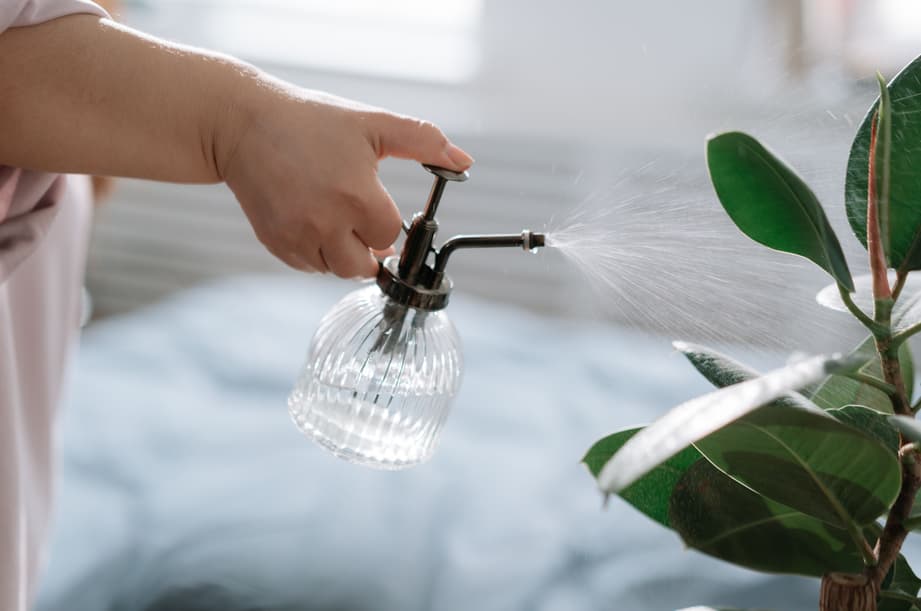
Avoid relying on frequent misting as a cure-all. Increasing humidity around a plant is different from repeatedly wetting its foliage.
For pothos, good root conditions and appropriate watering usually matter more than chasing a particular humidity percentage.
7. Fertilize Pothos for Consistent Growth
Light provides the energy for photosynthesis, but nutrients are also necessary for sustained growth.
A pothos growing actively in suitable light can benefit from periodic feeding with a balanced houseplant fertilizer.
Penn State Extension recommends regular fertilization, with more frequent feeding during active growth and reduced feeding during slower periods.
The exact frequency should depend on:
• The fertilizer concentration
• The plant’s growth rate
• Light levels
• Season
• Potting medium
• Manufacturer instructions
More fertilizer does not mean more growth.
Excessive fertilizer can contribute to salt accumulation and root stress.
A practical approach
If your pothos is actively producing new leaves and growing vigorously, follow the fertilizer label and use a moderate feeding routine.
If growth is slow because the plant is receiving very little light, increasing fertilizer may not solve the underlying problem.
Fix the limiting factor first.
Proper feeding can support healthy pothos growth, but too much fertilizer can cause problems. Learn how to fertilize indoor plants properly, including when to feed, what to use, and common mistakes to avoid.
8. Prune Your Pothos to Make It Fuller
If your goal is a long, trailing plant, you can simply allow healthy vines to extend.
But if you want to know how to make pothos fuller, pruning is one of the most useful techniques.
Pothos naturally tends to produce long vines. If you never prune it, you may eventually end up with attractive trailing stems but relatively sparse growth near the center of the pot.
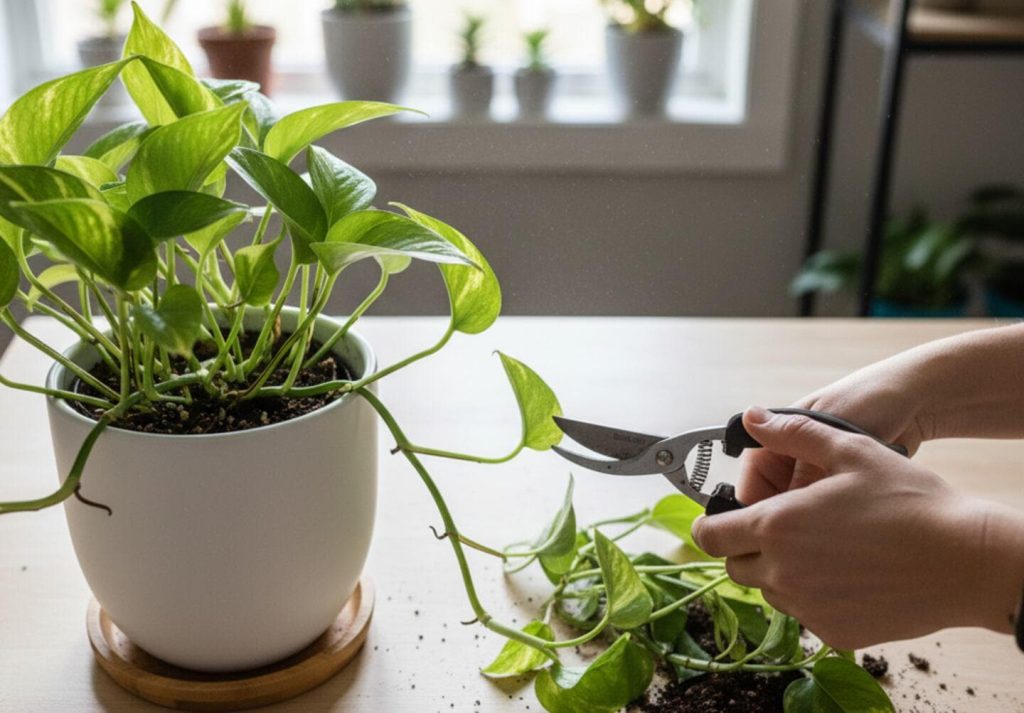
Pruning allows you to reshape the plant and stimulate new growth from remaining nodes.
How to prune pothos
1. Inspect the vine and identify a healthy leaf node.
2. Use clean, sharp scissors or pruning shears.
3. Cut just above the selected node.
4. Remove excessively long or bare sections.
5. Keep healthy cuttings for propagation if desired.
A node is the point on a stem where a leaf and associated growth structures emerge. Nodes are especially important because new roots and shoots can develop from them.
RHS recommends tip pruning to promote branching, while Penn State Extension advises shortening vining stems just above a node.
The mistake many beginners make
They cut only the very end of an extremely long vine and expect the entire plant to become bushy.
A better strategy is to assess the whole plant and prune several strategically selected vines where appropriate.
You can then propagate the healthy cut sections and eventually add rooted cuttings back into the container.
That combination—pruning plus propagation—can be particularly effective for creating a fuller-looking pot.
9. Give Climbing Pothos Something to Climb
Pothos is not limited to hanging baskets.
In nature, it is a climbing vine that uses aerial roots to attach itself to supporting surfaces.
Indoors, you can allow it to:
• Trail from a hanging basket
• Cascade from a shelf
• Climb a moss pole
• Climb another suitable support
• Wrap around a structure that can safely support the plant
University of Florida IFAS Extension (Gardening Solutions) notes that pothos can be trained onto a moss-covered totem using its aerial roots.
Why provide a support?
A climbing structure changes the plant’s presentation and can encourage it to grow upward rather than continuously hanging downward.
If your goal is a fuller display, however, remember that support alone will not magically create more stems at the base. Light, pruning, and propagation still matter.
10. Repot Pothos When It Actually Needs It
Pothos does not need to be repotted simply because another year has passed.
Repot when the plant gives you a reason.
Possible signs include:
• Roots emerging from drainage holes
• Roots tightly circling the root ball
• The plant becoming unstable in its container
• The potting mix breaking down or draining poorly
• The soil drying unusually quickly
• The plant becoming severely root-bound
Penn State Extension recommends repotting when roots become crowded and notes that pothos can benefit from being moved into a slightly larger container when appropriate.
How to repot pothos:
1. Select a container only modestly larger than the current one.
2. Make sure it has drainage.
3. Prepare fresh, well-draining potting mix.
4. Carefully remove the plant from its existing container.
5. Inspect the roots.
6. Gently loosen severely circling roots if necessary.
7. Position the plant at approximately the same depth.
8. Fill around the roots with fresh mix.
9. Water appropriately and allow excess water to drain.
Do not automatically move a small pothos into a huge container just because you want it to grow faster.
A bigger pot is not a substitute for good light and healthy roots.
When your pothos becomes root-bound or its growing medium deteriorates, repotting may be necessary. Learn how to repot indoor plants without damaging the roots using a careful, step-by-step approach.
11. How to Propagate Pothos From Stem Cuttings
Pothos is particularly useful for beginners because it can be propagated from stem cuttings.
The important detail is that a cutting needs an appropriate node for successful propagation.
Simple pothos propagation method:
1. Select a healthy vine.
2. Cut a section containing at least one healthy node.
3. Remove a lower leaf if necessary so the node can be exposed.
4. Place the node in water or a suitable propagation medium.
5. Keep the cutting in a warm location with suitable indirect light.
6. Monitor it for root development.
7. Once adequately rooted, transfer it to an appropriate growing medium if you started it in water.
Propagation can also be carried out through layering, and RHS lists stem-tip cuttings and layering among propagation methods for epipremnums.
Why propagation helps create a fuller plant
Suppose your pothos has three long vines but looks sparse near the soil.
Instead of buying another plant, you can:
Prune → propagate → root → plant cuttings back into the container.
Over time, this can give the container a denser appearance.
Cornell University College of Agriculture and Life Sciences also notes that pothos propagation through stem cuttings is particularly successful during the growing season.
12. Understand Pothos Yellow Leaves Before You Panic
Pothos yellow leaves are one of the most common problems beginners encounter.
But yellowing is a symptom, not a diagnosis.
Several factors can contribute to yellow leaves, so look at the entire plant and its growing conditions.
Yellow leaves from excessive moisture
If the soil stays wet for long periods and several leaves begin yellowing, examine your watering and drainage practices.
Potential contributing factors include:
• Watering too frequently
• Poor drainage
• An oversized container
• Compacted soil
• A pot without adequate drainage
Persistent waterlogging can damage roots and contribute to root rot.
Yellowing from environmental stress
A sudden change in light, temperature, or watering can also affect foliage.
For example, moving a pothos from a dim room directly into strong sunlight can damage leaves.
Natural aging
An occasional older leaf turning yellow is not necessarily a crisis.
Plants naturally shed older foliage as they grow.
The important question is whether yellowing is:
occasional and limited
or
widespread and accompanied by poor growth, soft stems, persistent wet soil, or other symptoms.
Look for patterns rather than reacting to one leaf.
13. Watch for Pests and Common Pothos Problems
Pothos is generally resilient, but it can still suffer from common houseplant pests.
Possible pests include:
• Scale insects
• Mealybugs
• Spider mites
Missouri Botanical Garden lists scale, mealybugs, and mites among pests that may affect pothos.
Inspect your pothos regularly
Look closely at:
• Leaf undersides
• Stem joints
• New growth
• Areas where leaves meet stems
Look for:
• Tiny insects
• Cottony material
• Sticky residue
• Fine webbing
• Discolored patches
• Distorted new growth
Early detection is much easier to manage than a severe infestation.
If you discover pests, isolate the affected plant from nearby houseplants and identify the pest before selecting a treatment.
Pothos can occasionally attract pests such as mealybugs, scale, and spider mites. Learn about common indoor plant pests and how to eliminate them before an infestation becomes difficult to manage.
How to Make Pothos Grow Faster
If your pothos is growing slowly, adding more fertilizer is not always the answer. Healthy growth depends on several factors working together, including light, watering, root health, nutrition, and growing conditions.
1. Improve the Light
Move your pothos to a brighter location with plenty of bright, indirect light if it is currently growing in a dim area. Insufficient light can slow growth, reduce leaf size, and cause longer spaces between leaves.
2. Correct Your Watering
Keep the growing medium appropriately moist without leaving it constantly waterlogged. Check the soil before watering and allow excess water to drain freely. Both prolonged dryness and consistently saturated soil can interfere with healthy growth.
3. Check the Roots
If your pothos has stopped growing, inspect its roots and growing medium. Severely crowded roots, compacted soil, or deteriorated growing medium can limit healthy growth. If necessary, repot the plant into a slightly larger container with fresh, well-draining mix.
4. Fertilize Appropriately
A pothos growing actively in suitable conditions can benefit from regular, moderate feeding. Follow the fertilizer manufacturer’s instructions rather than assuming that more fertilizer will produce faster growth. Excessive fertilization can stress the plant and damage its roots.
5. Prune Strategically
Prune excessively long or bare vines to encourage a more compact, fuller appearance. Make your cuts just above healthy nodes, where new growth can develop.
6. Propagate Healthy Cuttings
If your pothos has long, healthy vines, use suitable stem cuttings for propagation. Once the cuttings develop healthy roots, you can plant them back into the container to create a denser, fuller-looking plant.
7. Keep Growing Conditions Stable
Avoid repeatedly moving your pothos between dramatically different environments. Sudden changes in light, temperature, watering, or humidity can stress the plant and interrupt consistent growth.
The key to faster Pothos growth is knowing that there is no single fertilizer, household remedy, or secret trick that makes pothos grow faster. In most cases, faster growth comes from identifying and correcting whatever factor is limiting the plant. Give your pothos adequate bright, indirect light, appropriate moisture, healthy roots, suitable nutrition, and stable growing conditions, and allow it time to respond.
How to Make Pothos Fuller: The Practical Formula
If your main goal is a lush, bushy-looking pothos, focus on this combination:
Good light + appropriate watering + regular pruning + healthy roots + propagation
Here is a simple example.
Imagine you have a pothos with four long vines and large gaps between leaves.
Instead of simply watering it more:
• Move it to a brighter indirect-light location.
• Check that the soil drains properly.
• Prune the longest vines above appropriate nodes.
• Root the healthy cuttings.
• Plant rooted cuttings back into the pot when established.
• Continue moderate feeding during active growth.
• Rotate the container occasionally so growth does not become heavily one-sided.
This approach addresses both the health of the existing plant and the density of the container.
Pothos Care Mistakes to Avoid
Even though pothos is a forgiving houseplant, repeated care mistakes can lead to yellow leaves, slow growth, root problems, and sparse vines. Avoid these common pothos care mistakes to keep your plant healthy and growing well.
Mistake 1: Watering on a Fixed Schedule
Your pothos does not know that it is Sunday. Environmental conditions change with light, temperature, humidity, pot size, and season, so watering every few days or on a specific day can easily lead to overwatering. Instead, check the growing medium and water when it has dried sufficiently.
Mistake 2: Keeping the Soil Constantly Wet
Pothos needs moisture, but constantly saturated soil can deprive the roots of oxygen and contribute to root problems. Use a well-draining growing medium, choose a pot with drainage, and allow excess water to escape after watering.
Mistake 3: Growing Pothos in Deep Darkness
Pothos can tolerate relatively low light, but surviving in low light is not the same as growing vigorously. Too little light can result in slower growth, smaller leaves, longer spaces between leaves, and reduced variegation in some cultivars. Aim for bright, indirect light whenever possible.
Mistake 4: Using an Oversized Pot
A larger pot is not necessarily better for pothos. An oversized container holds more growing medium, which can remain wet for longer after watering and increase the risk of root problems. Choose a container that suits the current root system and move up only modestly when repotting.
Mistake 5: Overfertilizing a Struggling Pothos
Adding more fertilizer will not automatically make a struggling pothos grow faster. If inadequate light, poor drainage, or damaged roots are limiting growth, excessive fertilizer can create additional stress. Identify and correct the underlying problem before increasing feeding.
Mistake 6: Pruning Without Understanding Nodes
Nodes are important to pothos growth and propagation because new roots and shoots can develop from them. When pruning, identify healthy nodes and make your cuts strategically rather than simply removing the ends of long vines. Understanding where nodes are can help you prune more effectively and propagate healthy cuttings.
Mistake 7: Ignoring Pests Until the Plant Is Severely Damaged
Pothos can develop common houseplant pests such as scale, mealybugs, and spider mites. Waiting until the plant shows extensive damage can make the problem harder to manage. Inspect the leaves, stems, leaf joints, and undersides of foliage regularly so you can identify problems early.
Mistake 8: Assuming Every Yellow Leaf Has the Same Cause
Yellow leaves are a symptom, not a diagnosis. Excess moisture, poor drainage, environmental stress, and natural leaf aging can all contribute to yellowing. Before changing your care routine, examine the soil moisture, drainage, light, roots, age of the affected leaf, and the overall condition of the plant.
Golden Pothos, Marble Queen, Neon and Other Cultivars
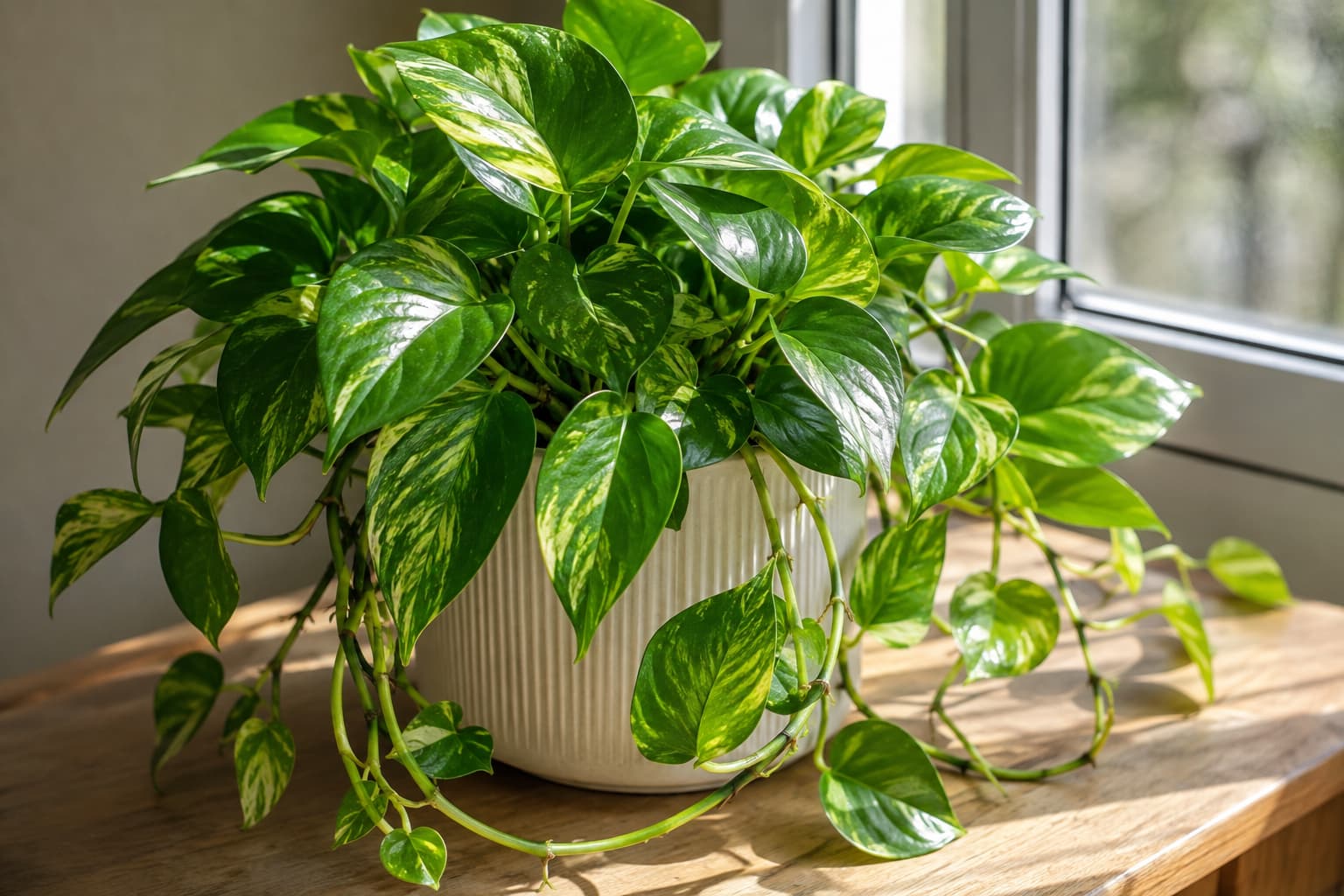
“Pothos” is often used broadly for several attractive cultivars and forms of Epipremnum aureum.
Common examples include:
• Golden pothos
• Jade pothos
• Neon pothos
• Marble Queen
• Lime
• Tricolor
Penn State Extension identifies several of these commonly cultivated forms, while RHS highlights the range of green, yellow, and cream-variegated foliage found among epipremnums.
Their basic care requirements overlap, but their appearance can respond differently to light.
For example, variegated plants generally need adequate light to maintain strong coloration. Too little light can cause variegation to become less pronounced.
This is one reason a Marble Queen or similarly variegated pothos may look different after being moved into a darker room.
Pothos vs. Philodendron: Are They the Same?
No.
Pothos and heartleaf philodendrons are both popular tropical houseplants and can look remarkably similar, but they belong to different genera.
Pothos is Epipremnum aureum, while heartleaf philodendron belongs to the genus Philodendron.
One useful identification feature is the petiole—the stalk attaching the leaf to the stem. Penn State Extension notes that pothos petioles have a groove, while young philodendron leaves emerge within a protective sheath called a cataphyll.
This distinction matters when researching care because similar-looking plants do not necessarily have identical requirements.
Is Pothos Safe Around Cats and Dogs?
No.
Pothos should not be considered a pet-safe plant.
The ASPCA identifies Epipremnum aureum as toxic to cats and dogs because it contains insoluble calcium oxalates. Ingestion can cause oral irritation, drooling, vomiting, and difficulty swallowing.
If you have pets that chew plants, place pothos somewhere inaccessible or choose a genuinely pet-safe alternative.
This is especially important because pothos’ trailing stems can make its leaves easily accessible to curious animals.
A Simple Weekly Pothos Care Routine
You do not need to spend hours caring for pothos.
A quick inspection can prevent many problems.
Every few days
Look at the plant.
Check for:
• Drooping
• Yellowing
• New growth
• Pest activity
• Unusual leaf damag
When watering is due
Check the soil rather than automatically following a calendar.
If the soil has dried sufficiently, water thoroughly and allow excess water to drain.
Every few weeks
Inspect the stems and leaf undersides for pests.
Rotate the container if the plant is growing strongly toward one direction.
During active growth
Monitor new growth and fertilize according to the product’s instructions when appropriate.
Every few months
Assess whether the plant has become too leggy.
If necessary, prune and propagate healthy cuttings.
When necessary
Repot only when the plant shows signs that the current container or growing medium is no longer serving it well.
Quick Pothos Troubleshooting Guide
| Problem | Possible Cause | What to check First |
| Yellow Leaves | Excess moisture, stress, aging foliage | Soil moisture and drainage |
| Drooping leaves | Dry soil or root problems | Check soil before watering |
| Slow growth | Low light, poor roots, limited nutrients | Light and root condition |
| Long gaps between leaves | Insufficient light or natural vine growth | Light level and pruning |
| Loss of variegation | Insufficient light | Move to brighter indirect light |
| Brown/scorched patches | Excessive direct sunlight | Relocate from harsh sun |
| Mushy roots | Excessive moisture/poor drainage | Inspect roots and soil |
| Pest damage | Scale, mealybugs, mites, etc. | Inspect stems and leaf undersides |
| Sparse pot | Long unpruned vines | Prune and propagate cuttings |
Yellow leaves, drooping, brown spots, and slow growth can have several causes. Explore common indoor plant problems and how to fix them with practical troubleshooting guidance for healthier plants.
Frequently Asked Questions About Pothos Plant Care
1. How often should I water pothos?
Water when the growing medium has dried sufficiently rather than following a rigid calendar. Check the soil before watering and make sure excess water can drain freely.
2. What is the best soil for pothos?
Use a loose, well-draining indoor potting mix that retains some moisture without becoming waterlogged. A quality soilless potting mix can work well.
3. How do I make pothos fuller?
Provide adequate indirect light, prune long vines above nodes, and propagate healthy cuttings. Rooted cuttings can eventually be added back to the same container to create a denser display.
4. Why are my pothos leaves turning yellow?
Yellow leaves can have several causes, including excessive moisture, poor drainage, environmental stress, or normal aging. Examine the soil and roots and look at the overall pattern of yellowing rather than assuming one cause.
5. Why is my pothos growing slowly?
Low light is a common reason. Other possibilities include poor root conditions, unsuitable watering, insufficient nutrients, temperature stress, or simply a slower growth period.
6. Can pothos grow in low light?
Yes. Pothos is adaptable and can survive in relatively low-light locations, but growth may slow and variegated cultivars may lose some of their coloration. Bright indirect light is generally better for vigorous growth.
7. Can pothos grow in direct sunlight?
It can tolerate some brighter conditions, but harsh direct sunlight—particularly intense afternoon sun through glass—can scorch the foliage. Bright filtered or indirect light is a safer choice for indoor cultivation.
8. How do I propagate pothos?
Take a healthy stem cutting containing at least one node and root it in water or an appropriate propagation medium. Stem cuttings are a common and effective propagation method for pothos.
9. Does pothos need fertilizer?
Pothos can benefit from periodic feeding during active growth. Follow the fertilizer manufacturer’s instructions and avoid excessive application.
10. Does pothos need a moss pole?
No. A moss pole or other support is optional. It is useful if you want the plant to climb rather than trail.
11. Is pothos poisonous to cats and dogs?
Yes. The ASPCA lists pothos (Epipremnum aureum) as toxic to cats and dogs because of insoluble calcium oxalates.
Conclusion
Healthy pothos care is less about complicated tricks and more about consistently getting the fundamentals right. Give your pothos bright, indirect light, and water it based on soil moisture rather than a fixed schedule.
Use a loose, well-draining growing medium and a pot with functional drainage to prevent excess moisture around the roots. Keep the plant warm, protect it from cold drafts, and maintain reasonably stable indoor conditions. During active growth, fertilize moderately, prune long vines to encourage a fuller appearance, and provide support if you want your pothos to climb.
Repot when the roots become crowded or the growing medium breaks down, and propagate healthy cuttings that contain nodes. If leaves turn yellow, treat them as a symptom that needs diagnosis rather than assuming the cause. Regularly inspect your pothos for pests and other problems so you can address issues early.
If you remember only one principle, make it this: pothos thrives when you balance moisture, light, drainage, and growing conditions rather than following a rigid care schedule.
Texas A&M AgriLife Extension offers research-based, practical guidance on gardening, plants, pest management, and sustainable home landscapes, helping readers make informed decisions with trusted expert advice.

About the Author: Emebu Blessing Oghale
Emebu Blessing Oghale is an expert SEO content writer, digital creator, and indoor gardening enthusiast based in Asaba, Nigeria. Combining horticultural principles with years of digital media experience, he founded Indoor Plant Guide to provide practical, beginner-friendly troubleshooting tips for plant parents across West Africa and beyond. When he isn’t cultivating tropical houseplants, he serves his local community as a pastor at Living Faith Church.