Dumb cane (Dieffenbachia) is a popular houseplant that can instantly make any room feel greener and more tropical. With its large, beautifully patterned leaves and upright growth habit, it adds bold visual interest to indoor spaces. Best of all, dumb cane plant care is relatively straightforward, as this adaptable plant can tolerate typical indoor conditions and less-than-perfect lighting when given the right balance of water, light, and humidity.
But “easy-care” does not mean “care-free.” Most dumb cane problems come from a few preventable issues: watering too often, keeping the plant in poor light, using soil that stays wet for too long, exposing it to temperature stress, or allowing pests to go unnoticed.
The good news is that dumb cane plant care is straightforward once you understand what the plant needs and, more importantly, how to recognize what it is telling you.
This guide covers 15 practical tips for growing a healthy dumb cane indoors, including light, watering, soil, humidity, feeding, repotting, pruning, common problems, and safety.
For more practical guidance on growing healthy houseplants, explore our Indoor Plant Care for Beginners: The Complete Guide, covering essential tips for light, watering, soil, humidity, and everyday plant care.
Quick Dumb Cane Care Guide
| Care Requirement | What Dumb Cane Needs |
| Botanical name | Dieffenbachia spp. |
| Light | Bright, filtered or indirect light; tolerates lower light |
| Water | Water thoroughly, then allow the soil to dry somewhat before watering again |
| Soil | Loose, well-draining indoor potting mix |
| Humidity | Moderate to high humidity is beneficial |
| Temperature | Warm indoor conditions; protect from cold drafts |
| Fertilizer | Balanced fertilizer during active growth, used according to label directions |
| Repotting | When roots become crowded or the potting mix deteriorates |
| Pruning | Remove damaged or unwanted growth with clean tools |
| Common problems | Yellow leaves, brown tips, drooping, pests, slow growth |
| Safety | Safety Toxic if eaten and irritating to skin and eyes; keep away from children and pets |
The exact needs can vary somewhat between Dieffenbachia species and cultivars, but reputable horticultural guidance consistently emphasizes filtered light, well-drained growing media, moderate watering, warmth, and humidity.
What Is a Dumb Cane Plant?
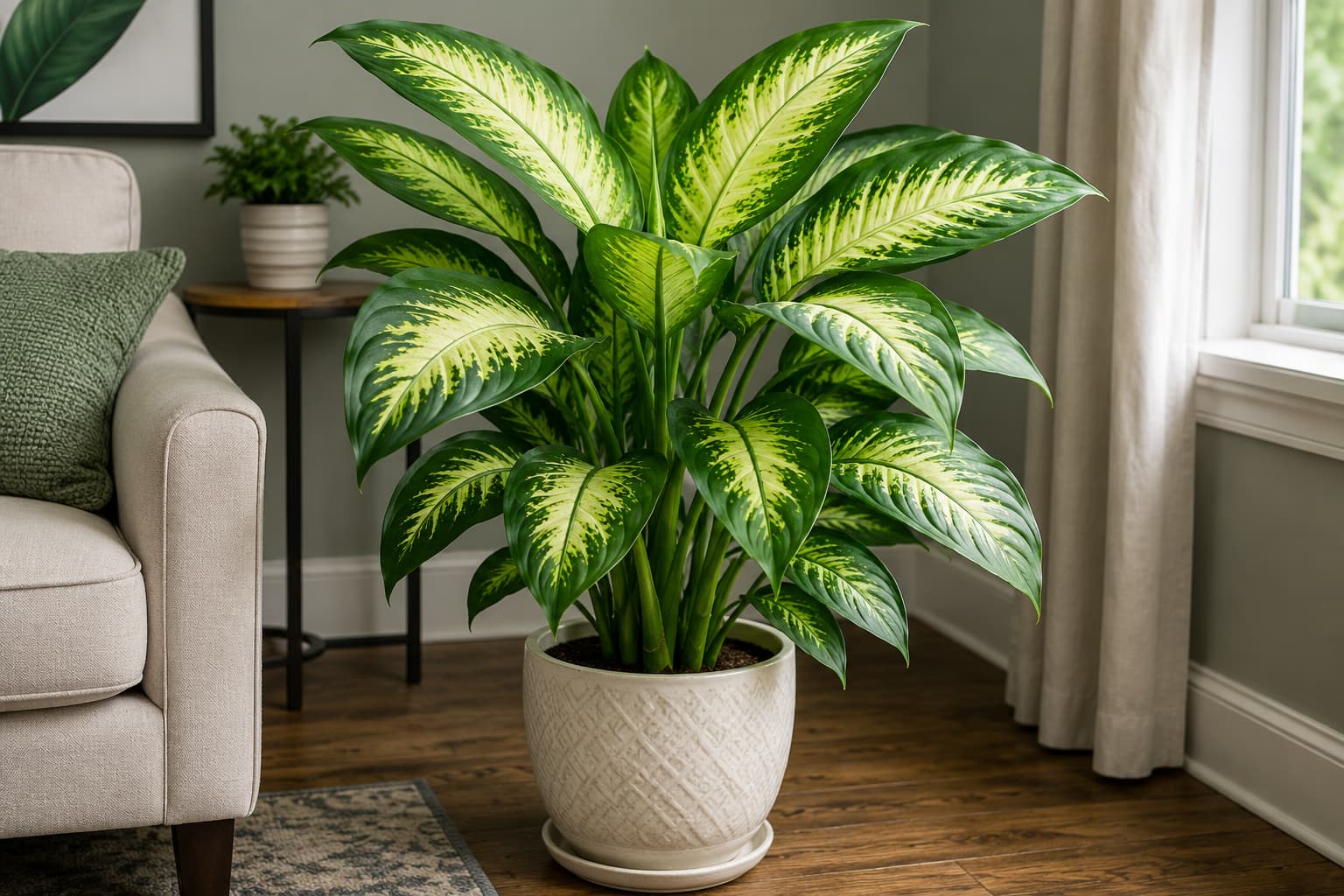
Dumb cane is the common name for plants in the genus Dieffenbachia, a group of tropical, evergreen plants in the Araceae family. They are grown primarily for their attractive foliage rather than their flowers.
Their large leaves are commonly patterned with combinations of green, cream, white, or yellow. Depending on the species or cultivar and growing conditions, plants can develop into substantial indoor specimens.
The name “dumb cane” has a rather unpleasant origin. The plant contains irritating calcium oxalate crystals, which can cause significant irritation and swelling if plant material is chewed or swallowed. Its sap can also irritate the skin and eyes.
That does not make dumb cane unsuitable as a houseplant. It simply means it should be treated as an ornamental plant rather than something children or pets should have access to.
15 Dumb Cane Care Tips for Healthy Growth
Below are 15 proven dumb cane care tips to help your Dieffenbachia grow healthy, lush, and vibrant indoors, from proper lighting and watering to soil, humidity, and routine care.
1. Give Your Dumb Cane Bright, Filtered Light
Getting the dumb cane light requirements right is one of the easiest ways to improve its appearance.
Dumb cane generally performs well in bright, filtered or indirect light. It can tolerate lower-light conditions, but growth may become slower and less vigorous. University of Florida IFAS Extension (Gardening Solutions) recommends diffused sunlight or partial shade, while the Royal Horticultural Society (RHS) recommends bright filtered light for cultivation under glass.
A good indoor location might be:
• Near an east-facing window
• A short distance from a bright south- or west-facing window
• Near a bright window protected by a sheer curtain
• In a naturally bright room where direct midday sunlight does not fall strongly on the leaves
Avoid assuming that “tolerates low light” means “needs no light.”
A plant kept in a very dark corner may survive for a while but produce slower, weaker growth.
How to tell if light is too low
Watch for:
• Very slow production of new leaves
• Long, stretched stems
• Sparse growth
• The plant leaning strongly toward a window
• Leaves becoming less vigorous
UF/IFAS specifically notes that uneven growth can occur when the plant stretches toward a light source, and recommends turning it periodically to encourage more even growth.
Rotate the pot every week or two if one side consistently faces the window to encourage more even growth.
2. Protect It From Harsh Direct Sun
Dumb cane needs light, but more sunlight is not automatically better.
Strong direct sunlight, particularly through hot glass, can stress foliage and contribute to leaf scorching. A filtered-light position is generally safer.
If your plant has been sitting in a dim location, do not suddenly move it into intense sunlight. Make changes gradually.
For example, if a dumb cane has spent months in a relatively dark room, moving it immediately beside a hot west-facing window may create more problems than it solves.
Increase light gradually and monitor the leaves for signs of stress or sunburn.
If your home has limited natural light, explore 21 Best Low Light Plants for Beginners (Easy to Grow) for easy-care plants that can thrive in lower-light indoor spaces.
3. Water According to the Soil, Not the Calendar
One of the most important rules in dumb cane watering is to stop thinking in terms of a fixed weekly schedule.
Instead, check the growing medium.
UF/IFAS recommends regular watering while allowing the soil to dry between waterings. The RHS similarly recommends moderate watering and keeping the plant in moist but well-drained growing conditions.
A simple routine is:
1. Check the top portion of the potting mix.
2. If it has dried to an appropriate depth, water thoroughly.
3. Allow excess water to drain away.
4. Empty standing water from the saucer or cachepot.
5. Wait until the plant needs water again rather than watering automatically.
The exact interval will vary according to temperature, humidity, pot size, soil composition, plant size, and light levels.
A dumb cane in bright light and a warm room may use water faster than one growing in a cool, dim corner.
Why overwatering is dangerous
Repeatedly keeping the root zone saturated reduces the air available around the roots. Over time, this can contribute to root problems and poor plant health.
This is why well-drained soil and sensible watering need to work together.
Choosing the right soil is essential for healthy indoor plants. Explore Best Soil for Indoor Plants: How to Choose the Right Potting Mix for practical tips on drainage, moisture, and healthy root growth.
4. Do Not Let the Plant Sit in Standing Water
Even if you have mastered when to water, drainage still matters.
A pot with drainage holes gives excess water somewhere to escape. Without adequate drainage, water can accumulate around the roots and the potting medium can remain excessively wet.
After watering, allow the container to drain freely.
If your decorative planter has no drainage hole, consider placing the dumb cane in a properly drained nursery pot inside the decorative container.
Then remove accumulated water from the outer container.
Avoid watering the plant and leaving several centimeters of standing water beneath the inner pot, as this can lead to root rot.
That is not the same thing as keeping the plant properly hydrated.
Proper watering is essential for healthy houseplants. Learn How to Water Indoor Plants Properly: Complete Beginner’s Guide for simple tips on when, how, and how often to water.
5. Use a Loose, Well-Draining Potting Mix
The right dumb cane soil requirements are relatively simple: the growing medium should retain enough moisture for the roots while still draining efficiently.
The RHS recommends a well-drained potting medium for Dieffenbachia.
A practical indoor mix can contain:
• Quality indoor potting mix
• Material that improves drainage and aeration, such as perlite
• Organic material that helps retain moderate moisture
The goal is not to create the “perfect” recipe. The goal is to prevent the soil from becoming a dense, waterlogged mass.
If your existing soil stays wet for many days after watering, the problem may be the growing medium rather than the amount of water you are applying.
For a more detailed discussion of choosing indoor potting mixes, see our guide to the best soil for indoor plants.
6. Choose a Pot With Good Drainage
The container is part of your plant-care system.
A dumb cane does not need an enormous pot simply because you want it to become large. An oversized container can hold a large volume of wet soil around a relatively small root system.
When repotting, choose a container that gives the roots room to continue developing without dramatically increasing the amount of wet soil around them.
Look for:
• At least one effective drainage hole
• A stable base
• A size appropriate for the existing root system
• A container that is not unnecessarily deep or oversized
If you are unsure how to choose a container, our guide on how to choose the right pot for indoor plants provides additional guidance.
Choosing the right pot can improve drainage, root health, and overall plant growth. Explore How to Choose the Right Pots for Indoor Plants for nine practical tips to choose wisely.
7. Keep the Plant Warm and Away From Cold Drafts
Dumb cane is a tropical plant and generally prefers warm indoor conditions.
UF/IFAS gives a preferred temperature range of about 60–75°F (16–24°C), while also advising protection from colder conditions.
For indoor growing, avoid placing your plant directly beside:
• Cold drafts
• Air-conditioning outlets
• Frequently opened exterior doors
• Very cold windows
• Strong sources of sudden temperature changes
In warm climates such as much of Nigeria, excessive heat combined with direct sun can be a more relevant concern than cold. Good ventilation, filtered light, and appropriate watering become especially important.
Looking for houseplants that suit local conditions? Explore 25 Best Indoor Plants in Nigeria + Complete Care Guide for easy-to-grow options and practical tips for healthy indoor plants.
8. Provide Reasonable Humidity
Dumb cane naturally comes from tropical environments, so it generally appreciates humidity.
The New York Botanical Garden recommends high humidity for cultivation of Dieffenbachia.
However, you do not necessarily need to turn your home into a greenhouse.
If your indoor environment is naturally warm and reasonably humid, the plant may do perfectly well without special equipment.
If the air is particularly dry, consider:
• Grouping plants together
• Using a humidifier
• Keeping the plant away from very dry airflow
• Monitoring the leaves for signs of stress
A humidity tray can be used, but it should not be treated as a substitute for good watering and drainage.
9. Feed During Active Growth, but Do Not Overfertilize
Dumb cane needs nutrients to produce healthy foliage, but fertilizer is not a cure for poor light, bad soil, or incorrect watering.
The RHS recommends balanced liquid fertilizer monthly during active growth for several Dieffenbachia cultivars.
For a home grower, the safest approach is to use a balanced houseplant fertilizer according to the manufacturer’s instructions.
Avoid the temptation to add extra fertilizer because you want faster growth.
Too much fertilizer can lead to salt accumulation and leaf damage. UF/IFAS notes that excessive fertilizer can contribute to curled leaves and brown edges.
If your plant is already stressed, correct the underlying care problem before assuming it needs more fertilizer.
For a deeper explanation of feeding houseplants, see how to fertilize indoor plants the right way.
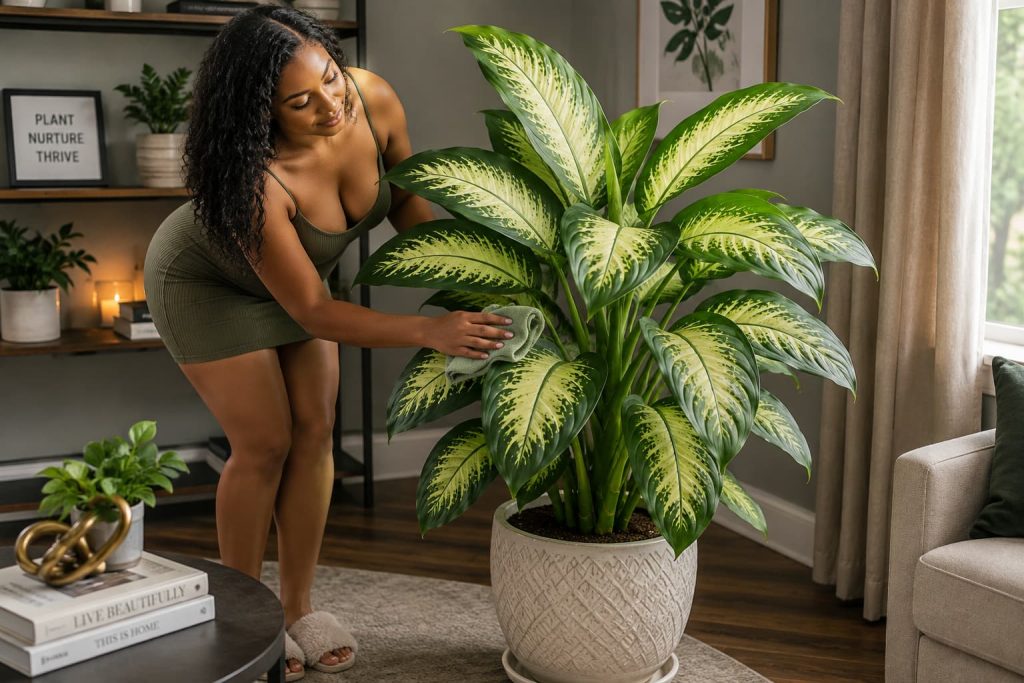
10. Clean the Leaves Regularly
Large dumb cane leaves can collect dust, especially indoors.
A layer of dust can make the foliage look dull and can interfere with your ability to inspect the plant properly for pests or damage.
Every so often, gently wipe the leaves with a clean, damp cloth.
Be gentle. The objective is simply to remove dust rather than polish the foliage with unnecessary products.
This is also a useful opportunity to inspect both the upper and lower surfaces of the leaves.
Look for:
• Small insects
• Webbing
• Cottony material
• Brown spots
• Yellowing
• Leaf distortion
• Sticky residue
Early detection makes many plant problems easier to manage.
Yellow leaves, drooping, and slow growth can signal common houseplant problems. Explore 21 Common Indoor Plant Problems and How to Fix Them Fast for practical solutions to keep your plants healthy.
11. Rotate the Plant for More Even Growth
Dumb cane naturally grows toward available light.
If the same side faces a window for months, the plant can become noticeably lopsided.
Rotating the container periodically allows different sides of the plant to receive similar exposure.
This is a small task, but it can make a significant difference to the plant’s overall shape.
Cornell University College of Agriculture and Life Sciences recommends turning dumb cane regularly to encourage even growth.
If you notice one side becoming much fuller than the other, do not immediately assume the plant has a disease. Uneven light may simply be the explanation.
12. Prune Damaged or Unwanted Growth
Dumb cane generally does not require extensive pruning, but occasional trimming can improve its appearance and remove damaged foliage.
Remove leaves that are:
• Completely yellow or brown
• Severely damaged
• Dead
• Diseased-looking
• Creating an unwanted shape
Use clean, sharp pruning tools.
Because dumb cane sap can irritate the skin and eyes, wear gloves when cutting the plant and avoid touching your face while working.
The RHS notes that Dieffenbachia sap is potentially harmful and can irritate skin and eyes.
Dispose of removed plant material safely, particularly if children or pets are present.
13. Repot When the Plant Actually Needs It
Repotting is useful, but it should not become a yearly ritual simply because the calendar says so.
Consider repotting when:
• Roots are becoming crowded
• The plant repeatedly dries out unusually quickly
• The potting mix has broken down and drains poorly
• Roots are emerging substantially from drainage holes
• The plant has become unstable in its container
• Growth is being restricted by the root environment
When repotting, avoid jumping to a dramatically larger container.
A modest increase in pot size is often more sensible.
Choose fresh, well-draining potting mix and make sure the new container drains properly.
For a complete walkthrough, see how to repot indoor plants without damaging the roots.
14. Watch for Pests Before They Become a Major Problem
Dumb cane can experience common houseplant pests, including mealybugs and spider mites.
American Horticultural Society (AHS) specifically identifies mealybugs and spider mites among pests that can affect Dieffenbachia.
Mealybugs
They may appear as small, cottony masses around stems, leaf joints, or other protected areas.
Spider mites
They can cause pale or stippled foliage and may produce fine webbing, particularly on the undersides of leaves.
If you suspect an infestation:
1. Isolate the affected plant from nearby houseplants.
2. Inspect stems and both sides of leaves.
3. Remove or wash away pests where practical.
4. Choose a treatment appropriate for the pest.
5. Follow the product label carefully if using a pesticide.
6. Continue monitoring after treatment.
Do not assume that one treatment always solves an infestation. Repeated monitoring is often necessary.
For broader troubleshooting, your article on common indoor plant pests and how to eliminate them can serve as a useful companion resource.
15. Treat Yellow Leaves as a Clue, Not a Diagnosis
One of the most common searches related to dumb cane is dumb cane yellow leaves.
The important thing to understand is that a yellow leaf does not automatically mean one specific problem.
Yellowing can have several possible causes, including:
• Natural aging of older leaves
• Excessive moisture
• Inconsistent watering
• Poor growing conditions
• Temperature stress
• Pest activity
• Other forms of plant stress
Missouri Botanical Garden notes that the lowest leaves may naturally turn yellow and droop as part of normal aging. It also identifies watering irregularities and cold conditions as possible causes of other leaf problems.
Use the pattern to investigate
One old lower leaf turns yellow:
This may simply be normal aging, particularly if the rest of the plant looks healthy.
Several leaves turn yellow while the soil stays wet:
Review your watering frequency, drainage, and potting mix.
Leaves droop and the soil is very dry:
The plant may need water.
Leaves have brown tips:
Look at watering consistency, humidity, and fertilizer practices. UF/IFAS specifically associates brown tips with uneven watering.
New growth is weak and the plant stretches toward the window:
Review light levels.
The key is to look at the entire plant rather than treating one symptom in isolation.
How to Tell What Your Dumb Cane Needs
When your plant looks unhealthy, use this quick diagnostic approach.
Leaves are drooping
Check the soil first.
Very dry soil → watering may be needed.
Wet soil → do not automatically add more water.
Wet soil plus repeated yellowing → investigate drainage and root conditions.
Drooping after exposure to cold → move the plant to a warmer location.
Chicago Botanic Garden notes that drooping can result from insufficient water, while cold stress can also cause drooping and leaf loss.
Leaves are turning yellow
Check:
1. Which leaves are affected?
2. How wet is the soil?
3. How frequently are you watering?
4. Is the pot draining properly?
5. Has the plant recently experienced a temperature change?
6. Are pests present?
Do not fertilize immediately just because leaves are yellow.
Leaves have brown edges or tips
Start by reviewing:
• Watering consistency
• Fertilizer use
• Humidity
• Root-zone conditions
• Exposure to hot or stressful conditions
Texas A&M AgriLife Extension notes that inconsistent watering and excessive fertilizer can contribute to brown or damaged leaf margins.
The plant is growing slowly
First examine the basics.
Is the plant receiving enough useful light?
Is the root environment healthy?
Has the plant been recently repotted?
Is it receiving appropriate nutrition during active growth?
Low light can reduce new growth, and UF/IFAS specifically recommends moving a slow-growing plant to a brighter location when inadequate light is suspected.
Where Should You Put a Dumb Cane Indoors?
The best location combines bright filtered light, warmth, reasonable humidity, and protection from extremes.
Good locations can include:
• A bright living room
• A bedroom with filtered window light
• A well-lit office
• A bright hallway near a window
• A sheltered area where strong direct sunlight is filtered
Avoid placing it:
• In a completely dark corner
• Directly beside an air-conditioning outlet
• In intense, prolonged direct sunlight
• Where children or pets can easily chew the plant
• In a location where water routinely accumulates around the pot
Dumb cane can tolerate lower light than many foliage plants, but if you want strong, attractive growth, providing better indirect light is generally preferable.
Can Dumb Cane Grow in Low Light?
Yes, dumb cane can tolerate lower light, which is one reason it is commonly grown indoors.
However, tolerating low light is not the same as thriving in darkness.
In low light, expect slower growth. A plant that receives inadequate light may also become stretched or develop uneven growth toward the nearest light source.
If your plant has stopped producing healthy new leaves, consider light before immediately changing fertilizer or watering.
How Often Should You Water a Dumb Cane?
There is no single number of days that works for every dumb cane.
Your plant’s watering needs depend on:
• Pot size
• Drainage
• Soil composition
• Temperature
• Humidity
• Light
• Plant size
• Season
• Root development
A better method is to check the soil regularly and water when it has dried sufficiently rather than following a rigid schedule.
When you water, do it thoroughly enough to moisten the root zone and allow excess water to drain.
Then let the plant move toward its next watering period.
This approach is more reliable than rules such as “water every Sunday.”
For additional guidance, see how to water indoor plants properly.
Should You Mist a Dumb Cane?
Misting is often recommended for tropical plants, but it should not be treated as a cure-all for dry indoor air.
If your home is genuinely dry, a humidifier can provide more consistent humidity than occasional misting.
The bigger priorities remain:
• Proper watering
• Good drainage
• Appropriate light
• Warm temperatures
• Healthy soil
• Adequate air movement
Humidity can support good growth, but increasing humidity does not compensate for waterlogged soil.
Is Dumb Cane Safe Around Children and Pets?
No. Dumb cane should be treated as a potentially toxic ornamental plant.
The American Society for the Prevention of Cruelty to Animals (ASPCA) classifies Dieffenbachia as toxic if eaten and notes that it can irritate the skin and eyes.
Poison Control explains that Dieffenbachia contains calcium oxalate crystals that can cause painful irritation, swelling, drooling, difficulty swallowing, and other symptoms after ingestion.
For this reason:
• Keep dumb cane away from young children.
• Keep it inaccessible to pets that chew plants.
• Wear gloves when pruning or handling broken stems.
• Avoid getting sap in your eyes.
• Wash your hands after handling the plant.
• Never intentionally consume any part of the plant.
If someone or a pet has ingested dumb cane, seek appropriate poison-control or veterinary guidance rather than relying on home remedies.
Dumb Cane Care: A Simple Weekly Routine
You do not need to spend hours caring for your plant.
A simple routine can be enough.
Once a week
Check the soil:
Feel the potting mix and determine whether the plant actually needs water.
Inspect the leaves:
Look for yellowing, brown areas, curling, pests, or unusual spots.
Check the plant’s position:
Make sure it is still receiving suitable filtered light.
Look underneath the leaves:
Pests often hide in less visible areas.
Every few weeks
Rotate the plant if it is growing toward one direction.
Wipe dusty leaves gently with a clean, damp cloth.
Check the drainage hole and make sure it is not blocked.
During active growth
Monitor new growth and fertilize according to the requirements of your chosen fertilizer.
When problems appear
Do not change five things at once.
Identify the most likely cause, make one or two sensible corrections, and observe the plant’s response.
This makes troubleshooting much easier.
Common Dumb Cane Care Mistakes to Avoid
Avoiding common dumb cane care mistakes can help your Dieffenbachia stay healthy, lush, and vibrant. Learn what to avoid for stronger growth and healthier leaves.
Mistake 1: Watering on a Fixed Schedule
A calendar cannot account for changing temperature, light, humidity, or soil conditions. Check the plant and soil first, then water when needed.
Mistake 2: Keeping Dumb Cane in a Dark Corner
Dumb cane can tolerate lower light, but too little light can slow growth and reduce the vibrancy of its foliage. Place it in bright, indirect or filtered light for healthier growth.
Mistake 3: Using Heavy Soil That Stays Wet
Heavy, poorly draining soil can retain excess moisture around the roots and increase the risk of root problems. Use a loose, well-draining potting mix that allows excess water to escape.
Mistake 4: Using a Pot That Is Too Large
An oversized pot contains more soil, which can retain moisture for longer and increase the risk of overwatering. When repotting, choose a container only slightly larger than the current one.
Mistake 5: Fertilizing When Leaves Look Unhealthy
Yellowing, drooping, or damaged leaves can have many causes, and fertilizer will not fix every problem. Identify the underlying issue before applying fertilizer.
Mistake 6: Ignoring Pests Until the Plant Is Badly Damaged
Small pest infestations are usually easier to manage before they spread and cause extensive damage to the leaves and stems. Inspect your dumb cane regularly for signs of pests.
Mistake 7: Forgetting That Dumb Cane Is Toxic
Dumb cane contains compounds that can cause irritation if parts of the plant are chewed or mishandled. Keep it away from children and pets, and wear gloves when handling broken stems.
Frequently Asked Questions About Dumb Cane Care
1. How often should I water a dumb cane plant?
Water your dumb cane when the upper portion of the potting mix has dried rather than following a fixed weekly schedule. Water thoroughly until excess drains from the bottom, then empty any water collected in the saucer. How quickly the soil dries depends on light, temperature, humidity, pot size, and the type of potting mix.
2. How much light does a dumb cane plant need indoors?
Dumb cane generally does best in bright, filtered or indirect light. Place it near a bright window where harsh direct sunlight is softened by a sheer curtain or distance from the glass. It can tolerate lower light, but growth may become slower and less vigorous.
3. Can dumb cane grow in low light?
Yes. Dumb cane is relatively tolerant of lower-light indoor conditions, but low light should not be confused with darkness. In a very dim location, the plant may grow slowly, become leggy, or lean toward the nearest light source. For healthier, fuller growth, provide bright indirect light whenever possible.
4. Why are my dumb cane leaves turning yellow?
Yellow leaves can have several causes, so look at the pattern rather than assuming there is one solution. An occasional older lower leaf turning yellow can be normal aging. However, widespread yellowing may indicate problems such as excessive moisture, poor drainage, inconsistent watering, temperature stress, or pests. Check the soil and roots before adding fertilizer or increasing watering.
5. What is the best soil for a dumb cane plant?
Use a loose, well-draining indoor potting mix that retains some moisture without becoming waterlogged. A quality houseplant mix amended with an aerating material such as perlite can work well. Avoid dense garden soil or mixtures that remain saturated for prolonged periods.
6. Why are the leaves on my dumb cane turning brown?
Brown tips or edges can be associated with inconsistent watering, excessive fertilizer, dry conditions, or environmental stress. Start by checking the soil moisture and reviewing your watering routine. Also consider whether the plant has recently experienced very dry air, temperature extremes, or excessive fertilizer. Avoid treating brown leaves with extra water or fertilizer until you identify the likely cause.
7. How can I make my dumb cane grow fuller and healthier?
Give it adequate bright indirect light, maintain appropriate watering, use well-draining soil, and rotate the pot periodically so growth develops more evenly. Remove severely damaged leaves with clean tools and provide nutrients during active growth according to the fertilizer label. Avoid excessive pruning or fertilizer in an attempt to force faster growth.
8. How often should I fertilize a dumb cane plant?
During active growth, dumb cane can benefit from a balanced houseplant fertilizer used according to the product’s directions. The exact frequency depends on the fertilizer formulation and growing conditions. Avoid applying more fertilizer than recommended, because excessive nutrients can damage roots and contribute to brown leaf margins.
9. When should I repot my dumb cane plant?
Repot when the plant has become significantly root-bound, the potting mix has deteriorated, drainage has become poor, or the container is no longer suitable for the root system. Choose a new pot only moderately larger than the current one and use fresh, well-draining potting mix. Repotting too frequently or moving a small root system into a very large pot can leave excess soil wet for too long.
10. Is dumb cane poisonous to cats, dogs, and children?
Yes. Dumb cane (Dieffenbachia) should be considered toxic if eaten. It contains calcium oxalate crystals that can cause painful irritation and swelling of the mouth and throat, along with other symptoms. Its sap can also irritate the skin and eyes. Keep the plant away from children and pets, and wear gloves when pruning or handling damaged stems.
11. What should I do if my dumb cane plant is drooping?
First, check the soil. If it is very dry, the plant may be experiencing water stress and may need a thorough watering. If the soil is already wet, do not automatically add more water. Examine drainage, watering frequency, temperature, and root conditions. A drooping plant with persistently wet soil may have a root-zone problem rather than a lack of water.
12. How do I get rid of pests on my dumb cane plant?
Start by identifying the pest and isolating the affected plant from other houseplants. Inspect both sides of the leaves, stems, and leaf joints for insects or webbing. Physically remove or wash away pests where practical, then use an appropriate treatment according to its label instructions. Continue inspecting the plant after treatment because pest problems may require repeated attention.
Conclusion
Successful dumb cane plant care is less about following a complicated schedule and more about learning how to read your plant and respond to its needs.
Provide bright, filtered light, water according to soil moisture, use a well-draining growing medium, maintain warm conditions, provide reasonable humidity, and check the foliage regularly. For additional botanical information and plant classification, you can also consult the USDA Plants Database.
When something goes wrong, resist the temptation to immediately add fertilizer or water. Instead, look at the complete picture first. Yellow leaves, drooping, brown tips, slow growth, and pests are clues that can help you identify what your Dieffenbachia needs.
Most importantly, remember that Dieffenbachia is toxic if eaten, while its sap can irritate the skin and eyes. Keep it away from children and pets and handle it responsibly.
With consistent care and the right growing conditions, dumb cane can become a striking, long-lasting foliage plant that brings beautiful tropical character to your indoor space.

I’m Bon (aka Guider), an indoor gardening writer and houseplant enthusiast passionate about helping beginners successfully grow and care for indoor plants. I create practical, beginner-friendly guides covering indoor plant care, watering, lighting, soil, repotting, plant problems, and choosing suitable houseplants for different homes. My articles draw on research from trusted horticultural organizations, university extension resources, and botanical institutions, combined with practical plant-care principles and careful content review.