
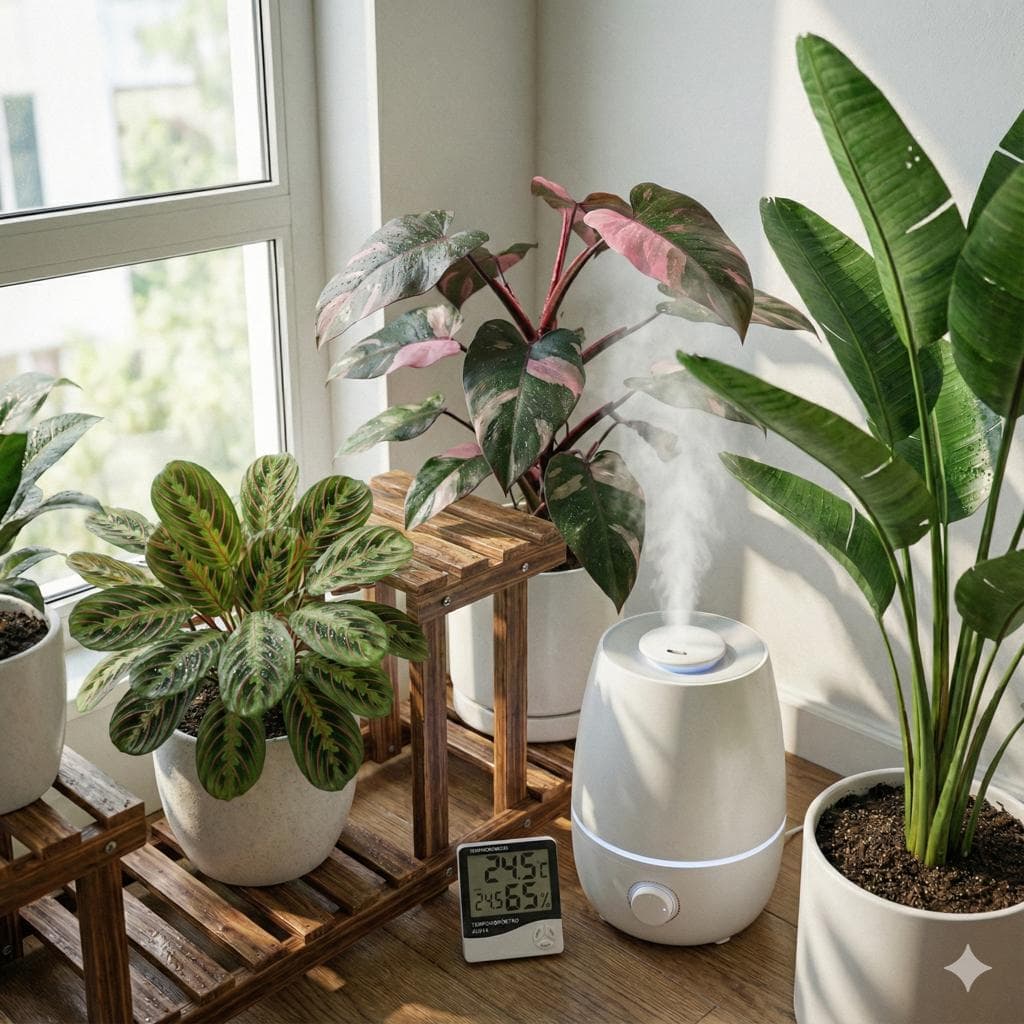
Dry indoor air can cause tropical houseplants to develop crispy leaf edges, curling foliage, browning tips, and disappointing new growth. If you are wondering how to increase humidity for plants, the solution is not simply spraying the leaves with water or placing every pot beside a bowl of water. Effective humidity management involves understanding your plant’s needs and using practical methods that provide more consistent moisture around the foliage without keeping the growing medium unnecessarily wet.
The most useful approach depends on how dry your room is, which plants you grow, and whether you need a small improvement around a single plant or a measurable increase throughout the room.
This guide explains 10 practical ways to increase humidity for indoor plants, including inexpensive household adjustments, DIY options, and when a humidifier is worth the investment. You will also learn how to recognize genuine humidity stress, avoid common mistakes, and choose a method that suits your growing conditions.
If you want to learn how to grow and care for houseplants successfully, explore our detailed Complete Indoor Plant Care Guide for Beginners and professionals.
What Is Humidity and Why Does It Matter for Indoor Plants?
Humidity refers to the amount of water vapor present in the air. In indoor gardening, it is usually discussed as relative humidity (RH), expressed as a percentage.
Relative humidity tells you how close the air is to holding its maximum moisture capacity at a particular temperature. Warm air can hold more water vapor than cool air, so the same amount of moisture can produce different relative humidity readings at different temperatures.
Plants lose water through tiny openings in their leaves called stomata. This process, known as transpiration, is a normal part of plant function. When the surrounding air is dry, water may be lost more rapidly, increasing the demand on the plant’s roots and water supply.
Many tropical foliage plants appreciate more humid conditions than those found in dry, air-conditioned, or heated homes. However, not every indoor plant needs high humidity. Cacti, many succulents, and other plants adapted to arid environments are generally comfortable with considerably drier air.
What humidity level is best for indoor plants?
There is no single ideal percentage for every houseplant.
| Relative Humidity | General Indoor Plant Consideration |
| Below 30% | Dry air may stress humidity-sensitive tropical plants |
| 30–40% | Tolerable for some resilient houseplants, but potentially uncomfortable for moisture-loving species |
| 40–60% | A practical range for many common indoor plants |
| 60–70% | May suit some tropical plants, provided air circulation and disease prevention are managed |
| Above 70% | Not automatically better; stagnant, persistently damp conditions can encourage problems |
These ranges are practical guidance rather than universal requirements. Plant species, temperature, airflow, and watering practices all influence how a plant responds.
Penn State Extension notes that many houseplants benefit from humidity higher than typical dry winter indoor conditions, while some succulents and cacti are exceptions.
A small digital hygrometer is more useful than guessing from how the air feels. Place it near your plants, away from direct mist, water droplets, or a humidifier’s output.
10 Easy Ways to Increase Humidity for Indoor Plants
If you are learning how to increase humidity for plants, there are several simple methods you can use at home. Let’s examine these 10 practical ways to increase humidity for indoor plants and how each method can help create a more suitable environment for moisture-loving houseplants.
1. Use a Humidifier Near Your Indoor Plants
If you want a dependable way to raise humidity for several indoor plants, a humidifier is usually the most controllable option.
Unlike temporary methods that release small amounts of moisture, a humidifier adds water vapor continuously while operating. This makes it particularly useful in rooms with air conditioning, heating, or persistently dry indoor air.
How to use a humidifier effectively
1. Place the unit in the same room as the plants.
2. Position it where the moisture can disperse without soaking leaves or walls.
3. Use a hygrometer to monitor relative humidity near the plant collection.
4. Follow the manufacturer’s cleaning and water-changing instructions.
5. Adjust operation according to the room’s humidity rather than leaving it running continuously by default.
A humidifier does not need to blow directly onto foliage. The objective is to improve the surrounding air, not create constantly wet leaves.
What type of humidifier is suitable?
Common options include:
• Ultrasonic humidifiers: Often quiet and suitable for bedrooms, offices, and plant corners.
• Evaporative humidifiers: Use a fan and a wet wick or filter to release moisture into the air.
• Warm-mist humidifiers: Heat water to produce vapor but may consume more electricity and become hot during operation.
The most suitable choice depends on room size, operating cost, maintenance requirements, and availability.
Important limitation
A humidifier that is too powerful for a small room can push humidity unnecessarily high. Excessive moisture combined with poor ventilation may encourage condensation and fungal problems.
This is best for plant collections, consistently dry rooms, and humidity-sensitive tropical plants.
2. Group Indoor Plants Together to Create a Humid Microclimate
Grouping plants is one of the simplest ways to improve the humidity around a collection without purchasing equipment.
Plants release water vapor through transpiration. When several plants occupy the same area, their combined moisture release can create a more humid microenvironment around the foliage than widely separated plants might produce.
This does not mean a cluster will automatically transform a dry room into a tropical greenhouse. Air movement, plant size, spacing, and room ventilation all affect the result.
How to group plants properly
• Arrange plants with broadly similar light requirements.
• Keep enough space between leaves for air movement.
• Place plants near suitable natural or artificial light.
• Avoid crowding foliage against damp walls or windows.
• Monitor for pests and leaf diseases, especially in dense arrangements.
For example, a collection of peace lilies, pothos, and other moisture-tolerant foliage plants may benefit from sharing a suitable growing area, provided their light and watering needs are compatible.
Iowa State University Extension explains that grouping plants can raise humidity around them, while North Carolina State Extension emphasizes maintaining air circulation to reduce the possibility of foliar diseases.
Most suitable for beginners, plant shelves, and people who already own several houseplants.
3. Move Humidity-Loving Plants to a Naturally More Humid Room
Some rooms naturally experience temporary increases in humidity because of bathing, cooking, or other activities that release water vapor.
A bathroom with adequate light can be a suitable location for certain humidity-loving plants. A kitchen may also work if the plant receives appropriate light and is kept away from cooking heat, grease, and harsh temperature fluctuations.
However, a humid room is not automatically a suitable plant room.
A dark bathroom with no window or grow light may be unsuitable for a plant that requires bright indirect light. Similarly, a kitchen beside a hot cooker may expose foliage to uncomfortable heat.
Before relocating a plant, check:
• Is there enough light?
• Does the room remain reasonably ventilated?
• Will the plant be exposed to hot steam or temperature extremes?
• Is the humidity reasonably consistent rather than occurring only during showers?
• Can the plant be protected from splashing water and household chemicals?
A bathroom can be especially useful for plants that appreciate humidity, but light remains a separate and essential requirement.
This is most suitable for humidity-sensitive plants that also tolerate the available lighting conditions.
4. Create a Pebble Tray for a Small Humidity Boost
A pebble tray is a traditional, inexpensive humidity method. It consists of a shallow tray containing pebbles and water, with the plant pot elevated above the waterline.
As water evaporates, it adds moisture to the surrounding air. The important question is how much of that moisture reaches the plant’s foliage.
How to make a humidity tray for plants
Materials needed:
• A shallow, waterproof tray.
• Clean pebbles or gravel.
• Water.
• A potted plant with drainage holes.
Instructions:
1. Choose a tray wider than the plant pot.
2. Spread an even layer of pebbles across the bottom.
3. Add water until it sits below the top of the pebbles.
4. Place the pot on the stones.
5. Confirm that the base of the pot remains above the water.
6. Refill the tray when necessary and clean it regularly.
It is important to note that you must never allow the pot’s drainage holes or bottom to sit directly in standing water. Constant contact with water can keep the potting mix excessively wet and increase the risk of root damage.
Do pebble trays increase humidity?
The answer requires nuance.
Some extension publications recommend pebble trays as a way to increase humidity near plants. Other horticultural guidance, including Penn State Extension, questions whether the effect is meaningful enough to improve humidity around the foliage in a typical room.
The practical conclusion is that a pebble tray may provide a modest local benefit, but it should not be treated as a replacement for a humidifier when room humidity is genuinely low.
Good for a low-cost experiment, small plant displays, and mildly dry conditions.
5. Reduce Dry Air From Air Conditioners, Heaters, and Strong Drafts
Sometimes the best way to protect an indoor plant from humidity stress is not to add more moisture but to stop exposing it to unnecessarily dry airflow.
Air conditioners, heating systems, fans, and strong drafts can alter the conditions around plant foliage. A plant positioned directly beneath an air-conditioning outlet may experience rapid moisture loss even when another part of the room has more comfortable humidity.
What to do
• Move plants away from direct air-conditioner discharge.
• Avoid placing sensitive foliage beside heaters.
• Keep plants away from persistent cold drafts.
• Check humidity near the plant rather than relying on a reading across the room.
• Avoid placing leaves directly in front of powerful fans.
This does not mean plants need completely still air. Gentle air circulation is beneficial, especially where humidity is elevated. The goal is to avoid harsh, continuous airflow while preserving ventilation.
It is best for plants showing dry leaf edges near cooling or heating equipment.
6. Use a Humidity Cabinet or Enclosed Plant Display
An enclosed plant cabinet can help maintain a more humid environment around selected houseplants by reducing the rapid exchange of moist air with the surrounding room.
This approach is especially useful for small tropical plants that struggle in dry homes but do not require an entire room to be humidified.
A cabinet may be a converted glass display case, a purpose-built indoor greenhouse, or another enclosed growing structure with suitable ventilation and lighting.
What makes an indoor plant cabinet effective?
• Adequate lighting.
• Some ventilation or controlled airflow.
• Sufficient space for the plant’s growth.
• A way to monitor temperature and humidity.
• Protection against excessive condensation.
• Easy access for watering and pest inspection.
A sealed cabinet is not automatically better than an open display. Without adequate airflow and monitoring, high moisture levels can create an environment favorable to fungal and bacterial problems.
This is best for small collections of humidity-sensitive tropical plants and dedicated indoor gardeners.
7. Use a Clear Propagation Dome for Suitable Small Plants
A propagation dome is a transparent cover placed over a suitable propagation tray or small plant container. It reduces moisture loss from the enclosed environment and can help maintain high humidity around cuttings and young plants.
This is particularly useful during propagation, when some cuttings benefit from reduced water loss before they develop a functioning root system.
How to use a propagation dome responsibly:
1. Place appropriate cuttings or young plants in a suitable growing medium.
2. Cover them with a clean, transparent dome.
3. Provide suitable indirect light.
4. Monitor condensation and plant condition.
5. Ventilate periodically when necessary.
6. Remove or loosen the cover as the plant develops and no longer needs such a humid environment.
A propagation dome is not intended for every mature houseplant. Some established plants need better airflow and more space than a small enclosure provides.
This is very good for propagation projects and young plants requiring a controlled environment.
8. Place Plants on a Wide, Moisture-Holding Display With Good Airflow
A carefully arranged plant display can help create a slightly more humid environment around a group of plants while making better use of available space.
This method works best when several plants share a suitable area and the display allows moisture to evaporate without leaving pots submerged or surfaces constantly wet.
You can use:
• A wide plant shelf.
• A plant stand with room between containers.
• A shallow moisture tray positioned beneath elevated pots.
• A larger decorative planter that accommodates several smaller containers without blocking drainage.
The key is to avoid confusing a decorative arrangement with a guaranteed humidity solution. The amount of moisture added depends on evaporation, surface area, airflow, and the surrounding room.
Very suitable for people who want to combine plant organization with modest environmental improvement.
9. Increase Humidity Around a Small Plant Collection With a Mini Greenhouse
A mini indoor greenhouse offers a more controlled environment than an ordinary open shelf.
Depending on its design, the enclosure can reduce moisture loss and help maintain higher humidity around plants. It may be useful for humidity-sensitive species that struggle in a dry room but do not require a full-sized greenhouse.
However, a mini greenhouse needs more attention than a simple plant stand.
What to monitor
• Humidity levels.
• Temperature fluctuations.
• Condensation on the enclosure.
• Air circulation.
• Signs of fungal disease.
• Available light.
Avoid placing a closed mini greenhouse in direct, intense sunlight unless it is specifically designed for those conditions. Internal temperatures can rise quickly.
A small fan may help improve air movement, but it should not blow harshly across delicate foliage.
This is best for dedicated indoor gardeners with limited space and a small collection of humidity-sensitive plants.
10. Combine Humidity Improvements With Better Plant Placement and Monitoring
The final method is less about one device and more about creating a supportive growing environment.
Humidity does not work in isolation. A plant exposed to unsuitable light, damaged roots, poor watering practices, or excessive heat may continue struggling even after you increase moisture in the air.
A sensible environmental adjustment may include:
1. Moving a plant away from direct air-conditioning airflow.
2. Placing it where light matches its requirements.
3. Grouping compatible plants.
4. Monitoring humidity with a hygrometer.
5. Using a humidifier if measurements show consistently dry conditions.
6. Maintaining adequate ventilation.
This combined approach prevents you from treating humidity as the explanation for every indoor plant problem.
Which Humidity Method Should You Choose?
Different households need different solutions. A person with two resilient houseplants in a naturally humid home may not need the same equipment as someone growing delicate tropical plants in an air-conditioned apartment.
The comparison below can help you decide.
| Method | Cost | Humidity Impact | Maintenance | Best Use |
| Humidifier | Medium to high | Usually the most controllable room-level option | Regular cleaning and monitoring | Dry rooms and plant collections |
| Grouping plants | Free if plants are already available | Modest local improvement | Low | Small collections |
| Humid room placement | Free | Depends on room conditions | Low | Suitable bathrooms and kitchens |
| Pebble tray | Low | Limited and variable | Occasional cleaning and refilling | Small local adjustments |
| Humidity cabinet | Medium to high | Potentially substantial within enclosure | Moderate to high | Sensitive tropical plants |
| Propagation dome | Low to medium | High within enclosed space | Frequent monitoring | Cuttings and young plants |
| Reducing harsh drafts | Free | Prevents localized drying | Low | Plants near AC or heaters |
| Mini greenhouse | Medium | Potentially high inside enclosure | Moderate | Controlled growing spaces |
The most reliable general strategy is to measure humidity first, then select the simplest method that addresses the actual conditions.
How to Tell If Indoor Plants Need More Humidity
Dry leaf tips alone do not prove that low humidity is the cause. Several unrelated problems can produce similar symptoms.
Signs that may be associated with low humidity
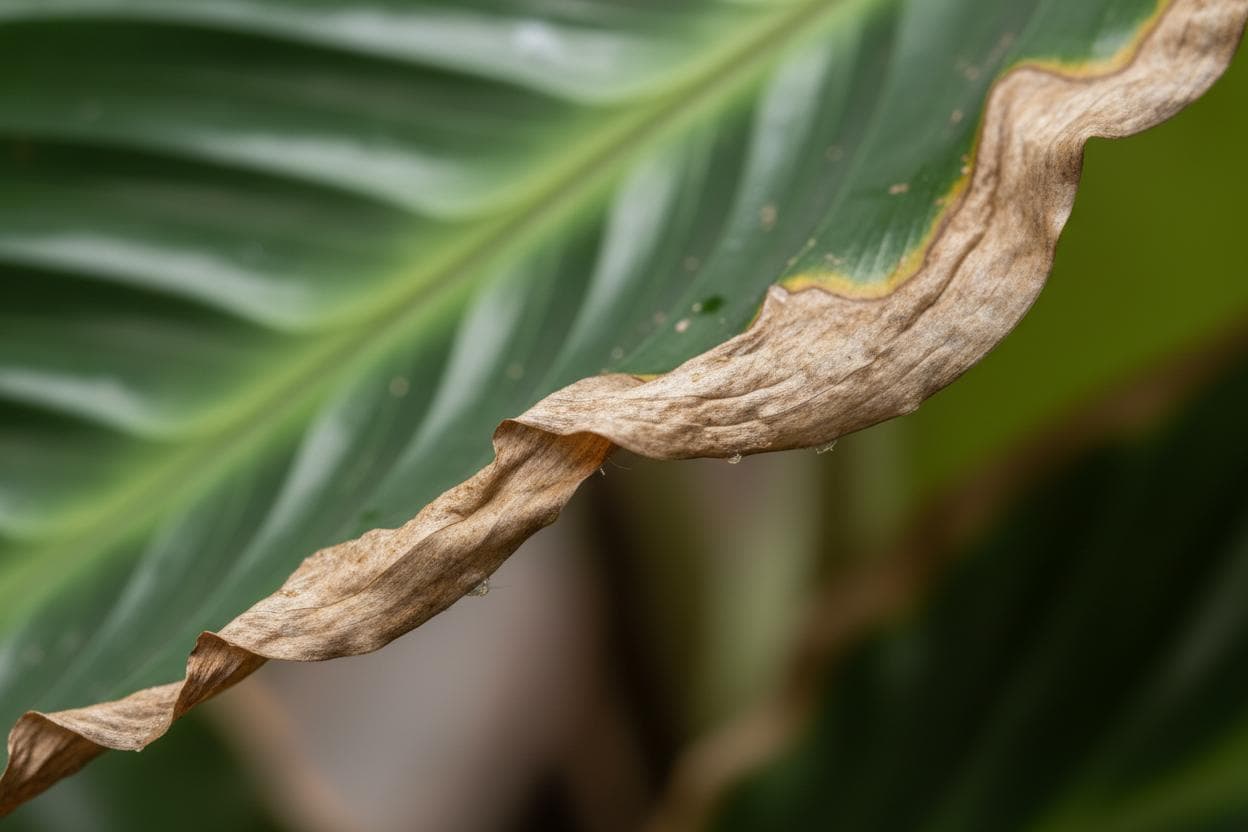
1. Crispy brown leaf edges
Dry, brown margins may occur when a plant loses water faster than it can replace it. Low humidity is one possible contributor, especially in humidity-sensitive tropical species.
However, excessive fertilizer salts, inconsistent watering, root damage, and heat stress can produce similar symptoms.
2. Curling leaf edges
Some plants curl or fold their leaves under environmental stress. Dry air may contribute, but curling is not a humidity-specific diagnosis.
3. New leaves struggling to develop
Humidity-sensitive plants may produce damaged or poorly expanding new foliage when conditions are unsuitable. Yet pests, inadequate light, nutritional issues, and root problems must also be considered.
4. A plant that improves after environmental correction
If a plant shows better growth after you correct several environmental problems, that is encouraging, but it does not prove that humidity alone was responsible.
A useful diagnostic checklist
Before purchasing a humidifier, ask:
• Is the humidity actually low?
• Is the plant receiving appropriate light?
• Is the potting mix staying excessively wet?
• Has the plant been underwatered?
• Are pests visible beneath leaves?
• Is the plant exposed to direct AC or heater airflow?
• Are fertilizer salts accumulating in the soil?
• Does the species naturally prefer humid conditions?
If your houseplants are showing signs of stress, discover these 21 common indoor plant problems and practical solutions to restore healthy growth and keep your plants thriving.
Why Brown Leaves Do Not Always Mean Low Humidity
The search query “why are my indoor plant leaves turning brown” often leads people directly to humidity solutions. That can be a mistake.
Brown foliage may result from several causes:
| Possible Cause | Typical Clues |
| Low humidity | Dry margins, especially on humidity-sensitive plants |
| Underwatering | Dry potting mix, wilting, crispy foliage |
| Overwatering or root damage | Yellowing, persistent wet soil, declining roots |
| Excess fertilizer salts | Brown leaf edges or tips, mineral buildup |
| Excessive sunlight | Bleached or scorched patches |
| Pest damage | Speckling, stippling, webbing, or distorted growth |
| Physical damage | Localized brown areas after injury |
These clues overlap. Examine the whole growing environment rather than treating one symptom as conclusive evidence.
For example, a peace lily with brown tips beside an air conditioner may benefit from improved humidity, but it still needs appropriate watering, light, and healthy roots.
Common Mistakes to Avoid When Increasing Humidity
Increasing humidity can benefit many indoor plants, but too much moisture or the wrong approach can create new problems. Avoid these common mistakes to maintain healthy humidity levels without encouraging fungal issues, pests, or root problems.
Mistake 1: Misting Leaves Repeatedly Throughout the Day
Misting is one of the most frequently recommended humidity remedies, but its effect is short-lived.
Water sprayed onto foliage evaporates relatively quickly. Penn State Extension explains that misting does not meaningfully raise room humidity for an extended period. Wet foliage may also increase disease risk under unsuitable conditions.
Misting can have other purposes for certain plants, but it should not be your primary strategy for correcting persistently dry indoor air.
Mistake 2: Allowing Pots to Sit in Water
A plant may need more moisture in the air without needing more water around its roots.
Keeping the potting mix constantly saturated reduces oxygen availability around roots and can encourage root problems. A humidity tray must elevate the pot above the waterline.
Mistake 3: Assuming Every Indoor Plant Needs Tropical Humidity
Some houseplants are adapted to dry environments and can perform well at ordinary household humidity.
Cacti, many succulents, and other drought-adapted plants may not benefit from the same humidity strategy used for ferns or tropical foliage plants.
Mistake 4: Increasing Humidity Without Improving Air Circulation
High humidity and stagnant air can create an unfavorable environment for foliage.
When you increase moisture, particularly inside cabinets or enclosed displays, maintain enough ventilation to reduce prolonged leaf wetness and condensation.
Mistake 5: Buying a Humidifier Without Measuring Humidity
A humidifier may be useful, but choosing one blindly can lead to unnecessary expense or excessive moisture.
A hygrometer helps establish a baseline and evaluate whether your changes are producing the desired result.
Mistake 6: Moving Plants Into a Dark Bathroom
Humidity cannot compensate for inadequate light.
A bathroom may be humid, but plants still need light appropriate to their species. If natural light is insufficient, consider a suitable grow light.
How to Increase Humidity for Indoor Plants Without a Humidifier
If you are working with a limited budget, begin with environmental adjustments rather than purchasing equipment immediately.
A practical low-cost plan
Step 1: Measure the humidity: Use a digital hygrometer near your plants.
Step 2: Group compatible plants: Arrange plants with similar light and environmental preferences in one suitable location.
Step 3: Reduce harsh airflow: Move plants away from direct air-conditioner outlets, heaters, or persistent drafts.
Step 4: Consider a naturally humid room: A well-lit bathroom or kitchen may help if its conditions suit the plant.
Step 5: Try a pebble tray with realistic expectations: Use it as a modest supplementary measure, not a guaranteed room humidifier.
Step 6: Reassess after environmental changes: Observe humidity readings and plant condition rather than assuming improvement.
If the room remains persistently dry, a humidifier may eventually become the more practical solution.
How to Increase Humidity in a Room for Plants
When several plants share one room, treating the entire environment is often more effective than trying to humidify each pot individually.
Start by identifying the room’s conditions
Check:
• Average relative humidity.
• Room temperature.
• Air-conditioning use.
• Ventilation.
• Distance between plants and air outlets.
• Presence of condensation.
• Number and size of plants.
A sensible room-level strategy
1. Place plants where their light requirements are satisfied.
2. Group compatible plants without overcrowding.
3. Position a humidifier where moisture can distribute throughout the room.
4. Monitor humidity near the plant canopy.
5. Adjust the humidifier’s operation based on actual readings.
6. Keep walls, windows, and furniture free from persistent condensation.
A humidifier is generally more appropriate for raising humidity across a room than relying on small bowls or trays of water.
How to Maintain Healthy Humidity Without Creating New Problems
Increasing humidity is only one part of indoor plant care. The goal is not to produce the highest possible reading but to create conditions that suit the plant and remain manageable in your home.
Keep these principles in mind
1. Match humidity to the plant: A fern, succulent, and peace lily do not necessarily share identical environmental preferences.
2. Maintain adequate light: Higher humidity cannot compensate for insufficient light.
3. Continue checking the soil: Do not increase watering merely because the air is dry. Root-zone moisture and atmospheric humidity are different factors.
4. Maintain air movement: Especially in enclosed displays, avoid prolonged stagnant conditions.
5. Clean humidifiers regularly: Follow the manufacturer’s maintenance instructions to keep the device functioning properly.
6. Watch for condensation: Persistent moisture on windows, walls, or furniture indicates that indoor humidity may be excessive for the space.
Frequently Asked Questions About Increasing Humidity for Indoor Plants
The following questions address additional practical concerns that are not covered in the main sections above.
1. Can humidity affect how often I need to water indoor plants?
Yes. Humidity influences the rate at which plants lose water through transpiration. However, watering frequency also depends on plant species, pot size, soil composition, temperature, light, and root health.
Do not establish a watering schedule based on humidity alone. Check the growing medium and the plant’s condition before watering.
2. Does humidity affect indoor plant growth during the night?
Humidity remains relevant at night, but plant responses vary with temperature, species, and environmental conditions.
Avoid creating persistently wet foliage or stagnant air overnight. A comfortable humidity level combined with suitable airflow is generally more useful than deliberately producing heavy condensation.
3. Can I use a humidifier in the same room where I sleep?
Yes, provided the device is used and maintained according to the manufacturer’s instructions.
Monitor room humidity, avoid excessive moisture, and keep the unit positioned safely away from electrical hazards and surfaces vulnerable to water.
4. Is humidity more important for mature plants or young plants?
Neither category universally requires more humidity.
Young cuttings may benefit from enclosed propagation conditions because they have limited root systems. Mature plants may have different requirements depending on their species and growing environment.
The plant’s developmental stage and biological needs matter more than age alone.
5. Can humidity help indoor plants recover from transplant shock?
Appropriate humidity may reduce water loss from foliage during recovery, particularly for some humidity-sensitive plants.
However, transplant shock can also involve root disturbance, watering problems, unsuitable light, or temperature stress. Humidity alone will not resolve every cause.
6. Does humidity affect fertilizer requirements for houseplants?
Humidity can influence water loss and plant growth, which may indirectly affect nutrient demand. However, it does not provide a universal formula for fertilizer frequency.
Base feeding decisions on plant species, growth rate, potting medium, season, and the fertilizer’s instructions.
7. Can indoor plants increase humidity enough to replace a humidifier?
A group of plants releases moisture through transpiration and may create a more humid microenvironment.
However, the effect depends on plant quantity, leaf area, room size, ventilation, and other conditions. A few plants should not be expected to replace a humidifier in a persistently dry room.
8. Does room temperature change the humidity reading around plants?
Yes. Relative humidity depends partly on temperature.
When temperature changes, the same amount of water vapor may produce a different relative humidity percentage. This is one reason humidity readings should be interpreted alongside temperature.
9. Can humidity affect the appearance of indoor plant leaves without affecting growth?
Yes. Leaf appearance can respond to environmental stress before serious growth problems become obvious.
However, cosmetic symptoms such as brown tips or curling do not automatically identify humidity as the cause. Examine other growing conditions before making changes.
10. Should I increase humidity for plants during the rainy season?
Not automatically. Outdoor rainy conditions do not guarantee that every indoor room has high humidity. Air conditioning, ventilation, room temperature, and building design can produce very different indoor conditions.
Use a hygrometer to determine whether an adjustment is necessary.
11. Can humidity problems affect newly purchased indoor plants?
Yes, especially when a plant moves between environments with different humidity, temperature, light, or watering practices.
A newly purchased plant may need time to adjust to its new surroundings. Avoid making several drastic changes at once. Observe the plant, check its growing conditions, and make gradual adjustments where necessary.
Conclusion
The best way to increase humidity for indoor plants is to match the solution to the actual conditions in your home and the needs of each plant.
Start by measuring the humidity with a hygrometer, checking your plant’s preferred growing conditions, and reducing harsh airflow from fans, air conditioners, or heating systems. Grouping plants and using a suitable humidifier can provide more consistent results, while pebble trays and enclosed displays may be useful supplementary options in appropriate situations.
For reliable guidance on plant requirements and growing conditions, resources from Royal Botanic Gardens, Kew and Texas A&M AgriLife Extension can help you better understand how environmental factors affect plant health.
Most importantly, do not treat brown leaf tips or curling leaves as automatic proof of low humidity. Healthy indoor plants need a balanced environment that includes suitable light, proper watering, appropriate temperature, good airflow, and adequate humidity.
Your next step is simple: place a hygrometer near your plants, record the room’s humidity, and use that information to decide whether an adjustment is actually necessary.

I’m Bon (aka Guider), a dedicated indoor gardening writer and houseplant specialist with years of hands-on experience cultivating diverse indoor flora. I author comprehensive, data-backed guides designed to help beginners master indoor plant care, including advanced soil science, precise watering schedules, lighting optimization, and pest troubleshooting. To ensure the highest level of accuracy and editorial integrity, every article integrates practical horticulture principles with peer-reviewed research from university extension services, botanical institutions, and trusted horticultural organizations.
Hello Bon,
This is such a helpful guide, especially for beginners who struggle with dry indoor air and plants developing brown leaf tips. I never realized there were so many simple ways to increase humidity without spending a lot of money. The pebble tray and grouping plants together are methods I’m definitely going to try. Thanks for making indoor plant care easier to understand!
Hi Amaka, good to see you visit and drop a comment.