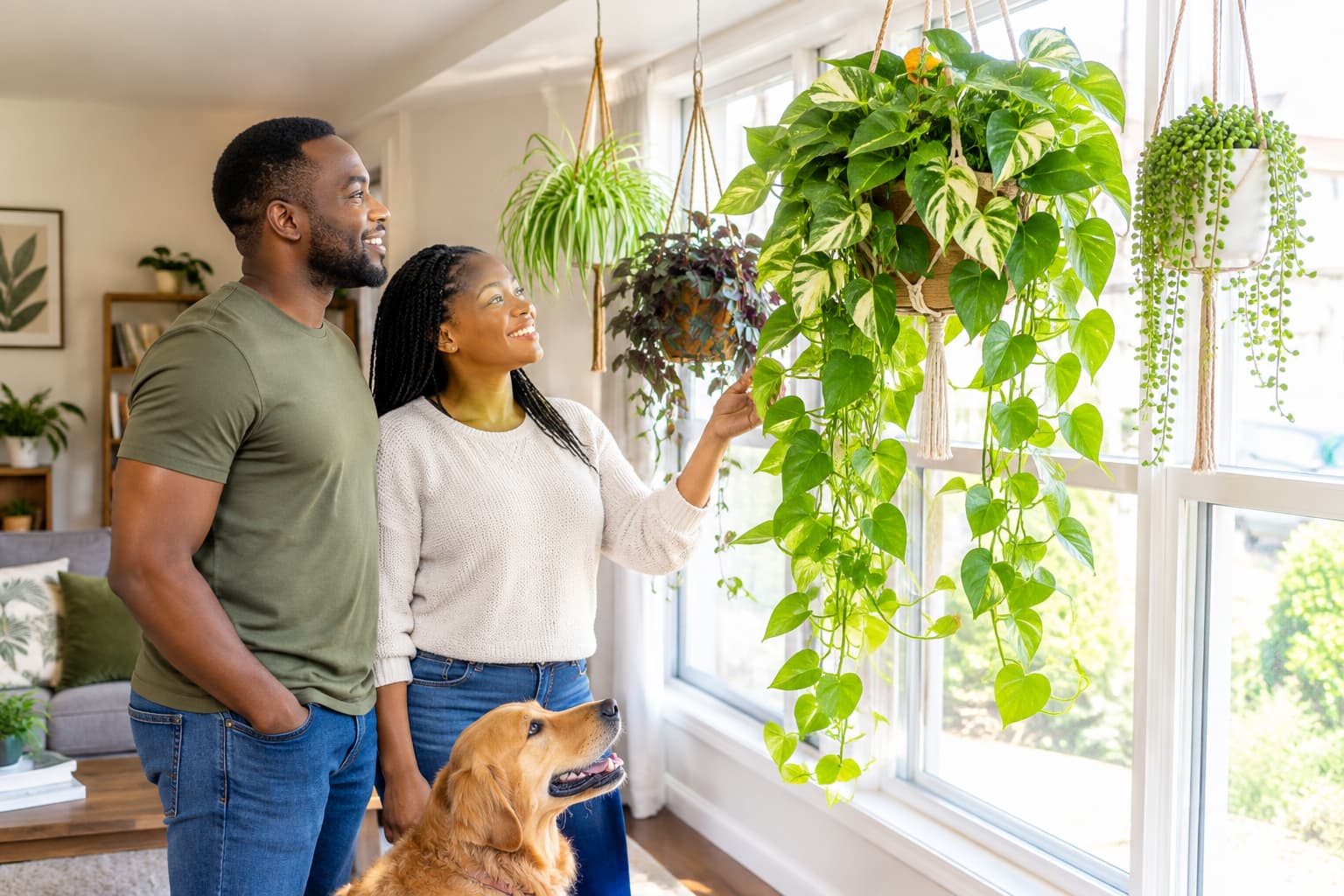
Hanging plants are a practical way to bring more greenery into your home while making better use of vertical space. They can free up shelves, tables, and windowsills, but growing plants above eye level also requires a slightly different approach to care. Hanging plant care involves paying close attention to watering, drainage, light, basket weight, and the plant’s growing conditions. A hanging basket may dry out faster than a floor pot, be harder to water thoroughly, or become increasingly heavy as the plant and growing medium mature.
Good hanging plant care therefore starts with more than remembering to water. The container, drainage, light, plant choice, basket position, and weight all matter.
This guide explains how to keep indoor hanging plants healthy while avoiding the common problems that cause baskets to become dry, weak, sparse, or difficult to manage.
If you’re new to growing houseplants, start with our Indoor Plant Care for Beginners guide to learn the fundamentals of watering, lighting, soil, humidity, and routine plant care.
What Is a Hanging Plant?
A hanging plant is a plant grown in a container or basket that is suspended from the ceiling, wall, or another elevated support rather than placed on the floor or a flat surface. Many hanging plants have trailing, cascading, or arching growth that allows their foliage to spill over the sides of the container.
Hanging plants are popular indoors because they make use of vertical space, add greenery without taking up valuable floor or table space, and can create an attractive natural display near windows, in living rooms, bedrooms, kitchens, and other suitable areas.
What Makes Hanging Plant Care Different?
A hanging plant has essentially the same biological requirements as any other container-grown houseplant: adequate light, water, oxygen around the roots, nutrients, and a suitable growing environment.
The difference is the container and position.
A hanging basket may have a smaller volume of growing medium than a large floor planter. Its sides may also be more exposed to moving air, and some basket styles have more exposed growing media. These factors can make moisture management less forgiving.
The plant is also harder to inspect. A yellow leaf or dry root zone may go unnoticed when the basket is several feet above the floor.
That means successful hanging basket plant care depends on creating a simple routine:
• Check the growing medium rather than watering by calendar alone.
• Match the plant to the available light.
• Use a container that drains properly.
• Keep the basket securely supported.
• Monitor growth as the plant becomes larger.
• Prune or redirect long growth before the basket becomes difficult to manage.
• Adjust care when the room becomes hotter, cooler, brighter, or darker.
The goal is not to keep the basket constantly wet. It is to maintain the moisture level appropriate for the particular plant while allowing excess water to drain freely.
Choose the Right Hanging Basket Before You Plant
The basket itself influences how difficult the plant will be to maintain.
1. Prioritize drainage
A hanging container should have a reliable way for excess water to leave the root zone. Poor drainage keeps roots in overly wet conditions and can contribute to root problems.
This is especially important indoors because water draining from the basket can damage floors, furniture, walls, or electrical equipment.
If you want a decorative container without drainage holes, a safer arrangement is to keep the plant in an inner pot with drainage holes and use the decorative container as an outer cover. Empty any collected water rather than allowing the plant to sit in it.
For more information about choosing containers, see our guide to How to Choose the Right Pots for Indoor Plants.
2. Consider basket size
A very small basket can dry rapidly and may leave little room for the roots to develop. An oversized container, meanwhile, can become unnecessarily heavy and difficult to support.
Choose a basket that is appropriate for the plant’s current root system and expected growth. If the plant becomes root-bound or the container becomes unstable, repotting may eventually be necessary.
Our guide on How to Repot Indoor Plants Without Damaging the Roots provides the broader repotting principles you can apply when a hanging plant outgrows its container.
3. Think about weight
A hanging basket is not supported in the same way as a plant sitting on a floor or shelf.
The total weight includes:
• The container
• Growing medium
• Water
• The plant itself
• Any decorative materials
The basket can become substantially heavier immediately after watering. The support point therefore needs to be strong enough for the fully watered container, not merely its dry weight.
Never assume that a hook, ceiling fitting, curtain rod, or shelf is strong enough simply because the empty basket feels light.
How to Choose Plants for Indoor Hanging Baskets
Not every houseplant is equally convenient for a hanging position.
For an indoor basket, look for plants with a growth habit that suits the location. Trailing or naturally cascading plants are obvious candidates, but compact plants can also work when the basket is positioned where their form can be appreciated.
More important than appearance is compatibility with the room.
Before choosing a plant, consider:
• How much natural light reaches the location?
• How far is the basket from a window?
• Will you be able to reach the plant easily?
• Does the plant prefer to dry somewhat between waterings?
• How quickly does it grow?
• Will its mature size make the basket difficult to manage?
• Does it require frequent pruning?
• Can the container safely support the mature plant?
Avoid combining plants simply because they look attractive together. Plants sharing one basket should have broadly compatible requirements for light, moisture, and temperature. Otherwise, one plant may thrive while another struggles.
Hanging Plants Light Requirements
Light is one of the first things to assess because hanging baskets are often placed according to decoration rather than plant requirements.
A bright window does not automatically mean every position several feet away receives enough light. Conversely, placing a plant directly against intense sunlight can create excessive heat or leaf scorch in some situations.
Before hanging the basket, observe the location at different times of day.
1. Bright light
Some plants tolerate or prefer strong light. These can work near bright windows when the particular species is suited to those conditions.
However, light intensity can change dramatically between a window and the interior of a room.
2. Medium or filtered light
Many common houseplants perform well in bright, indirect or filtered light. This can be a useful position for hanging plants where direct sunlight is limited.
3. Lower-light locations
A plant described as tolerant of lower light is not necessarily a plant that can grow indefinitely in a dark corner. Low light generally means slower growth and can contribute to sparse or stretched growth in plants that need more illumination.
If your room receives insufficient natural light, an appropriate grow-light setup may be more useful than choosing a plant and hoping it adapts.
The key principle is simply choose the plant for the location rather than forcing the location to suit an unsuitable plant.
How to Water Hanging Plants Properly
Watering is usually the part of hanging plant care that requires the most attention.
Hanging baskets can dry relatively quickly, particularly when the container is small or the growing medium is exposed to moving air. University extension guidance notes that hanging baskets may need frequent checking, with some requiring daily watering during hot conditions.
But there is no universal watering schedule.
A basket in a warm, bright room may need water much sooner than a basket in a cooler, dimmer room.
Check before watering
Instead of watering every Monday, Wednesday, and Saturday, inspect the growing medium.
Depending on the plant, you can check moisture by:
• Feeling the upper layer of the potting mix with a clean finger
• Lifting the basket when practical and noticing its weight
• Observing the plant for signs of moisture stress
• Using a suitable moisture meter as an additional reference
The correct point for watering depends on the plant. Some plants prefer the upper portion of the mix to dry before watering, while others need more consistent moisture.
Water thoroughly
When the plant needs water, apply enough to moisten the root zone rather than giving only a small splash to the surface.
For containers with drainage, water slowly and thoroughly until some water exits through the drainage holes. This helps wet the growing medium more completely.
Then allow excess water to drain.
Do not confuse frequent watering with shallow watering. A basket may need water often while still benefiting from a thorough application each time it is watered.
What if the hanging basket becomes extremely dry?
Severely dried-out potting mix can sometimes become difficult to re-wet. Water may run down the sides and escape through drainage holes without adequately moistening the root ball.
In that situation, temporarily taking the basket down and allowing the dry medium to absorb water gradually can help rehydrate it. Iowa State University Extension specifically recommends bottom rehydration for severely dried hanging baskets, followed by proper drainage.
Once the growing medium has rehydrated, return to a more consistent checking routine rather than allowing the plant to repeatedly reach that extreme condition.
For practical guidance on watering houseplants correctly, see our guide on how to water indoor plants the proper way.
How Often Should You Water Hanging Plants?
There is no reliable universal number of days.
Instead, watering frequency is influenced by:
• Plant species
• Container size
• Growing-medium composition
• Drainage
• Light intensity
• Room temperature
• Air movement
• Humidity
• Season
• Plant size
• Root development
A small basket in a warm, bright room may dry much faster than a large basket in a cooler room.
During periods of rapid growth or high heat, check more frequently. During cooler or darker periods, the plant may use water more slowly.
The important distinction is between checking frequently and watering automatically.
You may need to inspect the basket every day without actually watering it every day.
Drainage: Why It Matters for Hanging Plants
A healthy root system needs both water and oxygen. A container that remains saturated for too long can create poor conditions around the roots.
For hanging baskets, good drainage is particularly important because indoor watering can become messy when water cannot escape properly.
Look for:
• Drainage holes
• A suitable growing medium
• A container that does not trap excess water
• An outer cover that can be emptied after watering
Do not add a thick layer of gravel to the bottom of a container as a substitute for proper drainage. The more useful approach is to use an appropriate potting medium in a container designed to drain.
Choosing the right potting mix is essential for healthy roots and strong indoor plant growth. See our guide to Best Soil for Indoor Plants to learn how to choose the right soil mix for different houseplants.
How to Fertilize Hanging Plants
Plants grown in containers eventually use nutrients available in the growing medium. Regular watering can also carry soluble nutrients out of the container.
That does not mean a hanging plant needs fertilizer every time you water it.
Fertilizer requirements depend on the plant, growing medium, season, and whether a slow-release fertilizer was already incorporated into the mix.
For actively growing plants, follow the fertilizer label and avoid applying a stronger concentration than recommended.
A practical approach is to choose one feeding system and use it consistently rather than repeatedly adding different products.
Regular fertilizing can help indoor plants maintain healthy growth, especially during their active growing season. Learn How to Fertilize Indoor Plants with this step-by-step guide to choosing the right fertilizer and applying it correctly.
Never fertilize a severely stressed plant blindly
If a plant is badly wilted because the root zone is extremely dry, address the watering problem first.
Likewise, fertilizer should not be used as a substitute for adequate light, appropriate watering, or proper drainage.
Yellow leaves, weak growth, or poor appearance can have several causes. Adding fertilizer without identifying the cause may not solve the problem.
How to Prune Indoor Hanging Plants
Pruning is particularly useful for plants grown in hanging baskets because trailing growth can eventually become uneven, sparse, tangled, or excessively long.
You do not need to cut a healthy plant simply because it has grown.
Prune when there is a clear purpose, such as:
• Removing damaged growth
• Controlling excessive length
• Improving the shape of the plant
• Encouraging branching in suitable species
• Removing dead or unhealthy stems
• Preventing growth from becoming tangled
Use clean, sharp scissors or pruning shears.
Where a plant naturally branches from nodes, cutting appropriately above a healthy node can encourage new growth from lower points on the stem.
Do not assume every species responds identically to pruning. Some plants branch readily, while others have a more defined growth habit.
For flowering hanging plants, removing spent flowers may also improve appearance and, in some species, encourage continued flowering.
Keep the Basket Easy to Reach
A beautiful hanging plant is not successful if it becomes impossible to inspect.
When deciding where to install the basket, make sure you can safely:
• Check the leaves
• Inspect the growing medium
• Water thoroughly
• Remove dead foliage
• Prune the plant
• Check for pests
• Take the basket down when necessary
This matters more as the plant matures.
A basket hanging very high on a ceiling may look attractive, but routine maintenance becomes inconvenient. When maintenance is difficult, problems are more likely to go unnoticed.
Avoid Placing Hanging Plants in Problematic Locations
The best location is not simply the most attractive empty space.
Avoid positioning a hanging plant where:
• It blocks a doorway
• Trailing stems interfere with walking paths
• Water can drip onto electronics
• Leaves constantly touch a wall
• The basket is exposed to damaging heat
• It is directly in the path of strong air from a fan or air conditioner
• People could easily bump into it
• Children or pets can pull it down
• The support point cannot safely handle the load
Air movement itself is not automatically harmful, but persistent strong drafts can increase moisture loss and create an unsuitable environment for some plants.
Yellowing leaves, wilting, slow growth, and other symptoms can indicate that something is wrong with your houseplant. See our guide to Common Indoor Plant Problems to identify the cause and learn practical ways to fix them.
How to Keep Hanging Plants From Becoming Leggy
Long, sparse growth is often a signal that the plant is not receiving the conditions it needs.
One common cause is insufficient light.
Before pruning a leggy plant, ask why it became leggy in the first place.
If the plant needs more light, moving it to a better location may be more useful than repeatedly cutting it back.
Other possible contributors include:
• Natural growth habit
• Excessively vigorous growth
• Incorrect pruning
• Nutritional imbalance
• Seasonal changes
Once the underlying issue is corrected, pruning can help restore a more attractive shape where the plant responds well to it.
Common Hanging Plant Problems
Hanging plants can develop the same problems as other houseplants, but their elevated position sometimes makes the symptoms harder to notice.
1. Yellowing leaves
Yellow leaves can have many causes, including natural aging, watering problems, inadequate light, root stress, or other environmental issues.
Do not diagnose the cause from leaf color alone.
Look at the whole plant and check its growing conditions.
2. Brown leaf tips
Brown tips can occur for several reasons, including moisture stress, low humidity, salt accumulation, environmental stress, or damage.
Again, the symptom does not identify one single cause.
3. Wilting
Wilting can result from insufficient moisture, but it can also occur when roots are damaged or stressed and cannot function properly.
Check the growing medium before assuming the solution is simply more water.
4. Pests
Indoor hanging plants can still attract common houseplant pests. Because baskets are sometimes positioned above eye level, inspect the undersides of leaves and stems whenever you water or prune.
For a dedicated pest controlling guide, see 8 Common Indoor Plant Pests and How to Eliminate Them quickly.
A Simple Hanging Plant Care Routine
You do not need a complicated schedule.
Every few days
Check:
• Soil moisture
• Leaf condition
• New growth
• Wilting
• Any obvious pests
The frequency of checking should increase during hot or unusually dry conditions.
During watering
Take the opportunity to:
• Inspect the leaves
• Look underneath the foliage
• Check stems
• Remove dead material
• Look for signs of pests
• Notice whether water drains normally
Combining inspection with watering makes maintenance easier because you are already interacting with the plant.
Periodically
Review:
• Whether the plant still receives adequate light
• Whether stems have become excessively long
• Whether the basket remains safely supported
• Whether roots are becoming crowded
• Whether the plant has outgrown its location
• Whether feeding is appropriate for the season and plant
This small amount of routine observation can prevent many problems from becoming serious.
Hanging Plant Care Mistakes to Avoid
Even easy-care hanging plants can struggle when basic care practices are overlooked. Avoiding these common mistakes can make watering, maintenance, and long-term growth much easier.
1. Watering by Calendar
Watering every few days simply because it is “watering day” can lead to problems. Indoor conditions change with temperature, light, humidity, plant size, and the moisture level of the growing medium. Instead, check the soil before watering and adjust the frequency according to the plant’s actual needs.
2. Giving Only a Small Splash of Water
A quick splash may wet only the surface of the growing medium while leaving much of the root zone dry. When the plant needs watering, apply enough water to thoroughly moisten the medium and allow excess water to drain freely. Empty any water that collects in a saucer or outer container.
3. Keeping the Basket Constantly Wet
More moisture does not necessarily mean healthier roots. Roots need both water and oxygen, and continuously wet growing media can reduce air spaces around the roots and contribute to root problems. Allow the growing medium to dry to the appropriate level for the particular plant before watering again.
4. Choosing a Plant Solely Because It Trails
A trailing growth habit may look attractive, but appearance should not be the only consideration. Before choosing a hanging plant, consider its light requirements, watering needs, mature size, humidity preferences, and the conditions of the location where you plan to hang it.
5. Ignoring the Basket and Support
A hanging basket can become considerably heavier after watering, especially as the plant and growing medium mature. Regularly inspect the basket, hooks, chains, brackets, and mounting points for signs of weakness or wear. The support system should remain suitable for the plant’s increasing weight.
6. Hanging the Plant Too High
A plant that is difficult to reach can quickly become difficult to maintain. If you cannot comfortably check the leaves, feel the growing medium, water thoroughly, prune, or inspect for pests, routine care may be neglected. Hang plants at a height that provides good visibility and reasonable access.
7. Pruning Without Fixing the Underlying Cause
Pruning can improve the shape of a hanging plant, but it will not correct the reason for weak or stretched growth. For example, repeatedly cutting back a leggy plant without addressing insufficient light may only produce the same problem again. Identify the cause of poor growth before relying on pruning.
8. Fertilizing a Struggling Plant Without a Diagnosis
Fertilizer is not a universal solution for an unhealthy plant. Yellowing, weak growth, leaf drop, or browning can result from inappropriate watering, poor drainage, insufficient light, pests, root problems, or other environmental stresses. Diagnose the likely cause first and fertilize only when the plant’s needs and growing conditions support it.
A Practical Checklist for Healthy Hanging Plants
Use this checklist when setting up or reviewing an indoor hanging basket:
• The plant suits the available light.
• The container provides adequate drainage.
• The growing medium suits the plant.
• The basket is securely supported.
• The fully watered basket can be supported safely.
• The plant can be reached for inspection.
• Water can drain without damaging the surrounding area.
• The plant is not exposed to an unsuitable draft or heat source.
• Moisture is checked before watering.
• Fertilizer is applied according to the plant’s needs and product directions.
• Overgrown or damaged growth is pruned appropriately.
• Leaves and stems are inspected for pests.
• The basket is periodically reassessed as the plant grows.
Frequently Asked Questions About Hanging Plants
1. Can I hang a plant from a ceiling fan?
A plant should not be suspended from a moving ceiling fan or any component that is not specifically designed to support a hanging load. Movement can destabilize the basket, and the plant may interfere with the fan’s operation. Use a secure, load-rated support point that is appropriate for the structure.
2. How much weight can an indoor hanging basket safely hold?
There is no universal weight limit because the safe load depends on the hook, mounting hardware, ceiling or wall structure, basket, and installation method. The relevant figure is the capacity of the entire support system, including the fully watered plant.
3. Should I rotate a hanging plant?
Rotating a plant occasionally can help different sides receive more balanced exposure when light comes primarily from one direction. However, plants vary in how strongly they respond to directional light, so rotation is a maintenance option rather than a requirement.
4. Can I move a hanging plant from one room to another?
Yes, but a major change in light can affect the plant. A plant moved from a bright location to a much darker room may gradually produce weaker growth. When changing locations, consider the difference in light, temperature, humidity, and drafts.
5. Can hanging baskets damage painted ceilings or walls?
They can if water repeatedly splashes, drips, or leaks onto the surrounding surface. Choose a location where watering can be controlled and ensure the container drains properly. Protect nearby surfaces where necessary.
6. Should hanging baskets be near air conditioners?
Not necessarily. The important consideration is the intensity and duration of the airflow. Strong, continuous drafts can increase moisture loss and may create an unsuitable environment for some plants. Position sensitive plants away from direct blasts of conditioned air.
7. Can I put a hanging basket above a radiator?
It is generally better to avoid placing houseplants directly above or immediately beside strong heat sources. Rapid temperature changes and dry heat can increase stress and moisture loss. Choose a position with more stable conditions.
8. Can I use a decorative macramé hanger with any plant pot?
A macramé hanger must fit the pot securely and support its fully watered weight. Check that the container cannot easily tilt or slip through the hanger before installing it at height.
9. How can I tell whether a hanging basket has become too heavy?
Signs include a visibly strained support, sagging hardware, an unstable mounting point, or a basket that becomes difficult to handle safely. Do not wait for structural movement to become severe. Reassess the container and support before continuing to use it.
10. Can I bring an outdoor hanging basket indoors?
You can move a suitable plant indoors, but inspect it carefully for insects and other problems before bringing it near your existing houseplants. Outdoor conditions can also differ considerably from the indoor environment, so the plant may need time to adjust.
11. Is a hanging basket suitable for a plant with very large leaves?
It can be, but size and weight become important considerations. A plant with large foliage may eventually become difficult to support, prune, or position safely. Choose a container and support system that can accommodate the plant’s mature size rather than judging only by its appearance when young.
Final Thoughts
Good hanging plant care is mostly about making the plant’s environment predictable and the maintenance routine practical. Choose a plant that matches the available light, use a container with good drainage, check moisture before watering instead of relying on a rigid schedule, and keep the basket accessible enough to inspect regularly. For additional plant-care information, the New York Botanical Garden offers useful horticultural and plant resources.
Most importantly, treat the hanging basket as a living container that changes over time. As the plant grows, its water use, weight, shape, and maintenance needs can change too. A little regular observation makes those changes much easier to manage. For science-based horticultural guidance, the University of Florida IFAS Extension (EDIS) also provides practical resources that can help you make informed plant-care decisions.

I’m Bon (aka Guider), a dedicated indoor gardening writer and houseplant specialist with years of hands-on experience cultivating diverse indoor flora. I author comprehensive, data-backed guides designed to help beginners master indoor plant care, including advanced soil science, precise watering schedules, lighting optimization, and pest troubleshooting. To ensure the highest level of accuracy and editorial integrity, every article integrates practical horticulture principles with peer-reviewed research from university extension services, botanical institutions, and trusted horticultural organizations.